

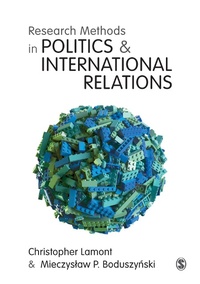
Research Methods in Politics and International Relations
1st Edition
Published on 24. February 2020
248 pages
978-1-5297-2180-5 (ISBN)
Description

This is the perfect guide to conducting a research project in politics and international relations. From formulating a research question and conducting a literature review to writing up and disseminating your work, this book guides you through the research process from start to finish.
The book:
- Is focused specifically on research methods in politics and IR
- Introduces the central methodological debates in a clear, accessible style
- Considers the key questions of ethics and research design
- Covers both qualitative and quantitative approaches
- Shows you how to choose and implement the right methods in your own project
The book features two example research projects - one from politics, one from IR - that appear periodically throughout the book to show you how real research looks at each stage of the process. Packed full of engaging examples, it provides you with all you need to know to coordinate your own research project in politics and international relations.
The book:
- Is focused specifically on research methods in politics and IR
- Introduces the central methodological debates in a clear, accessible style
- Considers the key questions of ethics and research design
- Covers both qualitative and quantitative approaches
- Shows you how to choose and implement the right methods in your own project
The book features two example research projects - one from politics, one from IR - that appear periodically throughout the book to show you how real research looks at each stage of the process. Packed full of engaging examples, it provides you with all you need to know to coordinate your own research project in politics and international relations.
Reviews / Votes
There's no better learning experience for political science students than carrying out an original research project. But the task can be daunting for students as well as instructors. Research Methods in Politics and International Relations is an excellent new resource that will be a useful companion as students set out on this endeavor. Boduszynski and Lamont's book is methodologically inclusive and touches on important subjects that are often overlooked, such as research ethics and publishing. -- Gene Park Research Methods in Politics & International Relations is a highly useful, engaging, and accessible methods textbook anchored in concise and compelling chapters and clear explanations of key dimensions of qualitative and quantitative research processes. Moreover, the book provides undergraduates with an in-depth understanding of how to design and carry out different types of research projects, ranging from research papers, capstone research projects, and senior dissertations.-- Victor Peskin Research training is more important than ever for students of Politics and International Relations at all levels. Lamont and Boduszynski provide a comprehensive, pluralist and accessible guide to the research process and the challenges and dilemmas it entails, a great resource for teachers and students alike.
-- Dr Daniela Lai Boduszynski and Lamont's new textbook breaks new ground in promoting a comprehensive introduction to research methods in politics and international relations. I especially appreciated the unique discussion of research ethics, which provides an opportunity to reflect on the broader significance of one's research as well as the importance of protecting human subjects. The text wholeheartedly embraces the notion of methodological pluralism, giving equal voice to a range of qualitative and quantitative methods. It does this while avoiding the divisive debates about whether some approaches are superior to others. The progression of chapters also usefully mirrors the research process, from exploring topics to writing and publishing. -- Michael Byron Nelson "Writing Up", Chapter 11, is an excellent resource. This is a practical chapter that presents a road map to essay writing, an outline for a thesis, and a
check list for the nervous student. Beautifully, the authors remind us that "academic writing, reflecting the social phenomena that we study, is not a
book reviews linear process" (p. 167), while continuing to instruct us on the contents of an introduction, the importance of the thesis or main argument, the best ways to present data and empirical analysis, and the elements all good conclusions must contain. Used in the way it was intended, as a guide to writing, a reference for further reading, and as a plan for research design, Research Methods in Politics and International
Relations has the potential to improve the readability of student work and provide a template for lecturers to guide undergraduates and postgraduates alike through the minefield of research. -- Sarah Lieberman
More details
Edition
1. Auflage
Language
English
Place of publication
London
United Kingdom
Publishing group
Sage Publications Ltd (Digital)
Target group
College/higher education
Product notice
Reflowable
ISBN-13
978-1-5297-2180-5 (9781529721805)
Copyright in bibliographic data and cover images is held by Nielsen Book Services Limited or by the publishers or by their respective licensors: all rights reserved.
Schweitzer Classification
Other editions
Additional editions
Christopher Lamont | Mieczyslaw P. Boduszynski
Research Methods in Politics and International Relations
Book
04/2020
1st Edition
SAGE Publications Ltd
€68.35
Article exhausted; check for reprint
Christopher Lamont | Mieczyslaw P. Boduszynski
Research Methods in Politics and International Relations
Book
04/2020
1st Edition
SAGE Publications Ltd
€162.19
Article exhausted; check for reprint
Persons
Christopher Lamont is Dean of E-Track's International Relations program and Vice Dean of the Graduate School of International Relations at Tokyo International University in Japan. He holds a PhD in Politics from the University of Glasgow. He was also a Fulbright fellow at the University of Zagreb and an RCUK postdoctoral fellow at the University of Ulster. His research interests are at the intersection of global governance, technology, and international justice. He is the author of Research Methods in International Relations, now in its second edition, published by Sage. He is also co-editor (with Arnaud Kurze) of New Critical Spaces in Transitional Justice: Gender, Art, and Memory published by Indiana University Press in 2019, and Non-Western Visions of Democratization: Imagining Democracy after the Arab Spring (with Jan van der Harst and Frank Gaennsmantel), which was published by Routledge/Ashgate in 2015. His monograph, International Criminal Justice and the Politics of Compliance (Routledge/Ashgate 2010) explored the international and domestic politics of international criminal justice processes in the former Yugoslavia. In addition to his scholarly contributions, his writings have also featured in Foreign Affairs, Foreign Policy, and The Diplomat, among others.
Mieczyslaw P. Boduszynski is Associate Professor of Politics and International Relations at Pomona College in Claremont, California, USA. He has been a Fulbright Fellow at the University of Zagreb and taught courses at universities in Japan, Egypt, Albania, and France. His research interests include democracy and human rights promotion; U.S. foreign policy; democratic transitions and authoritarian backsliding; and the politics of transitional justice. He is the author of two books: Regime Change in the Yugoslav Successor States (Johns Hopkins 2010) and U.S. Democracy Promotion in the Arab World (Lynne Rienner 2019). In addition to his scholarly contributions, his writings have also been featured in Foreign Affairs and Foreign Policy, among other outlets. Boduszynski also has substantial experience as a practitioner, having spent a decade as a U.S. diplomat and has worked a year each in the U.S. Congress and Department of Defense as a policy advisor. He holds a Ph.D. in Political Science from the University of California, Berkeley.
Mieczyslaw P. Boduszynski is Associate Professor of Politics and International Relations at Pomona College in Claremont, California, USA. He has been a Fulbright Fellow at the University of Zagreb and taught courses at universities in Japan, Egypt, Albania, and France. His research interests include democracy and human rights promotion; U.S. foreign policy; democratic transitions and authoritarian backsliding; and the politics of transitional justice. He is the author of two books: Regime Change in the Yugoslav Successor States (Johns Hopkins 2010) and U.S. Democracy Promotion in the Arab World (Lynne Rienner 2019). In addition to his scholarly contributions, his writings have also been featured in Foreign Affairs and Foreign Policy, among other outlets. Boduszynski also has substantial experience as a practitioner, having spent a decade as a U.S. diplomat and has worked a year each in the U.S. Congress and Department of Defense as a policy advisor. He holds a Ph.D. in Political Science from the University of California, Berkeley.
Content
About the Authors
Acknowledgements
Introduction
Chapter 1: Getting Started
Chapter 2: Methodology and Methods in Politics and International Relations
Chapter 3: Research Ethics
Chapter 4: Your Research Question
Chapter 5: Compiling and Writing a Literature Review
Chapter 6: Research Design
Chapter 7: Collecting Data for Qualitative Methods
Chapter 8: Tools and Strategies for Qualitative Analysis
Chapter 9: Collecting and Preparing Data for Quantitative Methods
Chapter 10: Tools and Strategies for Quantitative Analysis
Chapter 11: Writing Up Your Paper
Chapter 12: Looking Forward
Glossary
References
Index
Acknowledgements
Introduction
Chapter 1: Getting Started
Chapter 2: Methodology and Methods in Politics and International Relations
Chapter 3: Research Ethics
Chapter 4: Your Research Question
Chapter 5: Compiling and Writing a Literature Review
Chapter 6: Research Design
Chapter 7: Collecting Data for Qualitative Methods
Chapter 8: Tools and Strategies for Qualitative Analysis
Chapter 9: Collecting and Preparing Data for Quantitative Methods
Chapter 10: Tools and Strategies for Quantitative Analysis
Chapter 11: Writing Up Your Paper
Chapter 12: Looking Forward
Glossary
References
Index
