

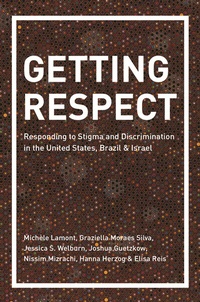
Getting Respect
Responding to Stigma and Discrimination in the United States, Brazil, and Israel
1st Edition
Published on 11. January 2017
400 pages
978-1-4008-8377-6 (ISBN)
Description

A comparative look at how discrimination is experienced by stigmatized groups in the United States, Brazil, and Israel
Racism is a common occurrence for members of marginalized groups around the world. Getting Respect illuminates their experiences by comparing three countries with enduring group boundaries: the United States, Brazil and Israel. The authors delve into what kinds of stigmatizing or discriminatory incidents individuals encounter in each country, how they respond to these occurrences, and what they view as the best strategy-whether individually, collectively, through confrontation, or through self-improvement-for dealing with such events.
This deeply collaborative and integrated study draws on more than four hundred in-depth interviews with middle- and working-class men and women residing in and around multiethnic cities-New York City, Rio de Janeiro, and Tel Aviv-to compare the discriminatory experiences of African Americans, black Brazilians, and Arab Palestinian citizens of Israel, as well as Israeli Ethiopian Jews and Mizrahi (Sephardic) Jews. Detailed analysis reveals significant differences in group behavior: Arab Palestinians frequently remain silent due to resignation and cynicism while black Brazilians see more stigmatization by class than by race, and African Americans confront situations with less hesitation than do Ethiopian Jews and Mizrahim, who tend to downplay their exclusion. The authors account for these patterns by considering the extent to which each group is actually a group, the sociohistorical context of intergroup conflict, and the national ideologies and other cultural repertoires that group members rely on.
Getting Respect is a rich and daring book that opens many new perspectives into, and sets a new global agenda for, the comparative analysis of race and ethnicity.
Racism is a common occurrence for members of marginalized groups around the world. Getting Respect illuminates their experiences by comparing three countries with enduring group boundaries: the United States, Brazil and Israel. The authors delve into what kinds of stigmatizing or discriminatory incidents individuals encounter in each country, how they respond to these occurrences, and what they view as the best strategy-whether individually, collectively, through confrontation, or through self-improvement-for dealing with such events.
This deeply collaborative and integrated study draws on more than four hundred in-depth interviews with middle- and working-class men and women residing in and around multiethnic cities-New York City, Rio de Janeiro, and Tel Aviv-to compare the discriminatory experiences of African Americans, black Brazilians, and Arab Palestinian citizens of Israel, as well as Israeli Ethiopian Jews and Mizrahi (Sephardic) Jews. Detailed analysis reveals significant differences in group behavior: Arab Palestinians frequently remain silent due to resignation and cynicism while black Brazilians see more stigmatization by class than by race, and African Americans confront situations with less hesitation than do Ethiopian Jews and Mizrahim, who tend to downplay their exclusion. The authors account for these patterns by considering the extent to which each group is actually a group, the sociohistorical context of intergroup conflict, and the national ideologies and other cultural repertoires that group members rely on.
Getting Respect is a rich and daring book that opens many new perspectives into, and sets a new global agenda for, the comparative analysis of race and ethnicity.
All prices
More details
Other editions
Additional editions
Michele Lamont | Graziella Moraes Silva | Jessica S. Welburn
Getting Respect
Responding to Stigma and Discrimination in the United States, Brazil, and Israel
Book
11/2018
Princeton University Press
€35.50
Shipment within 10-20 days
Michele Lamont | Graziella Moraes Silva | Jessica S. Welburn
Getting Respect
Responding to Stigma and Discrimination in the United States, Brazil, and Israel
Book
09/2016
Princeton University Press
€43.33
Article exhausted; check different version
Persons
Michèle Lamont is the director of the Weatherhead Center for International Affairs, Robert I. Goldman Professor of European Studies, and professor of sociology and African and African American studies at Harvard University. Graziella Moraes Silva is professor of sociology at the Federal University of Rio de Janeiro (UFRJ) and at the Graduate Institute of International and Development Studies, Geneva. Jessica S. Welburn is assistant professor of sociology and African American studies at the University of Iowa. Joshua Guetzkow is assistant professor in the Department of Sociology and Anthropology and in the Institute of Criminology at the Hebrew University of Jerusalem. Nissim Mizrachi is professor and chair of the Department of Sociology and Anthropology at Tel Aviv University. Hanna Herzog is professor emerita of sociology at Tel Aviv University. Elisa Reis is distinguished professor of political sociology at the Federal University of Rio de Janeiro.
Content
- Cover
- Title
- Copyright
- CONTENTS
- LIST OF TABLES
- PREFACE AND ACKNOWLEDGMENTS
- INTRODUCTION
- OUR APPROACH, CHALLENGES, AND QUESTIONS
- Incidents: Assault on Worth and Discrimination
- Responses to Incidents: Actual and Ideal
- Class, Gender, and Age Cohorts
- HOW WE DID OUR STUDY
- Our Cases
- Our Participants and Methods
- CHAPTER 1: ACCOUNTING FOR DIFFERENCES
- HOW TO EXPLAIN
- THREE DIMENSIONS OF NATIONAL CONTEXT
- CONNECTING FINDINGS AND EXPLANATION
- ADDITIONAL CONTRIBUTIONS
- CHAPTER 2: THE UNITED STATES
- SECTION 2.1: BACKGROUND FACTORS: HISTORICAL AND SOCIOECONOMIC CONTEXT
- A HISTORICAL LEGACY OF RACIAL DOMINATION
- PERSISTENT STRUCTURAL INEQUALITY AND RACIAL SEGREGATION
- THE RESEARCH SITE: THE NEW YORK METROPOLITAN AREA
- SECTION 2.2: ETHNORACIAL GROUPNESS
- SELF-IDENTIFICATION
- Black and/or African American Self-Labeling
- Racial and National Identity
- Meanings of Racial Identity
- GROUP BOUNDARIES
- Experiences of Spatial Segregation and Integration
- Boundaries and Friendship
- Universalism, Essentialism, and the Constructions of Racial Similarities and Differences
- Anti-white Moral Boundaries and White Privilege
- CONCLUSION
- SECTION 2.3: EXPERIENCES OF STIGMATIZATION AND DISCRIMINATION IN THE UNITED STATES
- STIGMATIZATION OR ASSAULT ON WORTH
- Blatant Racism: Being Insulted or Disrespected and Physical Assault
- More Subtle Racism: Being Misunderstood
- Poor Service and Double Standards
- DISCRIMINATION
- CLASS, AGE, AND GENDER DIFFERENCES
- Experiencing Racial or Class Stigma? The Role of Class Boundaries
- Surprisingly Few Differences across Classes
- Gender Differences and Gender Discrimination
- Age Cohorts
- CONCLUSION
- SECTION 2.4: RESPONSES TO STIGMATIZATION AND DISCRIMINATION
- ACTUAL RESPONSES TO INCIDENTS
- Confronting
- Management of the Self and Not Responding
- IDEAL AND OTHER ACTUAL RESPONSES
- Competence/Hard Work, Self-Improvement, Education, Religion, and Moral Reform: The Neoliberal Responses
- Decline of Collective Mobilization
- Race-Targeted Policies
- Hope Ahead? Explanations for Racism and Lessons for Children
- Making Sense of Ideal Responses in Relation to the American Dream
- CONCLUSION
- SECTION 2.5: A BIRD'S- EYE VIEW OF THE AFRICAN AMERICAN CASE
- CHAPTER 3: BRAZIL
- SECTION 3.1: BACKGROUND FACTORS: HISTORICAL AND SOCIOECONOMIC CONTEXT
- STUDYING RACE IN BRAZIL
- THE LEGACY OF SLAVERY AND THE RISE AND FALL OF RACIAL DEMOCRACY
- TOGETHER AND UNEQUAL? RACIAL INEQUALITY AND SEGREGATION
- THE RESEARCH SITE: RIO DE JANEIRO
- SECTION 3.2: ETHNORACIAL GROUPNESS
- SELF-IDENTIFICATION
- Self-Labeling: Negro, Moreno, Preto, and Pardo
- Meanings of Racial Identity
- GROUP BOUNDARIES
- Experiences of Spatial Segregation and Integration
- Boundaries and Friendship
- Universalism, Essentialism, and the Absence of Cultural Differences
- Weak Anti-white Moral Boundaries
- CONCLUSION
- SECTION 3.3: EXPERIENCES OF STIGMATIZATION AND DISCRIMINATION IN BRAZIL
- FROM RACIAL DEMOCRACY TO SUBTLE RACISM
- IS IT CLASS OR RACE STIGMA?
- STIGMATIZATION
- Stereotyped as Low Status and Receiving Poor Service
- When Race Becomes Salient: Racial Insults and Jokes
- Other Types of Assault on Worth
- DISCRIMINATION
- CONCLUSION
- SECTION 3.4: RESPONSES TO STIGMATIZATION AND DISCRIMINATION
- ACTUAL RESPONSES TO INCIDENTS
- Confronting
- Management of the Self
- Not Responding
- IDEAL RESPONSES
- Universal Policies versus Affirmative Action
- Collective Mobilization: Ambivalence toward the Black Movement
- CONCLUSION
- SECTION 3.5: THE BROAD PICTURE FOR BLACK BRAZILIANS
- CHAPTER 4: ISRAEL
- SECTION 4.1: BACKGROUND: HISTORICAL AND SOCIOECONOMIC CONTEXT
- ZIONISM AS CONSTITUTIVE LEGACY
- ARAB PALESTINIANS AND THE JEWISH POLITY
- ETHIOPIANS AND MIZRAHIM: IN THE PINCERS OF ETHNO-NATIONAL IDENTITY, EXCLUSION, AND INCLUSION
- THE RESEARCH SITE: TEL AVIV-JAFFA
- SECTION 4.2: NATIONAL BELONGING, RACE, AND ETHNICITY IN THE FORMATION OF GROUPNESS
- SELF-IDENTIFICATION, SELF-LABELING, AND THE MEANINGS OF GROUP IDENTITY
- Arab Palestinians
- Ethiopians and Mizrahim
- GROUP BOUNDARIES
- Arab Palestinians
- Ethiopians and Mizrahim
- CONCLUSION
- SECTION 4.3: EXPERIENCES OF STIGMATIZATION AND DISCRIMINATION IN ISRAEL
- STIGMATIZATION OR ASSAULTS ON WORTH
- Arab Palestinians
- Ethiopians and Mizrahim
- DISCRIMINATION
- Arab Palestinians
- Ethiopians and Mizrahim
- CONCLUSION
- SECTION 4.4: RESPONSES TO STIGMATIZATION AND DISCRIMINATION IN ISRAEL
- ACTUAL RESPONSES TO INCIDENTS
- Arab Palestinians
- Ethiopians and Mizrahim
- IDEAL RESPONSES
- Improving Their Group Situation
- Arab Palestinians
- Ethiopians and Mizrahim
- Lessons for Children
- Arab Palestinians
- Ethiopians and Mizrahim
- Is Affirmative Action an Option?
- Arab Palestinians
- Ethiopians and Mizrahim
- CONCLUSION
- SECTION 4.5: MAKING SENSE OF THE ISRAELI CASE
- CONCLUSION
- ZOOMING OUT
- ANALYTIC GAINS AND FOOD FOR THOUGHT
- Comparing Ethnoracial Exclusions as Cultural Phenomena: Macro Lenses and Micro Experiences
- Groupness and Boundaries
- Redistribution and Recognition
- Racial Formations, Reproductions, and Transformations
- NEW VENUES OF RESEARCH
- APPENDIX 1: METHODOLOGY
- UNITED STATES
- BRAZIL
- ISRAEL
- APPENDIX 2: TABLES OF FREQUENCY OF EXPERIENCES WITH AND RESPONSES TO STIGMATIZATION AND DISCRIMINATION BY RESPONDENTS
- NOTES
- REFERENCES
- INDEX

