

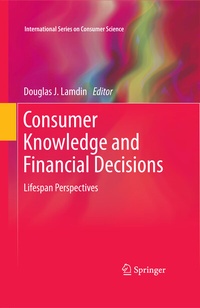
Consumer Knowledge and Financial Decisions
Description

There has been an increasing recognition that financial knowledge (i.e., literacy) is lacking across the population. Moreover, there is recognition that this lack of knowledge poses real problems as credit, mortgages, health insurance, retirement benefits, and savings and investment decisions become increasingly complex. Financial Decisions Across the Lifespan brings together the work of scholars from various disciplines (family and consumer sciences, economics, law, finance, sociology, and public policy) to provide a broad range of perspectives on financial knowledge, financial decisions, and policies. For consistency across the volume each chapter follows a similar format: (1) what individuals know or need to know (2) how what they know or need to know affects financial decisions and outcomes (3) ways in which policies or programs or financial innovations can enhance their knowledge, or decisions, or outcomes. Contributors will provide both new and existing research to create a valuable picture of the state of financial literacy and how it can be improved.
More details
Other editions
Additional editions
Person
Douglas Lamdin is a professor of economics at the University of Maryland, Baltimore County. He has also been a visiting professor of finance at the R.H. Smith School of Business at the University of Maryland, College Park. His teaching is primarily the introductory finance course, and the investments course (undergraduate and MBA). He has published more than 20 articles on financial economics and the economics of education in journals such as Journal of Family and Economic Issues, Journal of Regulatory Economics, Review of Economics and Statistics, Education Economics, and Contemporary Economic Policy. He edited The Managerial Economics Reader, Blackwell, 1994. He also serves on the editorial board of Business Economics, the journal of the National Association for Business Economics.
Content
I. Understanding and Furthering Financial Knowledge.-Coming to Terms with Financial Literacy.-Cultivating Financial Mindfulness: A Dual-Process Theory.-Cognitive Development and Children's Understanding of Personal Finance.-Financial Education for College Students.-The Current State of Financial Education in the U.S: How is Higher Education Helping?-An Overview of Contemporary Financial Education Initiatives Aimed at Minority Populations.-II. Credit, Home Purchase, and Bankruptcy.-Credit Cards as a Market Instrument: Consumer Understanding and Use.-Financial Education, Financial Knowledge, and Risky Credit Behavior of College Students.-Charging Ahead: An Exploratory Study of Financial Decision-Making Among Millennial Consumers.-Pre-Purchase Homebuyer Education and Counseling: Diverse Strategies for Diverse Homebuyers.-The Role of Default Counseling for Mortgage Borrowers in Financial Distress.-Non-Traditional Mortgage Products: Innovative or Toxic?-Debtors' Assessments of Bankruptcy Financial Education.-III. Retirement, Insurance, and Investing.-Social Security Knowledge.-Financial Preparedness for Long-Term Care Needs in Old Age.-The Impact of Numeracy on Medicare Part D Insurance in Older Adults.-Target-date Mutual Funds.-Measuring the Performance of Life-Cycle Asset Allocation.-Stock Market Investing: Lessons from History.-Individual Investments in Higher Education
