

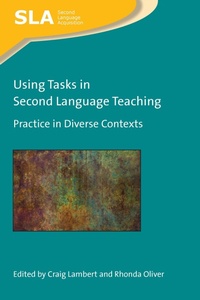
Using Tasks in Second Language Teaching
Practice in Diverse Contexts
Published on 15. July 2020
344 pages
978-1-78892-946-2 (ISBN)
Description

This book examines the use of tasks in second language instruction in a variety of international contexts, and addresses the need for a better understanding of how tasks are used in teaching and program-level decision-making. The chapters consider the key issues, examples, benefits and challenges that teachers, program designers and researchers face in using tasks in a diverse range of contexts around the world, and aim to understand practitioners' concerns with the relationship between tasks and performance. They provide examples of how tasks are used with learners of different ages and different proficiency levels, in both face-to-face and online contexts. In documenting these uses of tasks, the authors of the various chapters illuminate cultural, educational and institutional factors that can make the effective use of tasks more or less difficult in their particular context.
Reviews / Votes
Task-based instruction features the integration of theory, research, and practice. However, what is missing in the literature is 'practice', that is, how to effectively implement task-based instruction by taking into account various factors at the macro and micro level. Lambert and Oliver fill a significant gap through this timely initiative. * Shaofeng Li, Florida State University, USA * This volume provides insights into teachers' practices and challenges when introducing tasks in their classroom, covering a wide range of international educational contexts. Pre-service and in-service teachers will benefit from the concrete advice about practical issues in implementing tasks in different contexts. It is also useful for researchers and postgraduate students in that it considers the effects of tasks on L2 acquisition and performance. * Natsuko Shintani, Kansai University, Japan * Lambert and Oliver have assembled an excellent variety of chapters on task-based instruction. They provide a huge breadth of coverage, of different age ranges and instructional contexts. Most distinctive are the wide geographical contexts and the range of ages which motivate the different studies. This is an important book for researchers and professionals alike, making important theoretical and practical contributions. * Peter Skehan, Birkbeck College, UK * Lambert and Oliver have done an admirable job of collating a rich and diverse collection of studies, all offering insights into how tasks can be used more effectively in real-world classrooms. -- Priska Pramastiwi, Victoria University of Wellington, New Zealand * Language Teaching for Young Learners 3:2 * Like the other volumes in this remarkable series, the chapters in this book not only reflect on key current theory, but also discuss useful and usable empirical findings [...] I would whole-heartedly recommend this book to any teacher, teacher educator, researcher, and decision maker with a stake in effective language education. -- Thomas A. Williams, University of Szeged, Hungary * ELT Journal, 2022 * [This book] offers insightful considerations on theoretical and empirical aspects, highlighting research, pedagogical needs, and practical implications for the foreign language classroom. The book is particularly useful for teachers willing to embrace a task-based instruction, as chapters exemplify a variety of information, opinion, and reasoning tasks (Ellis, 2009), include spoken, written , and hybrid modalities, examine traditional and online genres, and combine old and new resources. -- Laura Dubcovsky, University of California, Davis, USA * LINGUIST List 32.1542 *More details
Series
Language
English
Place of publication
Bristol
United Kingdom
Target group
College/higher education
Product notice
Reflowable
Dimensions
Height: 234 mm
Width: 156 mm
ISBN-13
978-1-78892-946-2 (9781788929462)
Copyright in bibliographic data and cover images is held by Nielsen Book Services Limited or by the publishers or by their respective licensors: all rights reserved.
Schweitzer Classification
Other editions
Additional editions
Book
07/2020
Multilingual Matters
€61.80
Shipment within 3-4 weeks
Persons
Craig Lambert is an Associate Professor of Applied Linguistics in the School of Education at Curtin University. His recent books include Task-Based Language Teaching: Theory and Practice (with R. Ellis et al., Cambridge, 2020) and Referent Similarity and Nominal Syntax in Task-Based Language Teaching (Springer, 2019).
Rhonda Oliver is Professor and Head of the School of Education, Curtin University, Australia. Her publications include Teaching Through Peer Interaction (with R. Adams, Routledge, 2019) and Child Second Language Learning in Different Classroom Contexts (with B. Nguyen, Routledge, 2018).
Rhonda Oliver is Professor and Head of the School of Education, Curtin University, Australia. Her publications include Teaching Through Peer Interaction (with R. Adams, Routledge, 2019) and Child Second Language Learning in Different Classroom Contexts (with B. Nguyen, Routledge, 2018).
Content
Contributors
Chapter 1. Craig Lambert & Rhonda Oliver: Introduction: Tasks in Context
Section 1: Issues in Using Tasks
Chapter 2. Craig Lambert: Instructional Frameworks for Using Tasks in Second Language Instruction
Chapter 3. Jonathan Newton and Trang Le Diem Bui: Low-Proficiency Learners and Task-Based Language Teaching
Chapter 4. Curtis Kelly: Some Principles for Interactive Task Design: Observations from an EFL Materials Writer
Chapter 5. Marta Gonzalez-Lloret: Using Technology-Mediated Tasks in Second Language Instruction to Connect Speakers Internationally
Chapter 6. Lindy Norris: Using Tasks within Neo-liberal Educational Environments
Chapter 7. Rod Ellis: Teacher-Preparation for Task-based Language Teaching
Section 2: Approaches to Using Tasks
Chapter 8. Kyoko Hillman & Mike Long: A Task-based Needs Analysis for U.S. Foreign Service Officers: The Challenge of the Japanese Celebration Speech
Chapter 9. Rhonda Oliver: Developing Authentic Tasks for the Workplace using Needs Analysis: A Case Study of Australian Aboriginal Vocational Students
Chapter 10. Tatiana Bogachenko & Rhonda Oliver: The Potential use of TBLT in Post-Soviet Society: Case Studies from Ukraine
Chapter 11. Priscila Fabiane Farias & Raquel Carolina Souza Ferraz D`Ely: Task Design and Implementation for Beginning-Level Elementary School Learners in South-Brazil: Challenges and Possibilities
Chapter 12. Maria Elena Solares Altamirano: Teachers' Responses to an Online Course on Task-Based Language Teaching in Mexico
Section 3: Research on Using Tasks
Chapter 13. Masatoshi Sato: Metacognitive instruction for Collaborative Interaction: The Process and Product of Self-regulated Learning in the Chilean EFL Context
Chapter 14. Mohammad Ahmadian & Abbas Mansouri: Collaborative L1 Planning and L2 Written Task Performance in an Iranian EFL Context
Chapter 15. YouJin Kim, Hyejin Cho & Haoshan Ren: Collaborative Writing Tasks in an L3 Classroom: Translanguaging, the Quality of Task Outcomes and learners' Perceptions
Chapter 16. Scott Aubrey: The Role of Task-Based Interaction in Perceived Language Learning in a Japanese EFL Classroom
Chapter 17. Ainara Imaz Agirre & Maria del Pilar Garcia Mayo: The Impact of Agency in Pair Formation on the Degree of Participation in Young Learners' Collaborative Dialogue
Chapter 18. Justin Harris & Paul Leeming: The Accuracy of Teacher Predictions of Student Language Use in Tasks in a Japanese University
Chapter 19. Rhonda Oliver & Craig Lambert: Future Directions for Research on Tasks in Second Language Instruction
Index
Chapter 1. Craig Lambert & Rhonda Oliver: Introduction: Tasks in Context
Section 1: Issues in Using Tasks
Chapter 2. Craig Lambert: Instructional Frameworks for Using Tasks in Second Language Instruction
Chapter 3. Jonathan Newton and Trang Le Diem Bui: Low-Proficiency Learners and Task-Based Language Teaching
Chapter 4. Curtis Kelly: Some Principles for Interactive Task Design: Observations from an EFL Materials Writer
Chapter 5. Marta Gonzalez-Lloret: Using Technology-Mediated Tasks in Second Language Instruction to Connect Speakers Internationally
Chapter 6. Lindy Norris: Using Tasks within Neo-liberal Educational Environments
Chapter 7. Rod Ellis: Teacher-Preparation for Task-based Language Teaching
Section 2: Approaches to Using Tasks
Chapter 8. Kyoko Hillman & Mike Long: A Task-based Needs Analysis for U.S. Foreign Service Officers: The Challenge of the Japanese Celebration Speech
Chapter 9. Rhonda Oliver: Developing Authentic Tasks for the Workplace using Needs Analysis: A Case Study of Australian Aboriginal Vocational Students
Chapter 10. Tatiana Bogachenko & Rhonda Oliver: The Potential use of TBLT in Post-Soviet Society: Case Studies from Ukraine
Chapter 11. Priscila Fabiane Farias & Raquel Carolina Souza Ferraz D`Ely: Task Design and Implementation for Beginning-Level Elementary School Learners in South-Brazil: Challenges and Possibilities
Chapter 12. Maria Elena Solares Altamirano: Teachers' Responses to an Online Course on Task-Based Language Teaching in Mexico
Section 3: Research on Using Tasks
Chapter 13. Masatoshi Sato: Metacognitive instruction for Collaborative Interaction: The Process and Product of Self-regulated Learning in the Chilean EFL Context
Chapter 14. Mohammad Ahmadian & Abbas Mansouri: Collaborative L1 Planning and L2 Written Task Performance in an Iranian EFL Context
Chapter 15. YouJin Kim, Hyejin Cho & Haoshan Ren: Collaborative Writing Tasks in an L3 Classroom: Translanguaging, the Quality of Task Outcomes and learners' Perceptions
Chapter 16. Scott Aubrey: The Role of Task-Based Interaction in Perceived Language Learning in a Japanese EFL Classroom
Chapter 17. Ainara Imaz Agirre & Maria del Pilar Garcia Mayo: The Impact of Agency in Pair Formation on the Degree of Participation in Young Learners' Collaborative Dialogue
Chapter 18. Justin Harris & Paul Leeming: The Accuracy of Teacher Predictions of Student Language Use in Tasks in a Japanese University
Chapter 19. Rhonda Oliver & Craig Lambert: Future Directions for Research on Tasks in Second Language Instruction
Index
