

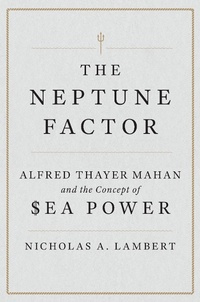
The Neptune Factor
Description

Winner of the 2024 Samuel Eliot Morison Award for Naval Literature
The Neptune Factor is the biography of an idea-the concept of "Sea Power,"¿a term first coined by Capt. A.T. Mahan and the core thread of his life's work.¿ His central argument was that the outcome of rivalries on the seas have decisively shaped the course of modern history. Although Mahan's scholarship has long been seen as foundational to all systematic study of naval power, Neptune Factor is the first attempt to explain how Mahan's definition of sea power shifted over time.
Far from presenting sea power in terms of combat, as often thought, Mahan conceptualized it in terms of economics. Proceeding from the conviction that international trade carried across the world's oceans was the single greatest driver of national wealth (and thus power) in history, Mahan explained sea power in terms of regulating access to 'the common' and influencing the flows of trans-oceanic trade. ¿A nation possessing sea power could not only safeguard its own trade and that of its allies but might also endeavor to deny access to the common to its enemies and competitors.
A pioneering student of what is now referred to as the first era of globalization, lasting from the late nineteenth century until the First World War, Mahan also identified the growing dependence of national economies upon uninterrupted access to an interconnected global trading system. Put simply, access to 'the common' was essential to the economic and political stability of advanced societies. This growing dependence, Mahan thought, increased rather than decreased the potency of sea power.¿
Understanding the critical relationship between navies and international economics is not the only reason why Mahan's ideas remain-or rather have once again become-so important. He wrote in, and of, a multi-polar world, when the reigning hegemon faced new challenges, and confusion and uncertainty reigned as the result of rapid technological change and profound social upheaval. Mahan believed that the U.S. Navy owed the American people a compelling explanation of why it deserved their support-and their money. His extensive, deeply informed, and highly sophisticated body of work on sea power constituted his attempt to supply such an explanation. ¿ Mahan remains as relevant-and needed-today as he was more than a century ago.
More details
Other editions
Additional editions
Person
Lambert resides outside Philadelphia with his family, having previously lived in Washington, DC, as well as India, Taiwan, and Australia. From 2016 to 2018, he held the 'Class of 1957 Distinguished Chair in Naval Heritage' at the US Naval Academy, and is privileged to be an honorary member of the Class of '57
Content
- Intro
- Title Page
- Copyright
- Dedication
- Contents
- Foreword by Adm. James Stavridis, USN (Ret.)
- Preface: A Prophet's Rise and Fall
- Acknowledgments
- Introduction. The Origins of Sea Power
- Part I
- Chapter 1. Mahan's World (1865-84)
- Chapter 2. Naval Instructor (1884-89)
- Chapter 3. Influence (1889-90)
- Part II
- Chapter 4. Benjamin Tracy and the Question of Influence (1889-90)
- Chapter 5. Revised Influence: Economics and War (1890-92)
- Chapter 6. Prophet in Exile (1892-97)
- Chapter 7. Return to Duty: The Spanish War (1898-99)
- Part III
- Chapter 8. The Recasting of Sea Power (1899-1905)
- Chapter 9. The Quixotic Crusade (1905-7)
- Chapter 10. Twilight Years (1908-14)
- Chapter 11. Interpreting Mahan's Legacy (1914-2021)
- Epilogue. Magister Resurget?
- List of Notes Abbreviations
- Notes
- Archival Sources
- Index
