

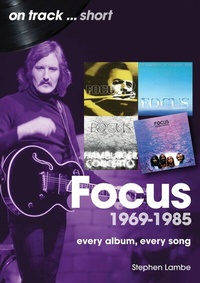
Focus
Description

For a few short years in the 1970s, the unique music of Focus entertained the world. Built around the prodigious instrumental talents of Dutch masters Jan Akkerman (guitar) and Thijs van Leer (keyboards and flute), the band produced three hit albums in quick succession between 1971 and 1974, at the same time scoring two worldwide hits with 'Sylvia' and 'Hocus Pocus'. The latter piece is as ubiquitous as tunes from the 70s get, distinctive for Akkerman's famous riff and van Leer's bizarre yodelling. Musical and personal tensions between the two led to a split in early 1976, but the band limped on without Akkerman until 1978. An unlikely revival in 1985 was a false dawn, and except for a few public appearances, the duo have not played together since. Distilled and updated from Stephen Lambe's previous Focus in the 1970s, this book guides the reader through the band's early history, covering all seven Focus albums from the era, song by song, plus the eponymous 1985 comeback. It is an important potted history of the band and an insight into the tensions which led to such a creative - if short-lived - peak, as well as a celebration of their unique music. Stephen Lambe is an author, publisher, and journalist. He currently writes features and reviews for Prog magazine and is an acknowledged expert on progressive rock, especially the work of Yes and Focus. His books include Yes On Track (Sonicbond, 2018) and the best-selling Citizens Of Hope and Glory: The Story Of Progressive Rock (Amberley, 2011). He has also contributed to a documentary about Focus for Dutch television. He lives in Tewkesbury, Gloucestershire, UK.
All prices
More details
Other editions
Additional editions
Content
Introduction
Music is created in many ways. When a group of musicians join together to become a 'band', the dynamic within that group initiates the music they produce. Sometimes, this creativity comes from harmony, sometimes from conflict. Most often, it is a combination of the two. It's different for every group, of course.
Take Jan Akkerman and Thijs van Leer of Focus, for instance. It was the lure of becoming a jobbing musician that, like his English contemporary Rick Wakeman, tempted Thijs away from his formal studies. For Jan, it was the beat boom of the early 1960s - albeit the version in his home country - that lured him into professional music. The two musicians were never really friends and were at loggerheads from very early in their musical collaboration. We'll speculate on that shortly. Nonetheless, the tensions between them arguably produced some of the most distinctive and beautiful music of the 1970s. For Jan, it was his bold and experimental take on rock guitar that gave him such a distinctive edge. For Thijs, it was the classics and, more specifically, his beloved J.S. Bach (the 18th-century composer of the Baroque period), which rarely left his influences. It was jazz that led them to meet in the middle, with Jan, in particular, an almost evangelical improviser. This approach was also embraced by Thijs - but only up to a point, and it was this which led to some of the tensions. Indeed, when Focus were at the height of their powers, one of the conflicts between the two musicians was about the level of improvisation, with Jan bemoaning Thijs' tendency to play - and indeed yodel - the same things night after night. Jan, however, rarely played in the same way twice. You never quite knew what he was going to do next, which might be both thrilling and terrifying in a live setting.
The fact that their music was almost entirely instrumental gave Focus a universal appeal. While it was considered unwise to attempt to become 'rock stars' without singing actual songs, there has always been a valuable niche for instrumental acts. Think Mike Oldfield or Jean Michel Jarre, for instance, or even the Pink Floyd of the early 1970s, for whom vocals were often a secondary consideration. In an era of vocal groups, Focus really stood out.
It was a star that burned brightly but all too briefly. The band's 'classic' lineup - Jan, Thijs, talented rock bassist Bert Ruiter and drummer Pierre van der Linden (who was heavily inspired by American jazz legend Buddy Rich) - only recorded one album (Focus 3) while the group's masterpiece remains its predecessor Focus II (aka Moving Waves) on which Jan allegedly played most of the bass parts. The van Leer/Akkerman partnership lasted for five studio albums in total, while the 1970s incarnation of Focus itself recorded only six (plus a live album and a compilation). Yet, even during the band's 25-year slumber, before the Thijs-led revival of the group in the early 2000s, they were never forgotten. Part of this is due to the sheer ubiquity of their untypical, unique track 'Hocus Pocus' - used in countless TV shows and movies over the years. But this is also due to two other pieces that have also seeped into the public consciousness worldwide - the 1973 European hit 'Sylvia' and their early chart success in the Netherlands, 'House Of The King'. Nobody ever sounded quite like Focus, and it's unlikely anyone ever will do so again.
When I first started appreciating progressive music in the late 1970s, the first incarnation of Focus had already run its course. But it was the sidelong composition 'Eruption' that really captured my imagination. Although there were no lyrics, in my febrile teenage imagination, I lived the story of Orpheus and Eurydice, so I went on my own journey of discovery, buying each album in turn. Sometimes I was disappointed, sometimes I was baffled. However, I was never bored.
Neither musician has quite thrown off the shackles of their famous band. Even in the 1970s, pieces that were originally recorded by the group found their way onto their solo albums, and while Thijs has fully embraced the music of Focus again in the last 20 years, a solo set by Jan is rarely without a version of 'Sylvia' or 'Tommy' to this day.
Jan Akkerman And Thijs van Leer
Jan Akkerman and Thijs van Leer were - and remain - very different people. However, despite their obvious difference in personality and upbringing, there are obvious parallels between the two musicians. For instance, both came from Jewish backgrounds, although whether this factor directly affected their careers in any sort of major way or not is unclear. Both men were strongly supported in their early careers by their parents, who were also musicians. Thijs came from a well-off family that encouraged him in his efforts to become a classical musician. Jan was supported throughout his early career by parents who did their best to make his early bands successful. Both musicians received a broad musical education, with jazz at the centre. Thijs discovered modern jazz in the early 1960s, while Jan was raised on the music of famed jazz maestro Django Reinhardt, as well as absorbing many more varied ethnic styles within his more cosmopolitan and working-class upbringing.
The reasons for the personality clash that blighted their relationship may well stem from this difference in class and background. There's plenty of evidence to suggest that the two were at loggerheads from time to time, even in 1970. However, the differences also stem from their attitude towards their music. As we've already discussed, Jan - something of an intense character - is an evangelical improviser. When recording his solos for 'Eruption', Mike Vernon notes that Jan never played a solo the same way twice. As a result, playing the same material over and over for years on end - as Jan was required to do, particularly during Focus's 'hard-touring' years from 1972 to 1974 - was immensely frustrating; even dispiriting. Jan found Thijs' lack of commitment to improvisation immensely frustrating. Yet, there's no doubt that, listening to many of the band's live tracks, Thijs - as a jazzer himself - was no stranger to improvisation. It's just that he was more comfortable with improvising in the planned sections of tracks like 'Anonymus II' and 'Eruption'. As a showman at heart, Thijs was much more comfortable and satisfied with playing the same pieces night after night.
With this in mind, it is almost astonishing that their collaboration lasted as long as it did - from 1969 until the start of 1976. From 1973 onwards, they rarely played in the same room when recording and stood a long way apart on stage. Additionally, Jan was not interested in the trappings of becoming a public figure, whereas Thijs was much more comfortable with such things. Perhaps it was displacement activities - his growing interest in music for the lute and, in 1975, particularly, his minor obsession with playing through a talkbox guitar effect, as well as a growing interest in the rhythm box - that kept Jan engaged.
Understanding the tension between improvised and written music is essential to understanding what made Focus - and specifically the musical relationship between Jan and Thijs - tick. Improvisation works best in a modestly-sized live setting, in which a symbiotic relationship between artist and audience can flourish. Jazz, for instance, works best in small clubs, where the audience can enjoy the relationship and spontaneity between the players. As rock music shifted through the gears in the 1970s and later in the 1980s, moving into bigger and bigger venues, this was gradually lost and audiences needed bigger shows and bigger sounds to make the experience worthwhile, since you could no longer see the interaction between the players in any sort of detail.
On recorded media, extensive improvisation also needs tempering since the audience only has one sense to experience what is happening - its sense of hearing. This is why, as I will explain later in this book, I feel that 'Eruption' is a masterwork, but that 'Anonymus II' is overcooked. The former is beautifully structured to fill one side of vinyl perfectly. It has a beginning, a middle and a satisfying end. That the band often wandered from that structure in live performance, I find frustrating. 'Anonymus II', however, feels like a well-structured studio jam. It would have been great to have experienced it in the studio at the time, but do we really want to listen to Bert's bass solo again and again? Your money may vary, of course. This is just the author's perspective, and for many, the fact that Focus jammed with great skill is a source of immense pleasure. Music appreciation is completely subjective, after all.
Jan Akkerman
Jan Akkerman was born in 1946 into a working-class family. His parents - Jacob and Gerda - were both musicians, and Jan's first instrument was the accordion. His first guitar was a triplex Egmond, which he purchased with a friend. Further practice took place with a neighbour, Tata Mirando, who played with The Royal Gypsy Orchestra, and who taught him about Django Reinhardt, a very early influence.
Jan formed a rhythm and blues combo called The Friendship Sextet at the age of 11 with a certain Pierre van der Linden, playing covers of 1950s hits. He had the full backing of his proud parents, who helped clothe and manage the band. After...
