

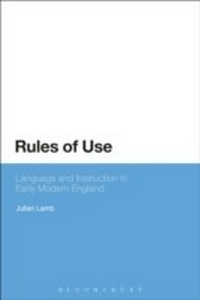
Rules of Use
Language and Instruction in Early Modern England
1st Edition
Published on 28. August 2014
288 pages
978-1-4725-3455-2 (ISBN)
Description

We take it for granted that we can use words properly - appropriately, meaningfully, even decorously. And yet it is very difficult to justify or explain what makes a particular use "proper." Given that properness is determined by the unpredictable vagaries of unrepeatable contexts, it is impossible to formulate an absolute rule which tells what is proper in every situation.
In its four case studies of texts by Ascham, Puttenham, Mulcaster, and the first English dictionary writers, Rules of Use shows the way in which early modern pedagogues attempted to articulate such a rule whilst being mindful that proper use can neither be determined by any single rule, nor definitively described in examples.
Using the philosophy of Ludwig Wittgenstein, and Stanley Cavell's influential reading of it, Rules of Use argues that early modern pedagogues became entangled in a sceptical problem: aspiring to formulate a definitive rule of proper use, their own instruction begins to appear uncertain and lacking in assurance when they find such a rule cannot be expressed.
In its four case studies of texts by Ascham, Puttenham, Mulcaster, and the first English dictionary writers, Rules of Use shows the way in which early modern pedagogues attempted to articulate such a rule whilst being mindful that proper use can neither be determined by any single rule, nor definitively described in examples.
Using the philosophy of Ludwig Wittgenstein, and Stanley Cavell's influential reading of it, Rules of Use argues that early modern pedagogues became entangled in a sceptical problem: aspiring to formulate a definitive rule of proper use, their own instruction begins to appear uncertain and lacking in assurance when they find such a rule cannot be expressed.
More details
Edition
1. Auflage
Language
English
Place of publication
London
United Kingdom
Publishing group
Bloomsbury Publishing PLC
Target group
College/higher education
Professional and scholarly
ISBN-13
978-1-4725-3455-2 (9781472534552)
Copyright in bibliographic data and cover images is held by Nielsen Book Services Limited or by the publishers or by their respective licensors: all rights reserved.
Schweitzer Classification
Other editions
Additional editions
Book
02/2016
Bloomsbury Academic
€55.80
Shipment within 15-20 days
Book
08/2014
Bloomsbury Academic
€176.80
Shipment within 3-4 weeks
Person
Julian Lamb is Assistant Professor of English Literary Studies, Chinese University of Hong Kong
Content
Acknowledgements
Introduction
1. Towards a Grammar of Use
Pedagogy and Scepticism
The Augustinian Picture of Language
Context
Use, Usual, Useful
2. Using Perfection: Roger Ascham's Toxophilus and The Scholemaster
Taking Aim: Toxophilus
Ascham's Scepticism: The Scholemaster, Book 1
'The daily use of writing': The Scholemaster, Book 2
3. Decorous Abuse: George Puttenham's The Art of English Poesy
Decorum and the Critics
The Art of Ambiguity
Usual Speech: The Eye and the Ear
Solace
4. Usual Spelling: Richard Mulcaster's The First Part of the Elementarie
Jonathan Goldberg's Reading of Mulcaster's Elementarie
Grounds
Sound
Training
Sound, Reason, Custom
Rules and Use
5. Arts of Use: Early English Dictionaries, 1604-1658
Context
Johnson's Dictionary: Aspiration and Resignation
'Hard usuall English wordes'
An Unused Siding
Bibliography
Index
Introduction
1. Towards a Grammar of Use
Pedagogy and Scepticism
The Augustinian Picture of Language
Context
Use, Usual, Useful
2. Using Perfection: Roger Ascham's Toxophilus and The Scholemaster
Taking Aim: Toxophilus
Ascham's Scepticism: The Scholemaster, Book 1
'The daily use of writing': The Scholemaster, Book 2
3. Decorous Abuse: George Puttenham's The Art of English Poesy
Decorum and the Critics
The Art of Ambiguity
Usual Speech: The Eye and the Ear
Solace
4. Usual Spelling: Richard Mulcaster's The First Part of the Elementarie
Jonathan Goldberg's Reading of Mulcaster's Elementarie
Grounds
Sound
Training
Sound, Reason, Custom
Rules and Use
5. Arts of Use: Early English Dictionaries, 1604-1658
Context
Johnson's Dictionary: Aspiration and Resignation
'Hard usuall English wordes'
An Unused Siding
Bibliography
Index
