

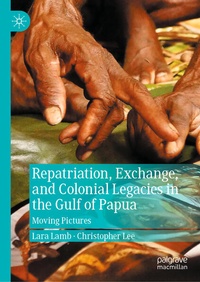
Repatriation, Exchange, and Colonial Legacies in the Gulf of Papua
Description

Reviews / Votes
"Moving Pictures is a remarkable book which provides an important case study of the value and importance of visual return for communities in the Papuan Gulf of Papua New Guinea and Oceania more widely. Through their critical engagement with Frank Hurley's photographs, Lamb and Lee demonstrate how and why heritage collections in museums and archives need to be examined with communities if we are to effectively address ongoing processes of dispossession in Oceania, and to understand our intersecting histories and obligations." -Joshua A. Bell, National Museum of Natural History, Smithsonian Institution, USA "This important book offers a valuable intervention into debates about colonial collecting and photography, visual repatriation, and the continuing power and resonance of the archive in the present day. Through deeply engaged and ethically driven research with descendants, Lamb and Lee reveal how the creation of this visual heritage was shaped by complex intercultural relations." -Jane Lydon, University of Western Australia "Moving Pictures innovatively and sensitively documents the analytical and emotional responses of contemporary Papuan Gulf peoples to the repatriation of images from the early twentieth century. Lamb and Lee take the visual repatriation process to a new level of sophistication, complexity, and nuance with an international reach and relevance well beyond the Gulf of Papua." -Ian J. McNiven, Monash University, AustraliaMore details
Other editions
Additional editions
Persons
Lara Lamb is a Professor of Anthropology at the University of Southern Queensland, Australia. She has worked with people in Papua New Guinea from 2008 to the present day, and has published a wide range of academic papers that have expanded our understanding of the Gulf Province significantly. Lara also has a long history of working with Indigenous communities on the central Queensland coast and in Arnhem Land, where she is engaged with ethnography, oral history and archaeology. At the time of publishing this book, she is conducting ethnographic and archaeological investigations on the Great Papuan Plateau.
Christopher Lee is a Professor in the English discipline in the School of Languages, Humanities and Social Science at Griffith University and a member of the Griffith Center for Social and Cultural Research. He is one of the foundation editors of the Journal for the Study of Australian Literature (JASAL) and a former national president of that professional Association. He has published widely on settler-colonial literature and cultural history with a special interest in the circulation of representations in the world. His most recent book publications are a study of settler-colonialism in the historical fiction of the Australian novelist Roger McDonald ( Postcolonial Heritage and Settler Well-Being , 2018); and an edited collection of essays on the recollection of trauma in the public sphere with Jane Goodall in Palgrave Macmillan's Memory study series ( Trauma and Public Memory ).
