

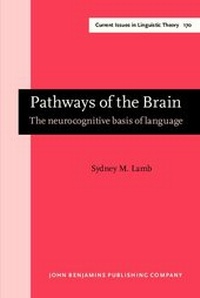
Pathways of the Brain
The neurocognitive basis of language
1st Edition
Published on 15. February 1999
XII, 418 pages
978-90-272-8403-7 (ISBN)
Description

The brain is the organ of knowledge and organizer of our abilities, our means of recognizing a face in a crowd, of conversing about anything we experience or imagine, of forming thoughts and developing ideas, of instantly understanding words coming rapidly in conversation. How does it manage all this? Does it represent information in symbols or in the connectivity of a vast network?Pathways of the Brain builds a theory to answer such questions. Using a top-down modeling strategy, it charts relationships among words and other products of the brain's linguistic system to reveal properties of that system. Going beyond earlier linguistics, it sets three plausibility requirements for a valid neurocognitive theory: operational, developmental, and neurological: It must show how the linguistic system can operate for speaking and understanding, how it can be learned by children, and how it is implemented in neural structures. Unlike theories that leave linguistics isolated from science, it builds a bridge to biology.
Of interest to anthropologists, linguists, neurologists, neuroscientists, philosophers, psychologists, and any thoughtful person interested in language or the brain.
The author is Agnes Cullen Arnold Professor Emeritus of Linguistics and Cognitive Sciences.
Of interest to anthropologists, linguists, neurologists, neuroscientists, philosophers, psychologists, and any thoughtful person interested in language or the brain.
The author is Agnes Cullen Arnold Professor Emeritus of Linguistics and Cognitive Sciences.
More details
Other editions
Additional editions
Book
02/1999
John Benjamins Publishing Co
€137.80
Shipment within 10-15 days
Person
Content
- PATHWAYS OF THE BRAIN
- Editorial page
- Title page
- Copyright page
- Dedication
- Table of contents
- Acknowledgements
- PREFACE
- CHAPTER ONE. THE WINDOW OF THE MIND
- Investigating Language
- A Focus on People
- Four Kinds of Evidence
- Nine Questions
- The Transparency Illusion
- CHAPTER TWO. EVIDENCE OF THE FIRST TWO KINDS
- Speech and Writing
- Phonetics
- Phonology
- Two Levels of Patterning
- Words, Words, Words
- Meaning
- Some Terms to Remember
- CHAPTER THREE. THE STRATIFICATION OF LANGUAGE
- The Linguistic System as a Complex of Multiple Systems
- Realization
- Evidence from Multi-Lingualism
- Realizational Discrepancy Within Phonology and Grammar
- Some Quantitative Estimates
- World-Wide Correspondences
- Two Concluding Observations
- CHAPTER FOUR. A NETWORK OF RELATIONSHIPS
- On Defining the Morpheme
- Objects and Relationships
- Objections
- Local and Distributed Representation
- Further Examples
- Traveling Activation
- Recapping
- CHAPTER FIVE. COMPONENTS OF RELATIONAL NETWORKS
- Basic Node Types
- Networks and Graphs
- Nections
- Terminology for Nections of Different Levels
- Narrow Network Notation
- Precedence Ordering in Narrow Relational Notation
- Nections of Narrow Notation
- Concluding Observation
- Some Terms to Remember
- CHAPTER SIX. SYNTAX
- Analytical Syntax
- Syntactic Operations
- Translating Rules into Nections
- Choice
- Tactics at Other Levels
- Differences in Sequencing
- Analyzing the Ordered 'And' node
- Operation of the Tactic Network
- It Ain't Necessarily So
- CHAPTER SEVEN. BUILDING MODELS
- Three Worlds
- Four Basic Properties of Mental Models of the World
- Analysis and Catalysis
- Introjective Models
- Descriptive Process
- Metaphorical Models
- Is the Relational Network a Metaphor?
- Bottom-Up and Top-Down Models
- Some Concluding Observations
- Terms to Rememeber
- CHAPTER EIGHT. INTERACTING SUBSYSTEMS
- Phonological and Lexicogrammatical Systems
- Meaning
- Production vs. Recognition
- The Primacy of Recognition over Production
- Bi-Directional Processing within One Subsystem
- Multiple Semological Systems
- CHAPTER NINE. MEANING
- Semantic Structure
- Semantic Structure vs. Semological Structure
- Procedures
- Social Groups
- Object Categories
- The Threshold Node
- Social Roles
- Processes and their Participants
- Some Terms to Remember
- CHAPTER TEN. BUILDING CONNECTIONS
- Learning in Relational Networks
- Lexicalization and Idiomaticity
- Consequences for Morphological Analysis
- Irregular Inflections
- Levels Within Levels
- The Learning Process
- Concluding Thoughts
- Some Terms to Remember
- CHAPTER ELEVEN. TRAVELING THE PATHWAYS
- Descriptive Overview of Linguistic Processes
- Inner Speech
- Linguistic Processing and Traveling Activation
- Idioms in action
- Semantic Relationships in Action
- Context-Driven Lexeme Selection
- Visualization in Interpretation
- Linguistically Guided Structure Building
- Interpreting Relative Clauses and Questions
- Different People, Different Systems
- Concluding Observations
- CHAPTER TWELVE. THE EVER-CHANGING NETWORK
- Creativity in the Cognitive System
- Lines, Nodes, and Activation
- Changes over Time
- Building Network Structure
- The Proximity Principle
- Competition
- Defining Proximity
- Nection Recruitment for Long-Distance Association
- Growing New Connections
- Fine Tuning
- Some Terms to Remember
- CHAPTER THIRTEEN. SOURCES OF LINGUISTIC PATTERNING
- Types of Patterning
- Patterning and Cognition
- Possible Sources of Patterning
- Fossils of Earlier Patterns
- Redundancy
- Conflicting Patterns
- Parts of Speech, Parts of Vision, Parts of Thought
- Patterning Imposed by the Observer
- Thresholds, Pattern Recognition, and Similarity
- Diversity and the Survival of Perceived Patterns
- CHAPTER FOURTEEN. SEQUENCE MANAGEMENT
- Phonotactics and Timing Devices
- High-Speed Inner Sequencing
- Sequence Control without Constituent Structure
- Managing New Combinations
- The Mutable Lexeme
- The Mutable Sememe
- Learning to Manage Sequences
- CHAPTER FIFTEEN. LINGUISTIC ILLUSIONS
- Semiotic Fallacies
- The Monosemy Assumption
- Linearity in Phonology
- Words and Morphemes as Illusory Objects
- The Illusion of Rules of Grammar
- Applying the Unity Fallacy to the Linguistic System
- Language, Thought, and Intelligence
- CHAPTER SIXTEEN. INTRODUCING THE BRAIN
- The Brain's Biological Context
- The Brain
- The Cerebral Hemispheres
- The Cerebral Cortex
- Hemispheres and Lobes
- Subdividing the Lobes
- Location and Function: General Principles
- Grey Matter and White Matter
- Neurons and Cortical Layers
- Synapses
- Electrical Activity from Dendrite to Axon
- Some Quantities
- CHAPTER SEVENTEEN. NEURONS AND NECTIONS
- Degrees of Activation
- Building Connections
- Long and Short Connections
- Nections and Cortical Columns
- Excitatory and Inhibitory Connections
- Bidirectional Connections
- Preponderance of Latent Connections
- Nections that May Not be Implemented as Cortical Columns
- Local and Distributed Representation
- Arguments against Local Representation
- Arbitrary and Functional Representation
- Coarse and Fine Coding
- Relational Network Representation of Conceptual Categories
- Recognizing New Things
- Estimating the Abundance Requirement
- CHAPTER EIGHTEEN. THE ANATOMY OF LANGUAGE
- Hierarchy
- Implications of the Proximity Hypothesis
- Implementing the Levels of the Model
- The Language Cortex
- Neurological Evidence on Localization
- Objections and Answers
- Communication between Cognitive Subsystems
- EPILOG
- APPENDIX
- NOTES
- REFERENCES
- INDEX
