

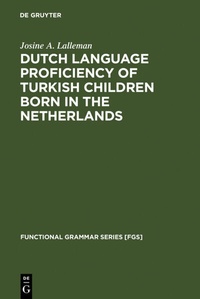
Dutch Language Proficiency of Turkish Children Born in the Netherlands
1st Edition
Published on 2. May 2011
XVI, 237 pages
978-3-11-085999-7 (ISBN)
Description

No detailed description available for "Dutch Language Proficiency of Turkish Children Born in the Netherlands".
More details
Series
Edition
Reprint 2010
Language
English
Place of publication
Berlin/Boston
Germany
Publishing group
de Gruyter Mouton
Target group
Professional and scholarly
US School Grade: College Graduate Student
Illustrations
Num. figs.
Num. figs.
File size
27,79 MB
ISBN-13
978-3-11-085999-7 (9783110859997)
Schweitzer Classification
Other editions
Additional editions
Josine A. Lalleman
Dutch Language Proficiency of Turkish Children Born in the Netherlands
Book
01/1986
1st Edition
De Gruyter Mouton
€169.95
Article exhausted; check different version
Josine A. Lalleman
Dutch Language Proficiency of Turkish Children Born in the Netherlands
Book
01/1986
1st Edition
De Gruyter Mouton
€119.95
Available immediately
Content
- Intro
- ACKNOWLEDGEMENTS
- LIST OF ABBREVIATIONS
- CHAPTER 1 GENERAL INTRODUCTION
- 1. Background to the study and research questions
- 2. Subjects
- 3. Data and data processing
- 3.1. The language samples
- 3.2. The social and socio-psychological material
- 4. The functional paradigm
- basic principles and concepts of Functional Grammar
- 4.1. Introduction
- 4.2. Outline of FG
- CHAPTER 2 ORAL DUTCH LANGUAGE PROFICIENCY OF TURKISCH CHILDREN BORN IN THE NETHERLANDS: Overall results
- 1. Introduction
- 2. The Tests
- 2.1. Morphology Test
- 2.2. Imitation Test
- 2.2.1. IT: Morphological Features
- 2.2.2. IT: Syntactic Features
- 2.2.3. IT: Semantic Features
- 2.3. Comprehension Test
- 3. Spontaneous Speech
- 3.1. Morphological Features
- 3.1.1. Verb Conjugation
- 3.1.2. Personal pronouns
- 3.1.3. Prepositions
- 3.1.4. Articles
- 3.2. Syntactic Features
- 3.3. Semantic Features
- 3.3.1. Informational Units
- 3.3.2. Semantic Category Agreement
- 3.3.3. Vocabulary
- 4. Summary and Establishment of an overall level of linguistic proficiency
- 4.1. Summary
- 4.2. Establishment of an overall level of linguistic proficiency
- 5. Conclusion
- CHAPTER 3 MORPHOLOGICAL PROFICIENCY: L1 and L2 development of the verbal predicate
- 1. Introduction
- 2. The Dutch tense system
- 3. Developmental sequences in L1 acquisition of the verbal predicate
- 4. Method of Analysis
- 5. L2 acquisition of the Dutch tense system
- 6. L2 acquisition of the present tense conjugation rule
- 7. L2 acquisition of the past participle and the past tense
- 7.1. Past Participle
- 7.2. Past Tense
- 8. Summary and discussion
- CHAPTER 4 SYNTACTIC PROFICIENCY: Complexity and correctness of utterances
- 1. Introduction
- 2. Word order properties of Dutch declarative main clauses
- 2.1. Complete Utterances
- 2.2. Elliptical Utterances
- 2.3. Spoken Dutch
- 3. The FG pattern of Dutch main clauses
- 4. Method of Analysis
- 5. Complexity
- 5.1. Length of Utterances
- 5.2. Structural diversity
- 5.2.1. One-constituent utterances
- 5.2.2. Two-constituent utterances
- 5.2.3. Three-constituent utterances
- 5.2.4. Four-constituent utterances
- 5.2.5. Five-, six-, and seven-constituent utterances
- 5.2.6. Conclusion
- 5.3. Summary
- 6. Correctness
- 6.1. Acceptable spoken Dutch patterns
- 6.1.1. Utterances starting with the finite verb
- 6.1.2. Utterances with a constituent added to a complete predication
- 6.1.3. Utterances with a noun directly followed by its corresponding demonstrative
- 6.1.4. Frequency of occurrence of acceptable spoken Dutch patterns
- 6.1.5. Conclusion
- 6.2. Utterances without subject and/or without verb
- 6.3. Utterances with a deviant word order pattern
- 6.3.1. Verb Final and V3
- 6.3.2. Utterances with the subject or verb in two different positions
- 6.3.3. Object Final and incorrect joint VfVi
- 6.3.4. Conclusion
- 6.4. Summary
- 7. Overall level of syntactic proficiency of the Turkish children
- CHAPTER 5 SEMANTIC PROFICIENCY: The communication of perceptual experiences
- 1. Introduction
- 2. A Functional Grammar of narratives
- 3. The analysis of the Banana-story
- 3.1. Introduction
- 3.2. The establishment of a basic text
- 3.3. A functional Analysis of the basic text
- 4. How the Dutch and Turkish children communicate perceptual experiences
- 4.1. Basic and Individual Story Fund
- 4.2. Semantic functions
- 4.3. Linguistic form of the Informational Units
- 4.4. Setting
- 4.5. Order of events
- 5. Summary and discussion
- CHAPTER 6 THE INFLUENCE OF SOCIAL AND SOCIO-PSYCHOLOGICAL FACTORS ON SECOND LANGUAGE PROFICIENCY
- 1. Introduction
- 2. Data gathering and Method of Analysis
- 3. General information
- 4. Social Distance
- 4.1. Introduction
- 4.2. Visits to/from Dutch people
- 4.3. Visits to/from Dutch children
- 4.4. Chats with neighbours
- 4.5. Help from neighbours
- 4.6. Contact with Dutch colleagues (father)
- 4.7. Contact with Dutch colleagues (mother)
- 4.8. Knowledge of Dutch politics
- 4.9. Squatting
- 4.10.Dutch papers
- 4.11.Overview of the results
- 5. Cultural Distance
- 5.1. Introduction
- 5.2. Ritual Prayers
- 5.3. Koran
- 5.4. Fasting
- 5.5. Religious Feasts
- 5.6. Alcohol
- 5.7. Marriage
- 5.8. Marriage Giving
- 5.9. Bars and Discotheques
- 5.10.Clothing (1)
- 5.11.Clothing (2)
- 5.12.Turkish language
- 5.13.Longing for Turkey
- 5.14.Return to Turkey
- 5.15.Turkish Food
- 5.16.Turkish music
- 5.17.Overview of the results
- 6. Psychological Distance
- 6.1. Introduction
- 6.2. Discrimination at work
- 6.3. Discrimination in finding a house
- 6.4. Discrimination at school
- 6.5. Discrimination by the Dutch population in general
- 6.6. Discrimination by the Dutch government
- 6.7. Overview of the results
- 7. Discussion
- APPENDICES 1A: The Morphology Test
- 1B: The Imitation Test
- 1C: The Comprehension Test
- 1D: The Conversation Sample (CS), the questions concerning the CS, and the questions relating to the CS
- 2 : Levels of Proficiency in Dutch of the individual Turkish children, with respect to 25 variables separately
- 5A: Transcribed text of the writers' version of the Banana-story
- 5B: Four versions of the Banana-story as told by the children
- 6A: Conversation with Hakan's parents (Turkish)
- 6B: Conversation with Hakan's parents (Dutch)
- 6C: Profile of Hakan's family
- REFERENCES
- SUBJECT INDEX
