

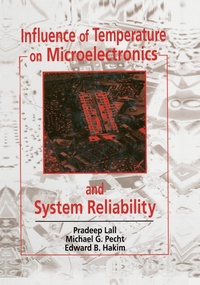
Influence of Temperature on Microelectronics and System Reliability
A Physics of Failure Approach
1st Edition
Published on 9. July 2020
336 pages
978-0-429-61111-7 (ISBN)
Description

This book raises the level of understanding of thermal design criteria. It provides the design team with sufficient knowledge to help them evaluate device architecture trade-offs and the effects of operating temperatures. The author provides readers a sound scientific basis for system operation at realistic steady state temperatures without reliability penalties. Higher temperature performance than is commonly recommended is shown to be cost effective in production for life cycle costs.
The microelectronic package considered in the book is assumed to consist of a semiconductor device with first-level interconnects that may be wirebonds, flip-chip, or tape automated bonds; die attach; substrate; substrate attach; case; lid; lid seal; and lead seal. The temperature effects on electrical parameters of both bipolar and MOSFET devices are discussed, and models quantifying the temperature effects on package elements are identified. Temperature-related models have been used to derive derating criteria for determining the maximum and minimum allowable temperature stresses for a given microelectronic package architecture.
The first chapter outlines problems with some of the current modeling strategies. The next two chapters present microelectronic device failure mechanisms in terms of their dependence on steady state temperature, temperature cycle, temperature gradient, and rate of change of temperature at the chip and package level. Physics-of-failure based models used to characterize these failure mechanisms are identified and the variabilities in temperature dependence of each of the failure mechanisms are characterized. Chapters 4 and 5 describe the effects of temperature on the performance characteristics of MOS and bipolar devices. Chapter 6 discusses using high-temperature stress screens, including burn-in, for high-reliability applications. The burn-in conditions used by some manufacturers are examined and a physics-of-failure approach is described. The
The microelectronic package considered in the book is assumed to consist of a semiconductor device with first-level interconnects that may be wirebonds, flip-chip, or tape automated bonds; die attach; substrate; substrate attach; case; lid; lid seal; and lead seal. The temperature effects on electrical parameters of both bipolar and MOSFET devices are discussed, and models quantifying the temperature effects on package elements are identified. Temperature-related models have been used to derive derating criteria for determining the maximum and minimum allowable temperature stresses for a given microelectronic package architecture.
The first chapter outlines problems with some of the current modeling strategies. The next two chapters present microelectronic device failure mechanisms in terms of their dependence on steady state temperature, temperature cycle, temperature gradient, and rate of change of temperature at the chip and package level. Physics-of-failure based models used to characterize these failure mechanisms are identified and the variabilities in temperature dependence of each of the failure mechanisms are characterized. Chapters 4 and 5 describe the effects of temperature on the performance characteristics of MOS and bipolar devices. Chapter 6 discusses using high-temperature stress screens, including burn-in, for high-reliability applications. The burn-in conditions used by some manufacturers are examined and a physics-of-failure approach is described. The
More details
Edition
1. Auflage
Language
English
Place of publication
London
United Kingdom
Publishing group
Taylor & Francis Ltd
Target group
Professional and scholarly
ISBN-13
978-0-429-61111-7 (9780429611117)
Copyright in bibliographic data and cover images is held by Nielsen Book Services Limited or by the publishers or by their respective licensors: all rights reserved.
Schweitzer Classification
Other editions
Additional editions
Pradeep Lall | Michael G. Pecht | Edward B. Hakim
Influence of Temperature on Microelectronics and System Reliability
A Physics of Failure Approach
Book
06/2019
1st Edition
CRC Press
€61.50
Shipment within 15-20 days
Pradeep Lall | Michael G. Pecht | Edward B. Hakim
Influence of Temperature on Microelectronics System Reliability
A Physics of Failure Approach
Book
04/1997
1st Edition
CRC Press
€142.37
Shipment within 15-20 days
Persons
Pradeep Lall, Michael G. Pecht, Edward B. Hakim
Content
Chapter 1 Temperature as a Reliability Factor, Chapter 2 Temperature Dependence of Microelectronic Package Failure Mechanisms, Chapter 3 Temperature Dependence of Microelectronic Package Failure Mechanisms, Chapter 4 Electrical Parameter Variations in Bipolar Devices, Chapter 5 Electrical Parameter Variations in MOSFET Devices, Chapter 6 a Physics-of-failure Approach to IC Burn-In, Chapter 7 Derating Guidelines for Temperature-tolerant Design of Microelectronic Devices, Chapter 8 Derating Guidelines for Temperature-tolerant Design of Electronic Packages, Chapter 9 Conclusions, References, Index, Permissions
