

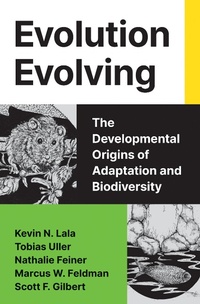
Evolution Evolving
The Developmental Origins of Adaptation and Biodiversity
1st Edition
Published on 4. October 2024
440 pages
978-0-691-26240-6 (ISBN)
Description

A new account of the central role developmental processes play in evolution
A new scientific view of evolution is emerging-one that challenges and expands our understanding of how evolution works. Recent research demonstrates that organisms differ greatly in how effective they are at evolving. Whether and how each organism adapts and diversifies depends critically on the mechanistic details of how that organism operates-its development, physiology, and behavior. That is because the evolutionary process itself has evolved over time, and continues to evolve. The scientific understanding of evolution is evolving too, with groundbreaking new ways of explaining evolutionary change. In this book, a group of leading biologists draw on the latest findings in evolutionary genetics and evo-devo, as well as novel insights from studies of epigenetics, symbiosis, and inheritance, to examine the central role that developmental processes play in evolution.
Written in an accessible style, and illustrated with fascinating examples of natural history, the book presents recent scientific discoveries that expand evolutionary biology beyond the classical view of gene transmission guided by natural selection. Without undermining the central importance of natural selection and other Darwinian foundations, new developmental insights indicate that all organisms possess their own characteristic sets of evolutionary mechanisms. The authors argue that a consideration of developmental phenomena is needed for evolutionary biologists to generate better explanations for adaptation and biodiversity. This book provides a new vision of adaptive evolution.
A new scientific view of evolution is emerging-one that challenges and expands our understanding of how evolution works. Recent research demonstrates that organisms differ greatly in how effective they are at evolving. Whether and how each organism adapts and diversifies depends critically on the mechanistic details of how that organism operates-its development, physiology, and behavior. That is because the evolutionary process itself has evolved over time, and continues to evolve. The scientific understanding of evolution is evolving too, with groundbreaking new ways of explaining evolutionary change. In this book, a group of leading biologists draw on the latest findings in evolutionary genetics and evo-devo, as well as novel insights from studies of epigenetics, symbiosis, and inheritance, to examine the central role that developmental processes play in evolution.
Written in an accessible style, and illustrated with fascinating examples of natural history, the book presents recent scientific discoveries that expand evolutionary biology beyond the classical view of gene transmission guided by natural selection. Without undermining the central importance of natural selection and other Darwinian foundations, new developmental insights indicate that all organisms possess their own characteristic sets of evolutionary mechanisms. The authors argue that a consideration of developmental phenomena is needed for evolutionary biologists to generate better explanations for adaptation and biodiversity. This book provides a new vision of adaptive evolution.
More details
Other editions
Additional editions
Kevin N. Lala | Tobias Uller | Nathalie Feiner
Evolution Evolving
The Developmental Origins of Adaptation and Biodiversity
Book
approx. 11/2026
Princeton University Press
€28.50
Not yet published
Kevin N. Lala | Tobias Uller | Nathalie Feiner
Evolution Evolving
The Developmental Origins of Adaptation and Biodiversity
Book
10/2024
Princeton University Press
€47.50
Article not available at the moment
Persons
Kevin N. Lala is professor of behavioral and evolutionary biology at the University of St. Andrews. He is the author of Darwin's Unfinished Symphony: How Culture Made the Human Mind (Princeton) and other books. Tobias Uller is professor of evolutionary biology at Lund University, Sweden. He is the coeditor of Evolutionary Causation: Biological and Philosophical Reflections and Philosophy of Science for Biologists. Nathalie Feiner is a Lise Meitner group leader at the Max Planck Institute for Evolutionary Biology at Plön, Germany, and is affiliated with Lund University. Marcus W. Feldman is the Burnet C. and Mildred Finley Wohlford Professor of Biological Sciences at Stanford University. He is the author of Niche Construction: The Neglected Process in Evolution (Princeton) and other books. Scott F. Gilbert is the Howard A. Schneiderman Professor of Biology Emeritus at Swarthmore College, the Finland Distinguished Professor Emeritus at the University of Helsinki, and the author of the widely used textbook Developmental Biology.
Content
- Cover
- Contents
- Foreword
- Part I: Introduction: Why Consider Development?
- 1. Nothing in Biology Makes Sense . . . Anymore
- 2. Rodents' Teeth and Raptors' Toes
- 3. How the Turtle Got Its Shell
- 4. Understanding the Debates
- Part II: How Development Works
- 5. Opening the Black Box
- 6. Five General Principles of Development
- Part III: The Developmental Bases of Evolutionary Processes
- 7. Developmental Bias
- 8. Plasticity-Led Evolution
- 9. The Causes of Selection
- 10. Inheritance beyond the Gene
- Part IV: Implications of the Developmental Perspective
- 11. Novelty and Innovation
- 12. The Developmental Origins of Evolvability
- 13. Human Evolvability
- 14. The Structure of Evolutionary Theory
- Notes
- References
- Index
