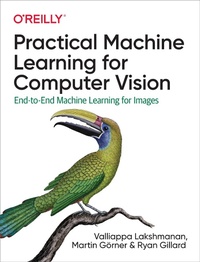
Practical Machine Learning for Computer Vision
Description

This practical book shows you how to employ machine learning models to extract information from images. ML engineers and data scientists will learn how to solve a variety of image problems including classification, object detection, autoencoders, image generation, counting, and captioning with proven ML techniques. This book provides a great introduction to end-to-end deep learning: dataset creation, data preprocessing, model design, model training, evaluation, deployment, and interpretability.
Google engineers Valliappa Lakshmanan, Martin Görner, and Ryan Gillard show you how to develop accurate and explainable computer vision ML models and put them into large-scale production using robust ML architecture in a flexible and maintainable way. You''ll learn how to design, train, evaluate, and predict with models written in TensorFlow or Keras.
You''ll learn how to:
- Design ML architecture for computer vision tasks
- Select a model (such as ResNet, SqueezeNet, or EfficientNet) appropriate to your task
- Create an end-to-end ML pipeline to train, evaluate, deploy, and explain your model
- Preprocess images for data augmentation and to support learnability
- Incorporate explainability and responsible AI best practices
- Deploy image models as web services or on edge devices
- Monitor and manage ML models
More details
Other editions
Additional editions