

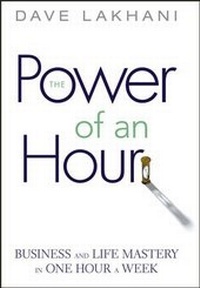
Power of An Hour
Business and Life Mastery in One Hour A Week
Published on 14. December 2010
224 pages
978-1-118-04073-7 (ISBN)
Description

Praise for The Power of an Hour
"The master at getting what you want from others now tells us howto get what we want from ourselves! This is really a great book,and I recommend it highly-for you, for your team, and for yourchildren."
-Bob Burg, author, Endless Referrals
"If you want to make predictable, systematic change in your life oryour business, buy this book. Each chapter is a stand-alone systemthat results in powerful change . . . fast."
-David Hancock, The Entrepreneurial Publisher, CEO, Morgan JamesPublishing
"Dave's methods helped me take my business from $0 to $10 millionin sales.If you're a creative business owner who wants total focusand massive success, run, don't walk, and get this book!"
-Stephanie Frank, author, The Accidental Millionaire
"The Power of an Hour is a mighty powerful way to sort out yourfinancesby first sorting out yourself!"
-Mark Joyner, #1 bestselling author, The Irresistible Offer
"The disease of the twenty-first century, no matter who you are orwhat you do,is Time Deficit Disorder. Dave Lakhani offers abrilliant solution in this book.Get it and take the cure-you'll besurprised how much better you feel!"
-David Garfinkel, author, Customers on Demand
More details
Other editions
Additional editions
Book
06/2006
1st Edition
Wiley
€31.00
Shipment within 10-20 days
Person
Dave Lakhani is an in-demand speaker, trainer, and thePresident of Bold Approach, Inc., a business acceleration firmconsultancy. Bold Approach has been nominated twice as one of FastCompany magazine's Fast 50 Companies. A successful entrepreneur, heis a popular speaker on the topics of persuasion, influence, sales,marketing, ideation, and business acceleration. He is also theauthor of Persuasion: The Art of Getting What You Want, from Wiley.Visit him online at www.powerofanhour.com.
Content
Acknowledgements.
Preface.
Chapter 1. The Power Of An Hour.
Chapter 2. How To Focus - The Power In An Hour.
Chapter 3. How To Think Critically.
Chapter 4. How To Think Creatively.
Chapter 5. Personal Hour 1 - Set The Stage.
Chapter 6. Personal Hour 2 - Identify The Blocks.
Chapter 7. Personal Hour 3 - Destroy The Blocks.
Chapter 8. Personal Hour 4 - Relationships.
Chapter 9. Personal Hour 5 - Finances.
Chapter 10. Personal Hour 6 - Self Improvement.
Chapter 11. Personal Hour 7 - Mental Vacation.
Chapter 12. Personal Hour 8 - Create A Master LifeVision.
Chapter 13. Personal Hour 9 - Overcome Your Fear AndReinvent Yourself.
Chapter 14. Business Hour 1 - Finding Your BusinessFocus.
Chapter 15. Business Hour 2 - Time Management.
Chapter 16. Personal Hour 3 - Management.
Chapter 17. Personal Hour 4 - Sales And Marketing.
Chapter 18. Personal Hour 5 - Customer Experience.
Chapter 19. Personal Hour 6 - Making Connections.
Chapter 20. Personal Hour 7 - Mentoring.
Chapter 21. Personal Hour 8 - Give Something Back.
Chapter 22. Personal Hour 9 - The Final Hour.
Chapter 23. Call It A Day.
Index.
CHAPTER 1 The Power of an Hour
Whether you own a business or just want to be the best person you can, you must subject yourself to change. Every day in my business I talk to business owners and corporate leaders who are working diligently to find time to create the change needed in their own businesses. Many also feel they'd be more effective if they were able to create personal change as well. But ultimately, what holds everyone back is time. While time may seem like the thing you need the most of, it turns out that isn't true. What you need is focus-a very specific kind of focus. I'm going to help you find that focus in your personal life and in your business as you read the coming chapters. You'll get practical step-by-step advice, and you'll get expert instruction from highly qualified specialists, who will show you exactly what to do and when to do it. Most important, they'll show you how to structure your activity so you are always able to achieve exactly the results you want.
Saying in the previous paragraph that time isn't the real issue will leave many of you scratching your head, when you consider the name of the book, so let me elaborate. We all get the same number of minutes and hours in a day to work, create, live, and prosper. It's how we use those hours that makes the real difference in terms of the quality of our lives and the value of our businesses. In order to create the kind of change that achieves truly meaningful goals, the focus must be on what I call the Critical Power HourT. I focus on a single hour because virtually anyone can extract himself from the rigors of daily life and invest one hour a day to create change. An hour is also the easiest quantity of time for us to schedule. Finally, I chose an hour because, after 15 years of helping people realize their business and personal goals, I've come to realize it only takes an hour to initiate change. Any more than an hour of real focus without a break results in a rapid breakdown in productivity. After an hour of intense focus, the mind begins to wander, excuses come to the surface, and restarting is harder than ever because of the amount of effort you've expended beyond an hour. I've also chosen an hour because it works. In virtually every business I've worked with, when I get people to use this process they achieve exponential results. Also, by limiting your focus to an hour, you will be able to immediately see and feel the gratification that comes from completion once that hour is past. I'm not saying there won't be times when it is necessary to focus for longer than an hour; however, those times should be limited. True focus is a marathon effort packed into a sprint. There is tremendous accomplishment at the end; there is also tremendous insight that occurs. I will cover more about that later in the book. The Power of an Hour works because it limits the amount of time used and is focused in a specific way. Here are the steps of the Power of an Hour program that should be applied each time a new area of desired change is identified.
1. Clearly identify what you need to change. 2. Apply critical thinking to identify the structure of the change. 3. Apply creative thinking to identify other solutions. 4. Identify next steps. 5. Schedule your change and take the first action. 6. Evaluate your activity and measure your success. 7. Reward your successful completion. Let's take a closer look at each step in order to better understand it and how it applies. You must understand the steps because they will be the basis of your Power of an Hour system for success.
Solving the wrong problem is one of the most significant reasons that real change does not occur. In order to create fast and lasting change, you must first take time to clearly identify the problems you want solved. Here are a few questions that need to be answered before a project is started. What is the specific factor initiating this change? In other words, what one thing contributed to this decision? Is that one thing important enough to focus your efforts and finances to achieve this change? Will this change lead to other changes that must occur as a result? If so, what areas? What would happen if the change does not solve your problem? What specifically needs to be changed? Who needs to be involved in order to create this change? What is the outcome that must be achieved as a result of this change? What does this mean to the organization financially, socially, environmentally, and organizationally? What does this mean to you personally? What specifically will you get from making this change? What will happen if this change does not occur? What is the best possible outcome of this change? Who, by name, will be impacted by the change? How will you define success? How will you reward successful completion of the change? After working with hundreds of companies, I've found that by simply going through this checklist and challenging the answers, change is created more quickly. This happens because as you go through the list and discuss specifics, often the problem may not be real; it may be smaller than it appeared, or perhaps it was not necessary to solve it. If we decide that the problem really needs to be solved, that gives us valuable information about how to create the change. This process does another thing too. It provides a complete understanding of who needs to be involved and held accountable. Finally, it informs you when you've been successful and reminds you to stop. Often, change doesn't work because those creating it don't know when to stop. The result is that the person or the organization that is changing can't see an end to the process and feels stuck in a state of flux. Successful change happens because there is a definite and defined end.
Critical thinking is such an important process that I'm dedicating an entire chapter to the topic (Chapter 3). Critical thinking needs to be applied early on in the process in order to break the change down to its smallest and most actionable items. Critical thinking also allows us to determine the best courses of action. Too often we start out with a new plan or idea that we are wildly enthusiastic about but fail to be realistic about requirements or outcomes. The result is that the idea dies on the vine. We've all experienced these failures in our personal lives when we resolve to diet, exercise, or stop smoking, for example. In business, when critical thinking is missing, we may start new revenue initiatives that don't take shape, or we create products that are never launched appropriately or never become as fully profitable as they could be. It's not that the idea isn't good; we simply failed to think it through appropriately in the Critical Power Hour.
A problem I see, whether I am coaching individuals or consulting with business clients, is the idea of absolutes. Many times absolutes are the result of strongly held beliefs or a failure to consider other perspectives. Absolutes nearly always result in a less positive outcome than is possible. Creative thinking is another skill that is so important I'll cover it in a separate chapter (Chapter 4). Challenging assumptions, beliefs, and absolutes for the purpose of seeing what else exists or is possible allows you to get the most out of your Critical Power Hour. It is important you explore all of the alternatives that exist when you set out to create powerful change in a short period of time. Often you'll discover there are quicker, better, and more efficient solutions to the challenges you face. Many of us forget to look for creative solutions and only look to linear solutions that seem obvious.
Now that you've identified what needs changing, why, and what the outcome could be, it's time to identify what to do next. It can be difficult for people to define what should be changed and what it can mean, because they focus on the result and abandon the process, hoping that someone else will pick up the pieces and make it happen. Unfortunately, it isn't quite that simple. You must identify the steps to be taken and document them. Be as specific as possible when documenting your next steps and assign specific completion times. Part of creating Fearsome FocusT is knowing what to focus on and for how long. Undocumented next steps don't happen-it's that simple. Part of being able to create Fearsome Focus is the ability to redirect your focus back to the plan whenever necessary; if you don't have a plan you won't know where to refocus your efforts.
The most powerful action you can take in initiating change is to schedule and act. The reason you can create massive change in an hour is because of your ability to focus for an hour. But not all problems can be solved in a single hour; in fact, many of the initiatives you undertake in this process will take many hours. The key...
Change
Whether you own a business or just want to be the best person you can, you must subject yourself to change. Every day in my business I talk to business owners and corporate leaders who are working diligently to find time to create the change needed in their own businesses. Many also feel they'd be more effective if they were able to create personal change as well. But ultimately, what holds everyone back is time. While time may seem like the thing you need the most of, it turns out that isn't true. What you need is focus-a very specific kind of focus. I'm going to help you find that focus in your personal life and in your business as you read the coming chapters. You'll get practical step-by-step advice, and you'll get expert instruction from highly qualified specialists, who will show you exactly what to do and when to do it. Most important, they'll show you how to structure your activity so you are always able to achieve exactly the results you want.
How the Power of an Hour Works
Saying in the previous paragraph that time isn't the real issue will leave many of you scratching your head, when you consider the name of the book, so let me elaborate. We all get the same number of minutes and hours in a day to work, create, live, and prosper. It's how we use those hours that makes the real difference in terms of the quality of our lives and the value of our businesses. In order to create the kind of change that achieves truly meaningful goals, the focus must be on what I call the Critical Power HourT. I focus on a single hour because virtually anyone can extract himself from the rigors of daily life and invest one hour a day to create change. An hour is also the easiest quantity of time for us to schedule. Finally, I chose an hour because, after 15 years of helping people realize their business and personal goals, I've come to realize it only takes an hour to initiate change. Any more than an hour of real focus without a break results in a rapid breakdown in productivity. After an hour of intense focus, the mind begins to wander, excuses come to the surface, and restarting is harder than ever because of the amount of effort you've expended beyond an hour. I've also chosen an hour because it works. In virtually every business I've worked with, when I get people to use this process they achieve exponential results. Also, by limiting your focus to an hour, you will be able to immediately see and feel the gratification that comes from completion once that hour is past. I'm not saying there won't be times when it is necessary to focus for longer than an hour; however, those times should be limited. True focus is a marathon effort packed into a sprint. There is tremendous accomplishment at the end; there is also tremendous insight that occurs. I will cover more about that later in the book. The Power of an Hour works because it limits the amount of time used and is focused in a specific way. Here are the steps of the Power of an Hour program that should be applied each time a new area of desired change is identified.
Seven Steps to Activating the Power of an Hour
1. Clearly identify what you need to change. 2. Apply critical thinking to identify the structure of the change. 3. Apply creative thinking to identify other solutions. 4. Identify next steps. 5. Schedule your change and take the first action. 6. Evaluate your activity and measure your success. 7. Reward your successful completion. Let's take a closer look at each step in order to better understand it and how it applies. You must understand the steps because they will be the basis of your Power of an Hour system for success.
Clearly Identify What You Need to Change
Solving the wrong problem is one of the most significant reasons that real change does not occur. In order to create fast and lasting change, you must first take time to clearly identify the problems you want solved. Here are a few questions that need to be answered before a project is started. What is the specific factor initiating this change? In other words, what one thing contributed to this decision? Is that one thing important enough to focus your efforts and finances to achieve this change? Will this change lead to other changes that must occur as a result? If so, what areas? What would happen if the change does not solve your problem? What specifically needs to be changed? Who needs to be involved in order to create this change? What is the outcome that must be achieved as a result of this change? What does this mean to the organization financially, socially, environmentally, and organizationally? What does this mean to you personally? What specifically will you get from making this change? What will happen if this change does not occur? What is the best possible outcome of this change? Who, by name, will be impacted by the change? How will you define success? How will you reward successful completion of the change? After working with hundreds of companies, I've found that by simply going through this checklist and challenging the answers, change is created more quickly. This happens because as you go through the list and discuss specifics, often the problem may not be real; it may be smaller than it appeared, or perhaps it was not necessary to solve it. If we decide that the problem really needs to be solved, that gives us valuable information about how to create the change. This process does another thing too. It provides a complete understanding of who needs to be involved and held accountable. Finally, it informs you when you've been successful and reminds you to stop. Often, change doesn't work because those creating it don't know when to stop. The result is that the person or the organization that is changing can't see an end to the process and feels stuck in a state of flux. Successful change happens because there is a definite and defined end.
Apply Critical Thinking to Identify the Structure of Change
Critical thinking is such an important process that I'm dedicating an entire chapter to the topic (Chapter 3). Critical thinking needs to be applied early on in the process in order to break the change down to its smallest and most actionable items. Critical thinking also allows us to determine the best courses of action. Too often we start out with a new plan or idea that we are wildly enthusiastic about but fail to be realistic about requirements or outcomes. The result is that the idea dies on the vine. We've all experienced these failures in our personal lives when we resolve to diet, exercise, or stop smoking, for example. In business, when critical thinking is missing, we may start new revenue initiatives that don't take shape, or we create products that are never launched appropriately or never become as fully profitable as they could be. It's not that the idea isn't good; we simply failed to think it through appropriately in the Critical Power Hour.
Apply Creative Thinking to Identify Other Solutions
A problem I see, whether I am coaching individuals or consulting with business clients, is the idea of absolutes. Many times absolutes are the result of strongly held beliefs or a failure to consider other perspectives. Absolutes nearly always result in a less positive outcome than is possible. Creative thinking is another skill that is so important I'll cover it in a separate chapter (Chapter 4). Challenging assumptions, beliefs, and absolutes for the purpose of seeing what else exists or is possible allows you to get the most out of your Critical Power Hour. It is important you explore all of the alternatives that exist when you set out to create powerful change in a short period of time. Often you'll discover there are quicker, better, and more efficient solutions to the challenges you face. Many of us forget to look for creative solutions and only look to linear solutions that seem obvious.
Identify Next Steps
Now that you've identified what needs changing, why, and what the outcome could be, it's time to identify what to do next. It can be difficult for people to define what should be changed and what it can mean, because they focus on the result and abandon the process, hoping that someone else will pick up the pieces and make it happen. Unfortunately, it isn't quite that simple. You must identify the steps to be taken and document them. Be as specific as possible when documenting your next steps and assign specific completion times. Part of creating Fearsome FocusT is knowing what to focus on and for how long. Undocumented next steps don't happen-it's that simple. Part of being able to create Fearsome Focus is the ability to redirect your focus back to the plan whenever necessary; if you don't have a plan you won't know where to refocus your efforts.
Schedule Your Change and Take the First Steps to Action
The most powerful action you can take in initiating change is to schedule and act. The reason you can create massive change in an hour is because of your ability to focus for an hour. But not all problems can be solved in a single hour; in fact, many of the initiatives you undertake in this process will take many hours. The key...
