

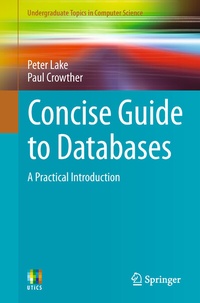
Concise Guide to Databases
Description

Topics and features: presents review and discussion questions at the end of each chapter, in addition to skill-building, hands-on exercises; introduces the fundamental concepts and technologies in database systems, placing these in an historic context; describes the challenges faced by database professionals; reviews the use of a variety of database types in business environments; discusses areas for further research within this fast-moving domain.
Reviews / Votes
From the book reviews:
"You may be interested in this book if you are a database newcomer or if you want to get a bigger picture of databases in general. Also, if you want to look at new solutions in DB business that could suit your company then you may be interested in this book. . This book may be useful if you are starting out on your DB journey and want to quickly get to know what it is all about." (Konrad Zdanowski, Vertabelo blog, vertabelo.com, March, 2015)
"Students who want to learn about the changes in concepts related to data and databases will benefit from reading this book. . This book will help computer scientists, students, and people who are working on data to gain a good understanding of basic data concepts and trends in data. I highly recommend it to engineers working on subjects related to data and to graduate /undergraduate students as a reference book." (Gulustan Dogan, Computing Reviews, August, 2014)
"I found this book quite interesting, andeasy to read and follow. It is very well structured, with good usage of theoretical and practical examples and many illustrations. . I would recommend it for computer science undergraduates, as well as postgraduate students and researchers . . a valuable source for self-study for practicing database professionals, or even for a course taught at the undergraduate or postgraduate level. Some university instructors may even adopt it as a core text." (Georgia Garani, Computing Reviews, June, 2014)
More details
Other editions
Additional editions
Persons
Peter Lake is Course Leader for the Oracle IT&M MSc and the IT Professional MSc at Sheffield Hallam University, UK. His other Springer publications include the successful Guide to Cloud Computing .
Paul Crowther is Head of Postgraduate (taught programmes) in the Faculty of Arts, Computing, Engineering and Sciences at Sheffield Hallam University, UK.
Content
Part I: Databases in Context.- Data: An Organisational Asset.- The History of Databases.- Physical Storage and Distribution.- Part II: Database Types.- Relational: The Start of the Modern Era in Databases.- NoSQL: Column-Based and Document-Based Databases.- Big Data.- Object and Object-Relational.- In-Memory Databases.- Part III: What Database Professionals Worry About.- Scalability.- Availability.- Performance.- Security.
