

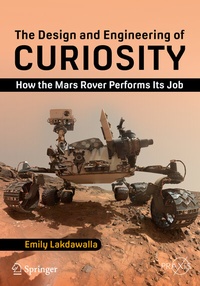
The Design and Engineering of Curiosity
Description

This book describes the most complex machine ever sent to another planet: Curiosity. It is a one-ton robot with two brains, seventeen cameras, six wheels, nuclear power, and a laser beam on its head. No one human understands how all of its systems and instruments work. This essential reference to the Curiosity mission explains the engineering behind every system on the rover, from its rocket-powered jetpack to its radioisotope thermoelectric generator to its fiendishly complex sample handling system. Its lavishly illustrated text explains how all the instruments work -- its cameras, spectrometers, sample-cooking oven, and weather station -- and describes the instruments' abilities and limitations. It tells you how the systems have functioned on Mars, and how scientists and engineers have worked around problems developed on a faraway planet: holey wheels and broken focus lasers. And it explains the grueling mission operations schedule that keeps the rover working day in and day out.
Reviews / Votes
"It is a fascinating read . . Emily does a great job making the book easy to understand . . I think this is a great book and any engineer who develops (or wants to develop) systems should read it. . I think this is the only book that I am aware of that presents all the required engineering elements to design and build a complex robot system. ... For experienced engineers it is also useful to read." (David Kohanbash, robotsforroboticists.com, February 2, 2022)
"This book presents an in-depth explanation of how 'the most complex machine ever sent to another planet' works. . There are in-depth discussions on wheel design and degradation as well as complete listings of the drill and scoop sampling campaign. Beautifully written and illustrated, Ladawalla's essay is truly encyclopaedic." (Richard McKim, The Observatory, Vol. 138 (1267), December, 2018)"The Design and Engineering of Curiosity is a comprehensive look at how the Mars Curiosity mission became a reality. Lakdawalla, an independent scholar, begins with an overview of the various iterations of the mission, starting with the goal of developing a bigger lander, and shows how the designers converged on the final mission and spacecraft design. . The book has a broad audience, ranging from general readers to the technical community." (D. B. Spencer, Choice, Vol. 56 (03), 2018)
More details
Other editions
Additional editions
Person
Lakdawalla has been following the Mars Science Laboratory mission closely since its inception, attending all relevant public meetings, including the last three landing site selection meetings and frequently checking in on its progress from the observation deck over the clean room at JPL.
Content
Dedication.- Foreword.- Acknowledgements.- Preface.- Chapter 1: Mars Science Laboratory.- Chapter 2: Getting to Mars.- Chapter 3: Mars Operations.- Chapter 4: How the Rover Works.- Chapter 5: SA/SPaH: Acquisition, Processing, and Handling.- Chapter 6: The Mast, Engineering Cameras, Navigation, and Hazard Avoidance.- Chapter 7: Curiosity's Science Cameras.- Chapter 8: Curiosity's Environmental Sensing Instruments.- Chapter 9: Curiosity's Chemistry Instruments.- Epilogue: Back on Earth.- Appendix.- About the Author.- Index.
