

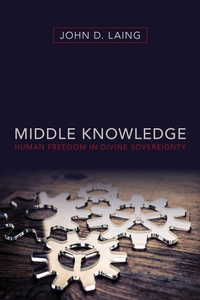
Middle Knowledge
Human Freedom in Divine Sovereignty
Published on 21. March 2019
302 pages
978-0-8254-7646-4 (ISBN)
Description

Most Christians believe God is in control, but they are unsure of how to reconcile that control with their struggles with sin, the command to evangelize, and the immense suffering in the world and their own lives.Laing offers an introduction to the doctrine of providence based on the theory of middle knowledge, first articulated in the sixteenth century. This view describes how creatures have true free will and God has perfect knowledge of what each creature could and would do in any circumstance. Middle knowledge helps answer the most perplexing theological questions: predestination and salvation, the existence of evil, divine and human authorship of Scripture, and science and the Christian faith. Laing provides extensive biblical support as well as practical applications for this theology.
More details
Other editions
Additional editions
Book
04/2018
Kregel Publications,U.S.
€26.50
Article not available at the moment
Content
- Cover Page
- Title Page
- Copyright
- Dedication
- Contents
- Introduction
- The Doctrine of Providence
- The Models of Providence
- Process Theology
- Open Theism
- Calvinism
- Theological Fatalism
- Middle Knowledge
- Assumptions
- The Nature of God
- Divine Omnipotence
- Divine Omniscience
- Divine omniscience and propositional knowledge
- Logical order of divine thoughts
- The Nature of Human Freedom
- The Nature of Divine Freedom
- Conclusion
- Chapter 1: The Doctrine of Middle Knowledge
- Introduction
- Middle Knowledge or Scientia Media
- Counterfactuals
- Possible Worlds Semantics
- Actualization of Worlds
- Feasibility of Possible Worlds, Creaturely World-Types, and Galaxies
- Comparative Similarity among Possible Worlds
- Conclusion
- Chapter 2: The Grounding Objection
- Introduction
- Conditional Excluded Middle
- Counterexamples to CEM
- Molinist Responses
- Counterfactuals and Determinism
- Counterfactuals, Determinism, and Risk
- Molinist Responses
- Counterfactuals, Determinism, and Individual Power
- Molinist Responses
- Counterfactuals, facts, and relative similarity among worlds
- Rejection of the power entailment principle
- Counterfactuals, Determinism, and the Causal History of the World
- Molinist Responses
- Grounding
- The No-Grounds Objection
- Grounding and God
- Grounding and the individual
- Molinist Responses
- No need for grounding
- Hidden assumptions
- Antirealism, the future, and divine foreknowledge
- Other-worldly occurrence
- Grounding and the mind of God
- Conclusion
- Chapter 3: The Circularity Objection
- Introduction
- Counterfactuals of Freedom, Truth, and Similarity among Worlds
- Vicious Circle Argument
- Molinist Responses
- Possible worlds semantics
- Logical/wording flaws
- Clarification of possible worlds analysis
- Explanatory Priority, Circularity, and Determinism
- Molinist Responses
- Conclusion
- Chapter 4: Divine Foreknowledge and Creaturely Free Will
- Introduction
- Divine Timelessness
- Traditional Models
- Criticisms of the traditional view
- Contemporary Models
- Stump and Kretzmann
- Criticisms and Stump and Kretzmann
- Leftow
- Criticisms of Leftow
- Ockhamism
- Ockham's Answer
- Contemporary Formulations
- Hard/soft facts
- Accidental necessity
- Problems with Ockhamism
- Arbitrary distinction
- Power over the past
- Molinism
- Conclusion
- Chapter 5: Predestination and Salvation
- Introduction
- Atonement
- Release from Evil Powers/Ransom to Satan
- Satisfaction
- Moral Influence
- Penal Substitution
- Example
- Governmental
- Assessment
- Soteriology
- Human Depravity
- Sovereign Election
- Excursis on reprobation
- Basis for election
- Effective Grace
- Regeneration and Faith
- Assurance of Salvation and Perseverance of the Saints
- Discipleship, Spiritual Growth, and Spiritual Gifts
- Conclusion
- Chapter 6: Middle Knowledge and the Problem of Evil
- Introduction
- The Problem of Evil
- Logical Problem of Evil
- Molinism and the Free Will Defense/Free Will Theodicy
- Probabilistic Problems of Evil
- Quantitative Argument
- Argument from Gratuitous Evil
- Skeptical Theism
- Contra skeptical theism
- Christianity/Theism and Gratuitous Evil
- Molinism and gratuitous evil
- Hasker on Molinism and Evil
- Molinist Response
- Conclusion
- Holocaust
- Pastoral Implications
- Chapter 7: Inerrancy and Inspiration
- Introduction
- Doctrine of Revelation
- Doctrine of Biblical Inspiration
- Doctrine of Biblical Inerrancy
- Middle Knowledge, Biblical Inerrancy, and the Problem of Libertarian Freedom
- Middle Knowledge, Divine Inspiration, and Inscripturation
- Possible Concerns/Objections
- Conclusion
- Chapter 8: Science and Theology
- Introduction
- Science and Theology
- Intelligent Design, Middle Knowledge, and the Problem of Creaturely Flaws
- Problem of Creaturely Flaws
- The logical problem of evil
- The free will defense
- The Intelligent Mutation Defense
- Counterfactuals of random genetic mutation
- Problem of intelligent designer's preference for creaturely adaptability
- Problem of the intelligence of random mutation
- Middle Knowledge and Quantum Physics
- Determinism, Process, Openness, and Randomness at the Quantum Level
- Molinism, Randomness, and Determinism/Orderliness
- Conclusion
- Chapter 9: Molinism: The Biblical Evidence
- Introduction
- Objections
- Contra Open Theism
- Matthew 11:22-24
- 1 Samuel 23:7-13
- Wisdom of Solomon 4:10-15
- Proverbs 24:11-12
- 1 Corinthians 2:6-16
- John 15
- Contra Calvinism
- Ordo Salutis
- Unconditional Election
- Use of "To Know"
- Genesis 18:19
- 2 Samuel 7:19-20
- Jeremiah 1:5
- Romans 9 (Moses and Pharaoh
- Jacob and Esau)
- Conclusion
- Chapter 10: Existentially Satisfying
- Introduction
- Unfulfilled Prophecy
- Efficacy of Petitionary Prayer
- Molinism, Evangelism, Discipleship, and Prayer
- Worthy of Worship
- Ethics, Providence, and End-of-Life Decisions
- Eschatology
- Conclusion
- Bibliography
- Books
- Essays and Articles
- Theses and Dissertations
- Book Reviews
- Unpublished Materials
- Scripture Index
- Author Index
- Subject Index
- Back Cover
