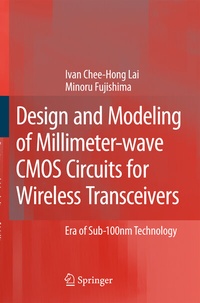
Design and Modeling of Millimeter-wave CMOS Circuits for Wireless Transceivers
Description

Design and Modeling of Millimeter-wave CMOS Circuits for Wireless Transceivers describes in detail some of the interesting developments in CMOS millimetre-wave circuit design. This includes the re-emergence of the slow-wave technique used on passive devices, the license-free 60GHz band circuit blocks and a 76GHz voltage-controlled oscillator suitable for vehicular radar applications.
All circuit solutions described are suitable for digital CMOS technology. Digital CMOS technology developments driven by Moore's law make it an inevitable solution for low cost and high volume products in the marketplace. Explosion of the consumer wireless applications further makes this subject a hot topic of the day.
The book begins with a brief history of millimetre-wave research and how the silicon transistor is born. Originally meant for different purposes, the two technologies converged and found its way into advanced chip designs. The second part of the book describes the most important passive devices used in millimetre-wave CMOS circuits. Part three uses these passive devices and builds circuit blocks for the wireless transceiver. The book completes with a comprehensive list of references for further readings.
Design and Modeling of Millimeter-wave CMOS Circuits for Wireless Transceivers is useful to show the analogue IC designer the issues involved in making the leap to millimetre-wave circuit designs. The graduate student and researcher can also use it as a starting point to understand the subject or proceed to innovative from the works described herein.
Reviews / Votes
From the reviews:
"The book is divided into three parts that address, respectively, the history of CMOS, millimeter-wave passive devices based on CMOS, and millimeter-wave active devices based on CMOS. The book is useful for all those working in electronics and communications." (Mircea Dragoman, Optics and Photonics News, March, 2009)
More details
Other editions
Additional editions