

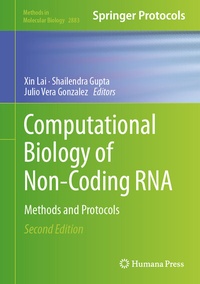
Computational Biology of Non-Coding RNA
Description

This second edition details a collection of state-of-art methods including identification of novel ncRNAs and their targets, functional annotation and disease association in different biological contexts. Chapters guide readers through an overview of disease-specific ncRNAs, computational methods and workflows for ncRNA discovery, annotation based on high-throughput sequencing data, bioinformatics tools and databases for ncRNA analyses, network-based methods, and kinetic modelling of ncRNA-mediated gene regulation. Written in the highly successful Methods in Molecular Biology series format, chapters include introductions to their respective topics, lists of the necessary materials and reagents, step-by-step, readily reproducible laboratory protocols, and tips on troubleshooting and avoiding known pitfalls.
Authoritative and cutting-edge, Computational Biology of Non-Coding RNA: Methods and Protocols, Second Edition aims to ensure successful results in the further study of this vital field.
More details
Other editions
Additional editions
Content
Overview of the different classes of small RNAs during B cell development.- A Current Perspective of Medical Informatics Developments for a Clinical Translation of (non-coding)RNAs and Single-Cell Technologies.- Non-coding RNA networks in infection.- The role of non-coding RNAs in tumorigenesis, diagnosis/prognosis, and therapeutic strategies for cutaneous melanoma.- A review on circular RNA translation and its implications in disease.- Modeling ncRNA-Mediated Circuits in Cell Fate Decision: From Systems Biology to Synthetic Biology.- Mathematical modeling for oscillations driven by noncoding RNAs.- Out-of-equilibrium ceRNA crosstalk.- Mechanistic Modelling the Role of MicroRNAs and Transcription Factors in Disease Progression.- Architects and Partners: The Dual Roles of Non-Coding RNAs in Gene Fusion Events.- Unveiling Long Non-Coding RNA Networks from Single-Cell Omics Data through Artificial Intelligence.- LncRNA recognition associated CpG island detection and methylation analysis.- Computational resources for lncRNA functions and targetome.- Temporal expression analysis to unravel gene regulatory dynamics by microRNAs.- Computational prediction of gene regulation by lncRNAs.- Structure-based prediction of lncRNA-protein interactions by deep learning.- Modelling ncRNA Synergistic Regulation in Cancer.- A Practical Guideline for MicroRNA Sequencing Data Analysis in Chronic Lymphocytic Leukemia.- A Network Biology-Guided Investigation of the Long Non-Coding RNAs' role in Glaucoma.- ncRNA editing: Functional Characterization and Computational Resources.
