

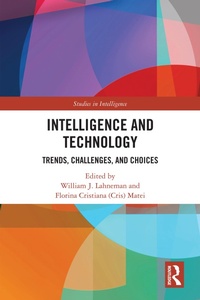
Intelligence and Technology
Trends, Challenges, and Choices
Published on 20. March 2026
280 pages
978-1-040-66521-3 (ISBN)
Description

This book examines the value of innovative technologies to intelligence organizations, with a particular focus on the United States.
It addresses how intelligence organizations and their partners keep up with innovations that will make or break their ability to continue to produce effective intelligence. The work uses a four-dimensional definition of technology as artifact, knowledge base, administrative support structure, and coordinating system, which enables analysis of the full range of technical, human, organizational, social, and governmental factors upon which successful technological innovation depends. This approach produced in-depth analyses by 14 subject-matter experts of topics ranging from artificial intelligence, unmanned aerial systems, and cyber intelligence to democratic governance issues, outsourcing needs, and workforce dynamics as large numbers of 'Generation Z' workers enter the IC workforce. These analyses both explore specific aspects of and highlight interconnections among important cutting-edge technologies that intelligence agencies must adopt to remain effective.
This will be of much interest to students of intelligence studies, national security, science and technology studies, and International Relations, as well as practitioners.
It addresses how intelligence organizations and their partners keep up with innovations that will make or break their ability to continue to produce effective intelligence. The work uses a four-dimensional definition of technology as artifact, knowledge base, administrative support structure, and coordinating system, which enables analysis of the full range of technical, human, organizational, social, and governmental factors upon which successful technological innovation depends. This approach produced in-depth analyses by 14 subject-matter experts of topics ranging from artificial intelligence, unmanned aerial systems, and cyber intelligence to democratic governance issues, outsourcing needs, and workforce dynamics as large numbers of 'Generation Z' workers enter the IC workforce. These analyses both explore specific aspects of and highlight interconnections among important cutting-edge technologies that intelligence agencies must adopt to remain effective.
This will be of much interest to students of intelligence studies, national security, science and technology studies, and International Relations, as well as practitioners.
More details
Series
Language
English
Place of publication
London
United Kingdom
Publishing group
Taylor & Francis Ltd
Target group
College/higher education
Professional and scholarly
Product notice
Reflowable
Illustrations
4 Tables, black and white; 4 Line drawings, black and white; 4 Illustrations, black and white
File size
1,11 MB
ISBN-13
978-1-040-66521-3 (9781040665213)
Copyright in bibliographic data and cover images is held by Nielsen Book Services Limited or by the publishers or by their respective licensors: all rights reserved.
Schweitzer Classification
Other editions
Additional editions
William J. Lahneman | Florina Cristiana Matei
Intelligence and Technology
Trends, Challenges, and Choices
Book
approx. 03/2026
1st Edition
Routledge
€212.60
Not yet published
Persons
William J. Lahneman is Professor Emeritus in the Security Studies and International Affairs Department of Embry-Riddle Aeronautical University, Daytona Beach, Florida, USA. He is the author, editor, or co-editor of seven books, including Keeping U.S. Intelligence Effective: The Need for a Revolution in Intelligence Affairs (2011). Lahneman is a 2018 Fulbright Scholar (Madrid, Spain) and a former Commander in the US Navy.
Florina Cristiana (Cris) Matei is a Senior Lecturer at the Naval Postgraduate School, Monterey, California, USA. She is co-editor of The Routledge Handbook of Civil-Military Relations (2012); of The Conduct of Intelligence in Democracies: Processes, Practices, Cultures (2019); of The Routledge Handbook of Civil-Military Relations, 2nd Edn (2021); and The Handbook of Latin American and Caribbean Intelligence Cultures (2022).
Florina Cristiana (Cris) Matei is a Senior Lecturer at the Naval Postgraduate School, Monterey, California, USA. She is co-editor of The Routledge Handbook of Civil-Military Relations (2012); of The Conduct of Intelligence in Democracies: Processes, Practices, Cultures (2019); of The Routledge Handbook of Civil-Military Relations, 2nd Edn (2021); and The Handbook of Latin American and Caribbean Intelligence Cultures (2022).
Content
Chapter 1. Intelligence, Technology, and Innovation Chapter 2. Technologized Intelligence-Democracy Quandary: The New Leviathan? Chapter 3. The Privatization of U.S. Intelligence Chapter 4. Tailoring Intelligence Education for Generation Z Chapter 5. From Data to Decisions: Proposing a Data Maturity Model for Intelligence Organizations Chapter 6. Intelligence at the Crossroads: Understanding, Detecting, and Countering Hybrid Threats Chapter 7. Cyber Intelligence in the Domain of Network Conflict Chapter 8. Artificial Intelligence, Ubiquitous Sensors, and Human-Machine Integration: How AI Will Transform the Intelligence Cycle Chapter 9. Unmanned Aerial Systems, Unmanned Aerial Combat Systems, and Swarm Surveillance Chapter 10. Technological Challenges to US Counterintelligence Effectiveness Chapter 11. Conclusion
