

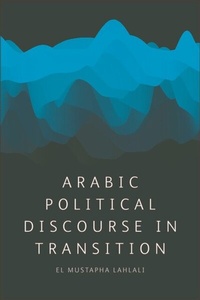
Arabic Political Discourse in Transition
1st Edition
Published on 31. October 2021
304 pages
978-0-7486-8273-7 (ISBN)
Description

10 years since the eruption of the Arab Spring, El Mustapha Lahlali explores the dialectical relationship between discourse and social change during and post the conflict. In particular, he examines how Arabic public and political discourse shapes and is
More details
Other editions
Additional editions
El Mustapha Lahlali
Arabic Political Discourse in Transition
Book
10/2021
Edinburgh University Press
€120.50
Shipment within 15-20 days
Content
- Cover
- Half-Title
- Title Page
- Copyright
- Contents
- Figures
- Guide to the Arabic Transliteration System
- Acknowledgements
- Introduction
- 1 Discourse and Social Change: A Theoretical Framework
- What is Discourse?
- Approaches to Discourse
- Conclusion
- 2 Discourse, Framing and Representational Strategies
- Representational Strategies in Discourse
- Discourse Representation
- Discourse of Revolutions
- Arab Spring: Transnational Arab Media versus Social Media
- Social Media and the Arab Spring
- Conclusion
- 3 Framing, Representation and Conflict in Arabic Discourse
- Theoretical Background
- Arab Public Discourse: Positive-Self and Negative-Other
- Positive Self and Negative Other in Arabic Political Discourse
- Discussion
- Conclusion
- 4 Doing Arabic Discourse: Micro-Analysis of Arabic Political Discourse
- Micro-Analysis of Arabic Political Discourse
- Conclusion
- 5 Macro-Analysis of Arabic Political Discourse: The Discourse of Enforcement and Persuasion
- Argumentation and Persuasion: Who is to Blame for the Uprising?
- Cognition in Arabic Political Discourse
- Conclusion
- 6 Arabic Political Discourse and Politeness Strategies
- Politeness and Arabic Discourse
- Politeness in Multilingual Slogans
- Politeness in Leaders' Speeches
- Politeness and the Tribe
- Antonyms and Politeness in Leaders' Speeches
- Conclusion
- 7 Arabic Islamic Political Discourse
- The Arab Spring and Islamic Parties
- The Arab Spring: Al-Nahda Discursive Practices
- ?izb al-?urriyya wa al-'Adala, Freedom and Justice Party (FJP), Egypt
- A New Approach to Studying Shifts in the Discourse of Islamic Parties
- Conclusion
- Conclusion and Findings
- References
- Additional References
- Index
