

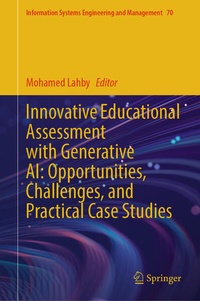
Innovative Educational Assessment with Generative AI: Opportunities, Challenges, and Practical Case Studies
Description

This book explores the transformative role of Generative Artificial Intelligence (GenAI) in reshaping educational assessment in higher education. Through theoretical insights, practical applications, and ethical reflections, the book examines how emerging GenAI tools such as ChatGPT, DeepSeek, Gemini, and LLaMA are revolutionizing assessment practices. It focuses on the use of personalized, adaptive assessment strategies, automated feedback, and data-driven evaluation methods that are redefining how students learn and are evaluated across global contexts.
The book is structured into three parts. The first part offers a foundational overview of GenAI in assessment, addressing its ethical, sociological, and security implications. The second part highlights how GenAI supports personalized learning, showcasing innovative tools like adaptive feedback systems and AI-powered tutoring environments. The final part presents case studies and practical applications from various countries all focused on assessments and Generative AI. These chapters collectively serve as a valuable resource for educators, researchers, and policymakers aiming to harness the power of Generative AI to improve educational assessment in a responsible and effective way.
More details
Other editions
Additional editions
Person
Content
Generative AI in Adult Learning and Assessment: Navigating Ethics, Justice, and Regional Disparities in Southeast Asia.- The Cultural Politics of 'Objectivity': A Sociological Critique of GenAI-Based Feedback Mechanisms in Educational Assessment.- Generative AI and Educational Assessment: A Bibliometric Mapping of Current Trends,Challenges, and Future Directions in the Era of Personalization.- Privacy and Data Security in Generative AI Assessments.- The Impact of Personalized Assessment Strategies on Student Outcomes: A Comprehensive Literature Review.- AI-Driven Personalized Learning and Adaptive Assessment: Transforming Higher Education Pedagogy.- Formative Assessment using a Personalized Bot Developed and Equipped with Educator-Specific Data: System and Assessment Feedback Quality.- Personalized Learning in Higher Education: The Impact of Generative AI on Deep Learning Project Performance.- Artificial Intelligence Supporting Formative Assessment A Case Study in the Tunisian University Context.- Exploring Vietnamese Students' Perceptions of Wordtune as an AI-based Writing Assistant.- Perceptions toward Generative AI among Filipino Pre- and In-services teachers: Implications for AI use in Edu-cational Assessment.- From Chalkboards to Chatbots: The Role of Generative AI in Philippine Teacher Education Assessment.- Enhancing Code Assessment and Feedback Generation with GenAI Agents.- What are the theological and pedagogical impacts of the integration of Artificial Intelligence (AI) in Catholic Religious Education (RE)?.
