

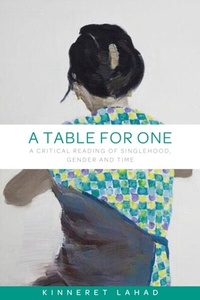
A Table for One
A Critical Reading of Singlehood, Gender and Time
1st Edition
Published on 11. August 2017
168 pages
978-1-5261-1635-2 (ISBN)
Description

Table for one: A critical reading of singlehood, gender and time is the first book to consider the profound relationship between singlehood and time. Drawing on a wide range of cultural resources - including web columns, blogs, advice columns, popular cliches, advertisements and references from television and cinema, the author challenges the conventional meaning-making processes of singlehood and time. Lahad's analysis gives us the opportunity to explore and theorize singlehood through varied temporal concepts such as waiting, wasting, timeout, age, the life course, linearity and commodification of time. This unique analytical approach enables the fresh consideration of some of our dominant perceptions about collective clocks, schedules, time tables and the temporal organization of social life in general.
An electronic edition of this book is freely available under a Creative Commons (CC BY-NC-ND) licence. -- .
An electronic edition of this book is freely available under a Creative Commons (CC BY-NC-ND) licence. -- .
Reviews / Votes
Kinneret Lahad has provided a fascinating discussion on gender, singlehood, and social time. Challenged by temporal metaphors such as "biological clock" or "missing the train", single , urban, upper and middle class women have been portrayed as outliers of heteronormative social norms, where being married is equalled to being "normal." Using discourses from popular culture, everyday talk, and new media technologies in the Israeli context, Lahad dissects and challenges the long standing linear life course studies in sociology with a fresh, interesting and innovative perspective on the feminist reading of singlehood. It is a ground-breaking work on the sociology of gender and the sociology of time.Goekce Yurdakul, Humboldt University, co-author of The Headscarf Debates: Conflicts of National Belonging
From the outset, the reader is drawn into a highly readable and theoretically engaging study of "long-term" single women. Drawing upon a wide range of sources, the author provides a detailed examination of a triple discrimination, in terms of age, gender and single status. Focussing upon but not confined to modern Israel, the study takes us through the numerous sites and temporal contexts where these discriminations occur. However, this is not just a study of a particular gendered status but it is also a major contribution to the understanding of everyday time; waiting time, time passing, commodified time. In her final chapter the author opens up possibilities of alternative definitions and practices of singlehood.
David Morgan, University of Manchester
A welcome contribution to the sociology of time, highlighting the implicit norms and expectations underlying such notions as being "on time" or "late" at the level of the life-course. Furthermore, the book provides a foundation for a sociology of singlehood, treating it as a major phenomenon in its own right rather than just as a transitional stage in anticipation of marriage, recognizing that "remaining" single is often a permanent rather than merely temporary state of being. The asymmetry between women's lack of need to account for their decision to get married and need to justify why they have thus far not done so is the book's most evocative finding.
Eviatar Zerubavel, Board of Governors and Distinguished Professor of Sociology at Rutgers University -- .
More details
Product info
Web PDF
Language
English
Place of publication
Manchester
United Kingdom
Target group
College/higher education
Edition type
Digital original
ISBN-13
978-1-5261-1635-2 (9781526116352)
Copyright in bibliographic data and cover images is held by Nielsen Book Services Limited or by the publishers or by their respective licensors: all rights reserved.
Schweitzer Classification
Other editions
Additional editions
Book
09/2019
Manchester University Press
€32.90
Shipment within 15-20 days
Person
Kinneret Lahad is Senior Lecturer in the NCJW Women and Gender Studies Program of Tel-Aviv University, Israel -- .
Content
1 Introduction
2 The linear life-course imperative
3 Singlehood as an unscheduled status passage
4 Facing the horror: becoming an "old maid"
5 On commodification: from wasted time to damaged goods
6 Taking a break
7 Waiting and queuing
8 Time work: keeping up appearances
9 Discussion: another time
Index -- .
2 The linear life-course imperative
3 Singlehood as an unscheduled status passage
4 Facing the horror: becoming an "old maid"
5 On commodification: from wasted time to damaged goods
6 Taking a break
7 Waiting and queuing
8 Time work: keeping up appearances
9 Discussion: another time
Index -- .
