

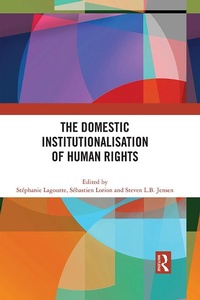
The Domestic Institutionalisation of Human Rights
1st Edition
Published on 19. August 2021
148 pages
978-1-000-43477-4 (ISBN)
Description

This book explores recent developments pointing towards a 'domestic institutionalisation of human rights', composed of converging international trends prescribing the setting up of domestic institutions, and the need for a national human rights systems approach. Building on new compliance theories, innovative arrangements have resolutely appeared around the turn of the millennium and some are now legally enshrined in human rights treaties.
In their introduction, the editors capture these developments, their main elements and key points of debate. They outline a research agenda aimed at structuring and generating further attention from both academics and practitioners. As a stepping stone, the book singles out the purposeful attempt by the United Nations and others to frame these trends around the concept of 'National Human Rights System'. The chapters assess various models and cases put forward for such systems. Each chapter highlights the specific forms of institutions being promoted and their intended domestic interactions, and discusses how these institutions are leveraged and strengthened by international bodies. Authors critically review their implications for the future of human rights, paving the way for additional research.
The chapters in this book were originally published as a special issue of the Nordic Journal of Human Rights.
In their introduction, the editors capture these developments, their main elements and key points of debate. They outline a research agenda aimed at structuring and generating further attention from both academics and practitioners. As a stepping stone, the book singles out the purposeful attempt by the United Nations and others to frame these trends around the concept of 'National Human Rights System'. The chapters assess various models and cases put forward for such systems. Each chapter highlights the specific forms of institutions being promoted and their intended domestic interactions, and discusses how these institutions are leveraged and strengthened by international bodies. Authors critically review their implications for the future of human rights, paving the way for additional research.
The chapters in this book were originally published as a special issue of the Nordic Journal of Human Rights.
More details
Edition
1. Auflage
Language
English
Place of publication
London
United Kingdom
Publishing group
Taylor & Francis Ltd
Target group
College/higher education
Product notice
Reflowable
ISBN-13
978-1-000-43477-4 (9781000434774)
Copyright in bibliographic data and cover images is held by Nielsen Book Services Limited or by the publishers or by their respective licensors: all rights reserved.
Schweitzer Classification
Other editions
Additional editions
Stephanie Lagoutte | Sebastien Lorion | Steven L. B. Jensen
The Domestic Institutionalisation of Human Rights
Book
09/2023
1st Edition
Routledge
€75.70
Shipment within 10-20 days
Stephanie Lagoutte | Sebastien Lorion | Steven L. B. Jensen
The Domestic Institutionalisation of Human Rights
Book
08/2021
1st Edition
Routledge
€205.70
Shipment within 10-20 days
Persons
Stephanie Lagoutte is Senior Researcher at the Danish Institute for Human Rights, Copenhagen, Denmark. She holds a doctoral degree in Law from the University of Paris 1 Pantheon-Sorbonne and a PhD in Law from the Aarhus University, Denmark. Most of her work focuses on the duties and role of the state in human rights protection.
Sebastien Lorion is Senior Adviser at the Danish Institute for Human Rights, Copenhagen, Denmark. He holds a PhD degree from the University of Copenhagen and undertakes legal and social sciences research focusing on governmental human rights focal points, national human rights action plans and national human rights institutions.
Steven L.B. Jensen is Senior Researcher at the Danish Institute for Human Rights, Copenhagen, Denmark. He holds a PhD degree from the University of Copenhagen. His areas of work have mainly focused on the historical evolution of human rights, health and human rights as well as national human rights institutions.
Sebastien Lorion is Senior Adviser at the Danish Institute for Human Rights, Copenhagen, Denmark. He holds a PhD degree from the University of Copenhagen and undertakes legal and social sciences research focusing on governmental human rights focal points, national human rights action plans and national human rights institutions.
Steven L.B. Jensen is Senior Researcher at the Danish Institute for Human Rights, Copenhagen, Denmark. He holds a PhD degree from the University of Copenhagen. His areas of work have mainly focused on the historical evolution of human rights, health and human rights as well as national human rights institutions.
Content
The Domestic Institutionalisation of Human Rights: An Introduction
Steven L. B. Jensen, Stephanie Lagoutte and Sebastien Lorion
1. The Role of State Actors Within the National Human Rights System
Stephanie Lagoutte
2. Parliaments as Human Rights Actors: The Potential for International Principles on Parliamentary Human Rights Committees
Kirsten Roberts Lyer
3. Business and Human Rights: From Domestic Institutionalisation to Transnational Governance and Back Again
Claire Methven O'Brien and Jolyon Ford
4. A Model for National Human Rights Systems? New Governance and the Convention on the Rights of Persons with Disabilities
Sebastien Lorion
5. NHRI Engagement with UN Human Rights Treaty Bodies: A Goal-based Approach
Domenico Zipoli
6. Establishing an NHRI in a Contested Political Space: A Deliberative Process in Israel
Tomer Broude and Natan Milikowsky
Steven L. B. Jensen, Stephanie Lagoutte and Sebastien Lorion
1. The Role of State Actors Within the National Human Rights System
Stephanie Lagoutte
2. Parliaments as Human Rights Actors: The Potential for International Principles on Parliamentary Human Rights Committees
Kirsten Roberts Lyer
3. Business and Human Rights: From Domestic Institutionalisation to Transnational Governance and Back Again
Claire Methven O'Brien and Jolyon Ford
4. A Model for National Human Rights Systems? New Governance and the Convention on the Rights of Persons with Disabilities
Sebastien Lorion
5. NHRI Engagement with UN Human Rights Treaty Bodies: A Goal-based Approach
Domenico Zipoli
6. Establishing an NHRI in a Contested Political Space: A Deliberative Process in Israel
Tomer Broude and Natan Milikowsky
