

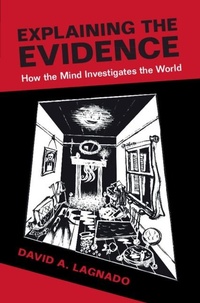
Explaining the Evidence
How the Mind Investigates the World
Published on 20. October 2021
978-1-009-06426-2 (ISBN)
Description

How do we make sense of complex evidence? What are the cognitive principles that allow detectives to solve crimes, and lay people to puzzle out everyday problems? To address these questions, David Lagnado presents a novel perspective on human reasoning. At heart, we are causal thinkers driven to explain the myriad ways in which people behave and interact. We build mental models of the world, enabling us to infer patterns of cause and effect, linking words to deeds, actions to effects, and crimes to evidence. But building models is not enough; we need to evaluate these models against evidence, and we often struggle with this task. We have a knack for explaining, but less skill at evaluating. Fortunately, we can improve our reasoning by reflecting on inferential practices and using formal tools. This book presents a system of rational inference that helps us evaluate our models and make sounder judgments.
Reviews / Votes
'This book is fun to read and easy to understand. It teaches us how we evaluate evidence and how we can evaluate it better. Ordinary people, without scientific training, on a jury or a city council or considering a big move to a new job can deploy these causal modelling techniques to manage evidence effectively.' Nancy Cartwright, Professor of Philosophy, Durham University, UK 'This is a remarkable achievement. Explaining the Evidence provides a wonderfully clear, entertaining and erudite introduction to one of humanity's most important, yet unreliable, abilities: building explanations of the world, and the people, around us.' Nick Chater, Professor of Behavioural Science, University of Warwick, UK 'Entertainingly illustrated with examples of legal cases, Lagnado's impressive book brings together insights from experimental psychology with modern tools for formal causal reasoning. We use causal stories to try to make sense of evidence, but these can all too easily mislead; this book should help us to overcome these cognitive biases.' A. P. Dawid, Emeritus Professor of Statistics, University of Cambridge, UK 'Using causal models and psychology, this work presents a systematic approach to modelling and evaluating evidence. The real criminal cases make for fascinating reading and help to ground the material. This book should be of interest to those in psychology, law and law enforcement, or those wanting to better understand and apply reasoning about evidence.' Joseph Y. Halpern, Professor of Computer Science, Cornell University, USA 'In this fascinating book, one of the world's leading experts in causal cognition uses criminal cases and their legal context to show how people seek explanations of the evidence by building causal mental models of the world. So clearly articulated in this book, these ideas are at the forefront of current thinking in this area. It will be of inestimable value to undergraduate and postgraduate students and researchers alike. I also would highly recommend it to psychologists, legal scholars and computer scientists.' Mike Oaksford, Professor of Psychology and Head of the Department of Psychological Sciences, Birkbeck College, UK 'This book provides a flowing, compelling and lucid account of how computational models of mental states are changing the face of cognitive psychology and decision-making sciences. It is a must for students of mind, cognition, behavioural sciences and law, especially data scientists who labour to emulate human behaviour on digital machines.' Judea Pearl, Professor of Computer Science, UCLA, USA 'How people respond to evidence (and how they don't) is one of the burning questions of our time. Yet one hardly expects a book on the psychology of evidence to be a page-turner. But that's exactly what Dave Lagnado has produced in this authoritative text on the cognition of crime, investigation and verdict.' Steven A. Sloman, Professor of Cognitive, Linguistic and Psychological Sciences, Brown University, USA 'Explaining the Evidence is especially compelling reading for anyone involved in law. Through crime investigations, it explores our human capacity for reasoning and exposes the challenges in evaluating evidence that confront decision-makers in criminal cases. Most excitingly, it provides new tools that could ensure sounder judgments and prevent miscarriages of justice.' Cheryl Thomas, Professor of Judicial Studies and Director of the Jury Project and Judicial Institute, UCL, UK 'This very readable book will help to make evidence, as a subject, an important focus of cross-disciplinary attention.' William Twining, Emeritus Quain Professor of Jurisprudence, UCL, UK 'This book is a terrific read. It is engaging on every level. Using examples of reasoning about crimes, Lagnado skilfully applies theories from empirical psychology. The result is a highly readable introduction to statistical reasoning, Bayes nets representations of causal relationships, heuristically useful reasoning strategies and much more. I strongly recommend it.' James F. Woodward, Distinguished Professor of History and Philosophy of Science, University of Pittsburgh, USAMore details
Language
English
Place of publication
Cambridge
United Kingdom
Target group
College/higher education
Professional and scholarly
Illustrations
Worked examples or Exercises
File size
7,49 MB
ISBN-13
978-1-009-06426-2 (9781009064262)
Copyright in bibliographic data and cover images is held by Nielsen Book Services Limited or by the publishers or by their respective licensors: all rights reserved.
Schweitzer Classification
Other editions
Additional editions
Book
10/2021
Cambridge University Press
€49.40
Shipment within 15-20 days
Book
10/2021
Cambridge University Press
€136.40
Shipment within 15-20 days
Person
David Lagnado is Professor of Cognitive and Decision Sciences in the Department of Experimental Psychology, UCL. He has written over 100 articles and co-authored a textbook on the psychology of decision making. He has worked with US intelligence, the UK government and various legal and financial institutions, looking at methods to improve reasoning and decision making.
Content
1. The Cliff Death; 2. Models in Mind; 3. Causal Modelling; 4. Thinking Beyond Biases; 5. Expert Reasoning in Crime Investigation; 6. Questions of Evidence; 7. Competing Causes; 8. Confirmation Bias: Good, Bad and Ugly; 9. Telling Stories; 10. Idioms for Legal Reasoning; 11. Causal Reasoning in a Time of Crisis; References.
