

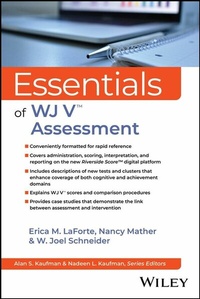
Essentials of WJ V Assessment
Description

A comprehensive guide to the administration, scoring, and interpretation of the Woodcock-Johnson V assessment battery
In Essentials of WJ V Assessment, a team of veteran psychological practitioners with expertise in formal assessment delivers a comprehensive resource for practitioners tasked with administering the Woodcock-Johnson V assessment battery. The book explains how to administer, score, and interpret all three parts of the WJ V: the WJ V Tests of Cognitive Abilities, the WJ V Tests of Achievement, and the WJ V Tests of Oral Language Abilities.
The book is an authoritative and current guide to using the Woodcock-Johnson V assessment tests. Practitioners will explore the newly introduced digital platform and tools and find expert instruction for understanding and administering newly added test components.
Inside the book:
- Practice quizzes to help readers ensure they've understood the material contained within
- Case examples that illustrate the concepts discussed in the book and how they're applied in real-world scenarios
- Straightforward explanations of all possible test scores and the interpretive features that assessors rely on to understand them
Perfect for school psychologists, clinical psychologists, and neuropsychologist, Essentials of WJ V Assessment is a must-have resource for all students and professionals interested in the proper administration of the Woodcock-Johnson V.
More details
Other editions
Additional editions
Persons
ERICA M. LaFORTE is a psychometrician with more than 25 years in the field of educational test development. She is Head of Test Development at Marker Learning, and is a co-author of the Woodcock-Johnson V.
NANCY MATHER is a Professor Emerita at the University of Arizona in Tucson. She is the co-author of Essentials of Dyslexia: Assessment and Intervention, Second Edition. She is also a co-author of the Woodcock-Johnson V.
W. JOEL SCHNEIDER is a Professor at Temple University in both the School of Psychology and Counseling Psychology Programs. He is a co-author of Essentials of Assessment Report Writing, Second Edition, and Psychological Testing and Assessment.
Content
Series Preface vi
Acknowledgments viii
One WJ V Overview 1
Two Theoretical Basis of the Woodcock- Johnson V 27
Three General Administration Procedures 61
Four WJ V Cognitive Test Administration 101
Five WJ V Achievement Test Administration 132
Six WJ V Virtual Test Library Test Administration 176
Seven Understanding and Interpreting WJ V Scores 199
Eight Clinical Applications for SLD 257
Nine Illustrative Case Reports 297
Appendix Frequently Asked Questions 372
Index 383
One
WJ V OVERVIEW
Although many standardized instruments exist for measuring cognitive and academic performance, the Woodcock-Johnson® (WJ) has been one of the most widely used tests since its original publication in 1977. The latest revision, the Woodcock-Johnson® V (WJ VT; McGrew et al., 2025b), provides examiners with an even more comprehensive instrument. The WJ V contains 60 individually administered tests that are designed to measure general intellectual ability, specific cognitive abilities, oral language, and achievement. Depending upon the purpose of the assessment, the WJ V may be used independently or in conjunction with other assessment instruments.
Essentials of WJ VT Assessment is an easy-to-use guide and reference for professionals and practitioners who wish to learn the key features of this instrument. This guide is appropriate for a wide array of professionals, whether their goal is to learn how to administer the test or simply to increase familiarity with the instrument. The topics covered in this guide include administration, scoring, interpretation, and application of the WJ V. All chapters include "Rapid Reference," "Caution," and "Don't Forget" boxes that highlight or summarize important points. At the end of each chapter, a "Test Yourself" section is provided to help review and reinforce the key information presented. These features make this guide an ideal resource for both in-service and graduate training in WJ V administration and interpretation. Examiners may wish to read the book from cover to cover or turn to individual chapters to find specific information. Rapid Reference 1.1 provides basic information about the WJ V and the publisher.
Rapid Reference 1.1
Basic Information About the WJ V
- Test name: Woodcock-Johnson V
- Authors: Kevin S. McGrew, Nancy Mather, Erica M. LaForte, and Barbara J. Wendling
- Publication date: 2025
- Age normative range: 4 to 90+
- Grade normative range: K.0 through 12.9
- Publisher: Riverside Insights (www.?riversideinsights.?com)
- Website: Riverside Score® (www.?riversidescore.?com)
- Price: Contact the publisher for subscription pricing
WJ V HISTORY AND DEVELOPMENT
The original Woodcock-Johnson was published as the Woodcock-Johnson Psycho-Educational Battery (WJ; Woodcock & Johnson, 1977). The WJ provided the first comprehensive, co-normed battery of cognitive abilities, achievement, and interests. The tests in the 1977 WJ measured a continuum of human abilities across a wide age range and provided common norms for interpretation.
The Woodcock-Johnson-Revised (WJ-R®; Woodcock & Johnson, 1989) was designed to expand the diagnostic capabilities of the WJ. The tests were divided into two main batteries, the WJ-R Tests of Cognitive Ability (WJ-R COG) and the WJ-R Tests of Achievement (WJ-R ACH), with each containing a Standard Battery and the Supplemental Battery that were housed in separate easel test books.
Like its predecessor, the Woodcock-Johnson III (Woodcock et al., 2001) had two primary batteries: the WJ III Tests of Cognitive Abilities (WJ III® COG) and the WJ III Tests of Achievement (WJ III ACH). The WJ III Diagnostic Supplement (WJ III DS; Woodcock et al., 2003) provided 11 additional cognitive tests that further expanded the range of interpretive options. Together, these batteries comprised a comprehensive system for measuring general intellectual ability (g), specific cognitive abilities, oral language, and achievement across a wide age range.
The next edition, the Woodcock-Johnson IV (Schrank et al., 2014a), comprised three batteries: the WJ IV Tests of Cognitive Abilities (WJ IV COG; Schrank et al., 2014b), the WJ IV Tests of Achievement (WJ IV ACH; Schrank et al., 2015a), and the WJ IV Tests of Oral Language (WJ IV OL; Schrank et al., 2015b). Together, these three batteries provided a comprehensive set of individually administered, norm-referenced tests for measuring general intellectual abilities, academic achievement, and oral language. As with prior versions, the normative data for the three batteries were based on the same individuals who were administered the cognitive, oral language, and achievement tests. This comprehensive assessment system facilitated exploring and identifying individual strengths and weaknesses across cognitive, oral language, and academic abilities.
The WJ V is an update and revision of the WJ IV and is administered almost exclusively in digital format. The WJ V contains two batteries: the WJ V Tests of Cognitive Abilities (WJ V COG; McGrew et al., 2025a) and the WJ V Tests of Achievement (WJ V ACH; Mather et al., 2025a). Several additional tests are contained in the WJ V Virtual Test Library (WJ V VTL; Mather et al., 2025b). The VTL tests, when administered alone or in conjunction with tests from the WJ V COG and WJ V ACH, provide additional information about an individual's cognitive abilities, oral language, and achievement. The WJ V includes an Examiner's Manual (Mather et al., 2025c) and a Technical Manual (LaForte et al., 2025) that are both available in PDF format on the Riverside Score® digital platform.
As with all prior editions of the Woodcock-Johnson, one of the most important features of the WJ V is that the normative data for all 60 tests are based on the same sample of individuals. This conorming provides greater accuracy and validity when making comparisons among and between an individual's cognitive, achievement, and oral language scores and provides options for data-based score comparison procedures.
CHANGES FROM THE WJ V
Examiners who are familiar with the WJ IV will find it easy to learn the overall structure and organization of the WJ V. Like prior editions, the WJ V is designed to facilitate selective testing by combining tests from the COG, ACH, and VTL to address specific referral questions or test specific hypotheses about an examinee's abilities and achievement. The WJ V maintains the traditional high standards for technical quality and psychometric rigor. All tests were re-normed to reflect the 2020 census for population demographics, based on a sample of 5,837 children and adults from across the United States.
Perhaps the biggest change for WJ IV users is the complete digital transformation of the battery in the WJ V. The WJ V is administered via the Riverside Score® digital platform by an examiner working on a laptop computer. The examinee sees visual stimuli on an iPad and, if applicable, hears auditory stimuli from the iPad speaker. For many of the test items, the examinee taps responses on the iPad screen. During testing, all data are captured in real time by the platform, eliminating the risk of data loss in case the Wi-Fi connection is interrupted. Many examiner testing tasks, including score calculations, starting item selections, continuation decisions, and basal and ceiling rules, are automated by Riverside Score®, decreasing overall testing time and examiner errors while increasing efficiency and examinee engagement. Chapter 3 provides more information about the Riverside Score® platform.
Several new tests have been added to the WJ V COG to reflect the current theoretical broad ability structure under Cattell-Horn-Carroll (CHC) theories. The auditory processing (Ga) tests were moved from the COG battery to the WJ V VTL. The composition of the General Intellectual Ability (GIA) cluster changed significantly from the WJ IV to WJ V. It is now comprised of eight tests instead of seven, no longer includes a measure of auditory processing (Ga), and contains more robust measures of comprehension-knowledge (Gc) and fluid reasoning (Gf) by including the new Matrices (Gf) and Verbal Analogies (Gc, Gf) tests. The new COG Visual Working Memory (Gwm, Gv) and Symbol Inhibition (Gs) tests tap into working memory and inhibitory control, two aspects of executive functioning.
The WJ V ACH battery has also undergone significant content updates. Two new tests, Paragraph Reading Comprehension and Story Comprehension, provide more ecologically valid measures of reading comprehension and oral comprehension, respectively, than the cloze-procedure tests (such as Passage Comprehension and Oral Comprehension) alone. Oral Language Samples, a new test of oral expression, provides an oral language parallel to the tasks in the WJ V Written Language Samples test (formerly Writing Samples), allowing an examiner to directly compare an examinee's written and oral ideational skills. A new writing test, Sentence Writing Accuracy, assesses mechanics such as spelling, punctuation, and capitalization to better represent the types of writing tasks a student encounters in the classroom. A new test of math problem solving, Math Problem Identification, mimics real-world applications of math concepts that require an individual to assess whether sufficient information exists to solve a problem. Two other new ACH tests, Number Sense and Magnitude Comparison, measure skills that are important for early math learning. Together with...
