

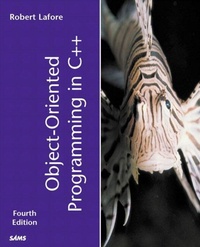
Object-Oriented Programming in C++
Description

Object-Oriented Programming in C++ begins with the basic principles of the C++ programming language and systematically introduces increasingly advanced topics while illustrating the OOP methodology. While the structure of this book is similar to that of the previous edition, each chapter reflects the latest ANSI C++ standard and the examples have been thoroughly revised to reflect current practices and standards.
More details
Other editions
Additional editions
Person
Robert Lafore has been writing books about computer programming since 1982. His best- selling titles include Assembly Language Programming for the IBM PC, C Programming Using Turbo C++, C++ Interactive Course, and Data Structures and Algorithms in Java. Mr. Lafore holds degrees in mathematics and electrical engineering, and has been active in programming since the days of the PDP-5, when 4K of main memory was considered luxurious. His interests include hiking, windsurfing, and recreational mathematics.
Content
Introduction.
A Note to Teachers.
1. The Big Picture.
2. C++ Programming Basics.
3. Loops and Decisions.
4. Structures.
5. Functions.
6. Objects and Classes.
7. Arrays and Strings.
8. Operator Overloading.
9. Inheritance.
10. Pointers.
11. Virtual Functions and Other Subtleties.
12. Streams and Files.
13. Multifile Programs.
14. Templates and Exceptions.
15. The Standard Template Library.
16. Object-Oriented Software Development.
Appendix A: ASCII Table.
Appendix B: Standard C++ Keywords.
Appendix C: Microsoft Visual C++.
Appendix D: Borland C++ Builder.
Appendix E: Console Graphics Lite.
Appendix F: STL Algorithms and Member Functions.
Appendix G: Answers to Questions and Exercises
