

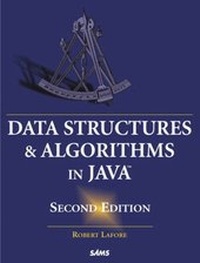
Data Structures and Algorithms in Java
Description

Data Structures and Algorithms in Java, Second Edition is designed to be easy to read and understand although the topic itself is complicated. Algorithms are the procedures that software programs use to manipulate data structures. Besides clear and simple example programs, the author includes a workshop as a small demonstration program executable on a Web browser. The programs demonstrate in graphical form what data structures look like and how they operate. In the second edition, the program is rewritten to improve operation and clarify the algorithms, the example programs are revised to work with the latest version of the Java JDK, and questions and exercises will be added at the end of each chapter making the book even more useful.
Educational Supplement
Suggested solutions to the programming projects found at the end of each chapter are made available to instructors at recognized educational institutions. This educational supplement can be found at www.prenhall.com, in the Instructor Resource Center.
All prices
More details
Other editions
Additional editions
Person
Robert Lafore has degrees in Electrical Engineering and Mathematics, has worked as a systems analyst for the Lawrence Berkeley Laboratory, founded his own software company, and is a best-selling writer in the field of computer programming. Some of his current titles are C++ Interactive Course and Object-Oriented Programming in C++. Earlier best-selling titles include Assembly Language Primer for the IBM PC and XT and (back at the beginning of the computer revolution) Soul of CP/M.
Content
What's New in the Second Edition. What This Book Is About. What's Different About This Book. Who This Book Is For. What You Need to Know Before You Read This Book. The Software You Need to Use This Book. How This Book Is Organized. Enjoy Yourself! 1. Overview.
What Are Data Structures and Algorithms Good For? Overview of Data Structures. Overview of Algorithms. Some Definitions. Object-Oriented Programming. Software Engineering. Java for C++ Programmers. Java Library Data Structures. Summary. Questions. 2. Arrays.
The Array Workshop Applet. The Basics of Arrays in Java. Dividing a Program into Classes. Class Interfaces. The Ordered Workshop Applet. Java Code for an Ordered Array. Logarithms. Storing Objects. Big O Notation. Whay Not Use Arrays for Everything. Summary. Questions. Experiments. Programming Projects. 3. Simple Sorting.
How Would You Do It. Bubble Sort. Selection Sort. Insertion Sort. Sorting Objects. Comparing the Simple Sorts. Summary. Questions. Experiments. Programming Projects. 4. Stacks and Queues.
A Different Kind of Structure. Stacks. Queues. Priority Queues. Parsing Arithmetic Expressions. Summary. Questions. Experiments. Programming Projects. 5. Linked Lists.
Links. The LinkList Workshop Applet. A Simple Linked List. Finding and Deleting Specified Links. Double-Ended Lists. Linked-List Efficiency. Abstract Data Types. Sorted Lists. Doubly Linked Lists. Iterators. Summary. Questions. Experiments. Programming Projects. 6. Recursion.
Triangular Numbers. Factorials. Anagrams. A Recursive Binary Search. The Towers of Hanoi. Mergesort. Eliminating Recursion. Some Interesting Recursive Applications. Summary. Questions. Experiments. Programming Projects. 7. Advanced Sorting.
Shellsort. Paartitioning. Quicksort. Radix Sort. Summary. Questions. Experiments. Programming Projects. 8. Binary Trees.
Why Use Binary Trees? Tree Terminology. An Analogy. How Do Binary Search Trees Work. Finding a Node. Inserting a Node. Traversing the Tree. Finding Maximum and Minimum Values. Deleting a Node. The Efficiency of Binary Trees. Trees Represented as Arrays. Duplicate Keys. The Complete tree.java Program. The Huffman Code. Summary. Questions. Experiments. Programming Projects. 9. Red-Black Trees.
Our Approach to the Discussion. Balanced and Unbalanced Trees. Using the RBTree Workshop Applet. Experimenting with the Workshop Applet. Rotations. Inserting a New Node. Deletion. The Efficiency of Red-Black Trees. Red-Black Tree Implementation. Other Balanced Trees. Summary. Questions. Experiments. 10. 2-3-4 Trees and External Storage.
Introduction to 2-3-4 Trees. The Tree234 Workshop Applet. Java Code for a 2-3-4 Tree. 2-3-4 Trees and Red-Black Trees. Efficiency of 2-3-4 Trees. 2-3 Trees. External Storage. Summary. Questions. Experiments. Programming Projects. 11. Hash Tables.
Introduction to Hashing. Open Addressing. Separate Chaining. Hash Functions. Hashing Efficiency. Hashing and External Storage. Summary. Questions. Experiments. Programming Projects. 12. Heaps.
Introduction to Heaps. The Heap Workshop Applet. Java Code fo Heaps. A Tree-based Heap. Heapsort. Summary. Questions. Experiments. Programming Projects. 13. Graphs.
Introduction to Graphs. Searches. Minimum Spanning Trees. Topological Sorting with Directed Graphs. Connectivity in Directed Graphs. Summary. Questions. Experiments. Programming Projects. 14. Weighted Graphs.
Minimum Spanning Tree with Weighted Graphs. The Shortest-Path Problem. The All-Pairs Shortest-Path Problem. Efficiency. Intractable Problems. Summary. Questions. Experiments. Programming Projects. 15. When to Use What.
General-Purpose Data Structures. Special-Purpose Data Structures. Sorting. Graphs. External Storage. Onward. Appendix A. Running the Workshop Applets and Example Programs.
The Workshop Applets. The Example Programs. The Sun Microsystem's Software Development Kit. Multiple Class Files. Other Development Systems. Appendix B. Further Reading.
Data Structures and Algorithms. Object-Oriented Programming Languages. Object-Oriented Design (OOD) and Software Engineering. Appendix C. Answers to Questions.
Chapter 1, Overview. Chapter 2, Arrays. Chapter 3, Simple Sorting. Chapter 4, Stacks and Queues. Chapter 5, Linked Lists. Chapter 6, Recursion. Chapter 7, Advanced Sorting. Chapter 8, Binary Trees. Chapter 9, Red-Black Trees. Chapter 10, 2-3-4 Trees and External Storage. Hash Tables. Heaps. Graphs. Weighted Graphs. Index.
