

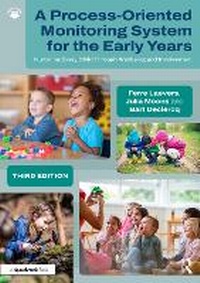
A Process-Oriented Monitoring System for the Early Years
Nurturing Every Child Through Wellbeing and Involvement
3rd Edition
Will be published approx. on 30. July 2026
114 pages
E-Book
978-1-040-82758-1 (ISBN)
Description

How is every child doing in your setting? Do all children get the necessary warmth, light, and care that they need? Do we leave some children out in the cold?
Excellent practice with children of any age and within any educational context is dependent on our environment, policies and procedures working in an effective way to help each child thrive. This fully revised new edition introduces the Process-Oriented Monitoring System (POMS), which allows practitioners to assess children's wellbeing and involvement and identify those needing more support.
Taking a strengths-based approach, the POMS provides practitioners with a reliable and inclusive compass to tailor their practice to the profile of each individual child and create optimal conditions for their development. Within the book, the authors:
Present a clear, experiential framework for evaluating children's wellbeing and involvement, with optional scales and guidelines for collecting data.
Encourage educators to use their observations of the group, as well as partnership work with parents, to build a holistic profile of the whole child.
Provide guidance on using profiles to tailor practice to each child's needs to help them fulfil their potential and enable deeper learning for all.
Integrate key areas of competence into ten developmental domains, from fine motor development to understanding of the social world.
Contain all the forms required to effectively carry out the POMS.
With a wealth of case examples, this empowering book is an invaluable resource for all early years educators working with children who want to improve each child's wellbeing and involvement both in their setting and at home.
Excellent practice with children of any age and within any educational context is dependent on our environment, policies and procedures working in an effective way to help each child thrive. This fully revised new edition introduces the Process-Oriented Monitoring System (POMS), which allows practitioners to assess children's wellbeing and involvement and identify those needing more support.
Taking a strengths-based approach, the POMS provides practitioners with a reliable and inclusive compass to tailor their practice to the profile of each individual child and create optimal conditions for their development. Within the book, the authors:
Present a clear, experiential framework for evaluating children's wellbeing and involvement, with optional scales and guidelines for collecting data.
Encourage educators to use their observations of the group, as well as partnership work with parents, to build a holistic profile of the whole child.
Provide guidance on using profiles to tailor practice to each child's needs to help them fulfil their potential and enable deeper learning for all.
Integrate key areas of competence into ten developmental domains, from fine motor development to understanding of the social world.
Contain all the forms required to effectively carry out the POMS.
With a wealth of case examples, this empowering book is an invaluable resource for all early years educators working with children who want to improve each child's wellbeing and involvement both in their setting and at home.
Reviews / Votes
"We all share the goal of creating a more powerful learning environment, and this book provides the essential tools to achieve it. POMS is an indispensable resource for early years practitioners because we are all committed to ensuring the best possible outcomes for the children in our care. It's a must-have for your professional library." - Sarah Watkins, Lecturer, Author and Early Years Specialist"This updated version of the wellbeing and involvement tool is so useful. We know that supporting children's wellbeing needs to underpin all our work, but sometimes it can be hard to measure and work out what is going on and how we can support the child. I have been eagerly waiting for this updated tool and will be using it throughout my work; it is such a valuable resource." - Sonia Mainstone-Cotton, Nurture Consultant and Author
"The POMS helps us to focus in on each child, gives us clear guidance about what to look for in our observations as well as practical advice about how to carry out these observations. Each section includes helpful case studies which bring the levels of wellbeing and involvement to life. The 10 action points are unpicked in more detail to help the reader move from merely observing children to sustainable changes in practice. The developmental domains fit comfortably with the EYFS and encourage us to think about each child developmentally as well as individual starting points. If you want to dive in to the Leuven Scales more deeply, I highly recommend this book to you." - Tamsin Grimmer, Early Years Consultant and Author
More details
Edition
3rd edition
Language
English
Place of publication
London
United Kingdom
Publishing group
Taylor & Francis Ltd
Target group
Professional and scholarly
Product notice
Reflowable
Illustrations
27 Tables, color; 7 Line drawings, color; 7 Illustrations, color
ISBN-13
978-1-040-82758-1 (9781040827581)
Copyright in bibliographic data and cover images is held by Nielsen Book Services Limited or by the publishers or by their respective licensors: all rights reserved.
Schweitzer Classification
Other editions
Additional editions
Ferre Laevers | Julia Moons | Bart Declercq
A Process-Oriented Monitoring System for the Early Years
Nurturing Every Child Through Wellbeing and Involvement
Book
approx. 07/2026
3rd Edition
Routledge
€25.00
Not yet published
Ferre Laevers | Julia Moons | Bart Declercq
A Process-Oriented Monitoring System for the Early Years
Nurturing Every Child Through Wellbeing and Involvement
Book
approx. 07/2026
3rd Edition
Routledge
€191.50
Not yet published
Persons
Ferre Laevers (Em. Prof. Dr.) is Director of the Centre for Experiential Education at the University of Leuven (Belgium) and co-founder of the European Early Childhood Education Research Association (EECERA). Most of his work is dedicated to the development and dissemination of an approach in which taking the perspective of the child is the key to create powerful learning environments - from early years up to higher education.
Julia Moons is an experienced preschool teacher and was involved in the development of an early years practice that supports the wellbeing and involvement of children. As a member of the Leuven team she made a major contribution to the dissemination of the experiential approach, both in Flanders and internationally.
Bart Declercq is a senior researcher and pedagogue who has been affiliated with CEGO, University of Leuven (Belgium), since 2002. He conducts research, training and development in the field of early childhood, both in Belgium and abroad.
Julia Moons is an experienced preschool teacher and was involved in the development of an early years practice that supports the wellbeing and involvement of children. As a member of the Leuven team she made a major contribution to the dissemination of the experiential approach, both in Flanders and internationally.
Bart Declercq is a senior researcher and pedagogue who has been affiliated with CEGO, University of Leuven (Belgium), since 2002. He conducts research, training and development in the field of early childhood, both in Belgium and abroad.
Content
Preface
1. The framework
2. Wellbeing
3. Involvement
4. From screening to interventions: Miss Julia's story
5. How to carry out a group screening: [form 1]
6. Focus on the general approach: [form 2]
7. Focus on individual children: Opening a file and follow up [form 3 and 8]
8. Individual observations: Wellbeing in relations [form 4]
9. Individual observations: Involvement in activities [form 5]
10. Individual observations: Developmental domains [form 6]
11. Compiling the child's profile: [form 7]
12. Involving parents
13. Collection of forms: [forms 1-8]
1. The framework
2. Wellbeing
3. Involvement
4. From screening to interventions: Miss Julia's story
5. How to carry out a group screening: [form 1]
6. Focus on the general approach: [form 2]
7. Focus on individual children: Opening a file and follow up [form 3 and 8]
8. Individual observations: Wellbeing in relations [form 4]
9. Individual observations: Involvement in activities [form 5]
10. Individual observations: Developmental domains [form 6]
11. Compiling the child's profile: [form 7]
12. Involving parents
13. Collection of forms: [forms 1-8]
