

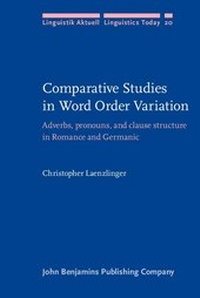
Comparative Studies in Word Order Variation
Adverbs, pronouns, and clause structure in Romance and Germanic
1st Edition
Published on 15. May 1998
X, 371 pages
978-90-272-8231-6 (ISBN)
Description

The present book is a typological study in crucial portions of the grammars of French/Romance and German/Germanic. It starts by asking: What do adverbs, pronouns and full noun phrases have in common? This question is tackled, on the one hand, from an empirical perspective by the description of relevant linguistic facts leading to significant and unexpected generalizations, and, on the other hand, from a theoretical perspective by the formalization of (i) a novel model of the Xbar-schema containing at most two Specifiers (double Spec model) and (ii) a well-defined model of Checking Theory, distinguishing A-feature checking from Abar-feature checking (Criterion). The first part of the book deals with the typology and placement of adverbs, while the second part of the book presents the application of Checking Theory, in interaction with the double Spec model of Xbar-theory, to pronouns in Romance and Germanic. The final part of the book contains a treatment of scrambling in Germanic and shows that word order variations among arguments and adverbs within the German(ic) Mittelfeld can be adequately explained in the light of the version of Checking Theory and Phrase Structure Theory developed so far for adverbs and pronouns. We are led to the conclusion that the well-known issue of word order variations can find promising solutions with the Principles & Parameters framework, on the basis of a well-defined formalization of (i) Xbar-theory, (ii) Checking Theory, (iii) clause structure composition, and (iv) locality constraints on syntactic operations and relations.
More details
Other editions
Additional editions
Christopher Laenzlinger
Comparative Studies in Word Order Variation
Adverbs, pronouns, and clause structure in Romance and Germanic
Book
05/1998
John Benjamins Publishing Co
€137.80
Shipment within 10-15 days
Person
Content
- Intro
- CONTENTS
- Foreword
- 1 Introduction
- 1.1 The empirical background
- 1.2 The theoretical background
- 1.2.1 The phrase structure component
- 1.2.2 The composition of clause structure
- 1.2.3 Checking Theory
- 1.2.4 Movement
- 1.2.5 Chains and conditions on representation
- 1.3 Organization of the book
- 2 The Syntax of Adverbs
- 2.1 Towards a typology of adverbs
- 2.2 The distribution of adverbs
- 2.2.1 Sentence adverbs
- 2.2.2 VP-adverbs
- 2.3 Towards a syntactic definition of adverbs
- 2.3.1 Adverbs as A-specifiers
- 2.3.2 Adverbs in predication
- 2.4 The semantics of adverbs
- 2.5 The syntax-semantics interface
- 2.6 The GB-based approaches
- 2.7 Adverb insertion and phrase structure
- 2.7.1 Against Adjunction
- 2.7.2 The double Spec model of X-schema
- 2.7.3 Kayne's (1994) Linear Correspondence Axiom
- 2.8 Extraposition in the right A-specifier
- 2.9 The licensing of adverb positioning
- 2.9.1 Two types of adverbial operators
- 2.9.2 The Adv-Criterion vs. Checking Theory
- 2.10 Adverb hierarchy and clause structure
- 2.11 The linear placement of adverbs
- 2.11.1 Verb movement
- 2.11.2 Extraposition
- 2.11.3 The distribution of adverbs within CP
- 2.12 Conclusion
- 3 Pronouns
- 3.1 Object pronouns
- 3.1.1 Romance object pronouns
- 3.1.2 Germanic object pronouns
- 3.2 Subject pronouns
- 3.2.1 French and Northern Italian subject pronouns
- 3.2.2 Subject pronouns in Germanic
- 4 The Structure of the German Clause
- 4.1 An overview of the German Mittelfeld
- 4.2 A survey of scrambling transformations
- 4.3 Scrambling and specificity
- 4.4 Scrambling and focus
- 4.5 Scrambling and adverb distribution
- 4.6 Speculations on V2
- 4.7 Conclusion
- 5 Conclusion
- Endnotes
- Bibliography
- Index
