

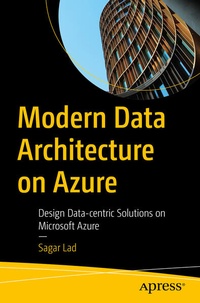
Modern Data Architecture on Azure
Description

This book is an exhaustive guide to designing and implementing data solutions on Azure. It covers the process of managing data from end to end, starting from data collection all the way through transformation, distribution, and consumption.
Modern Data Architecture on Azure begins with an introduction to the fundaments of data management, followed by a demonstration of how to build relational and non-relational data solutions on Azure. Here, you will learn data processing for complex analysis and how to work with CSV and JSON files. Moving forward, you will learn the foundational concepts of big data architecture, along with data management patterns and technology options offered by Azure. From there, you'll be walked through the data architecture process, including data consortium on Azure, enterprise data governance, and much more. The book culminates with a deep dive into data architecture frameworks with data modeling.
After reading this book, you will have a thorough understanding of data design and analytics using Azure, allowing you to collect and analyze massive amounts of data to optimize business performance, forecast future results, and more.
What Will You Learn
- Understand the fundamentals of data architecture including data management, data handling ethics, data governance, and metadata management
- Analyze and understand business needs to choose the right Azure services and make informed business decisions
- Understand Azure Cloud Data design patterns for relational and non-relational data, batch real-time processing, and ETL/ELT pipelines
- Modernize data architecture using Azure to leverage data and AI to enable digital transformation by securing and optimizing overall data lifecycle management
Who Is This Book For:
Data solution architects, data engineers, and IT consultants who want to gain a better understanding of modern data architecture design and implementation on Azure.More details
Other editions
Additional editions
Person
Sagar Lad
is an Azure Data Solution Architect working with a leading multinational software company who has deep expertise in implementing data management and analytics solutions for large enterprises using cloud and artificial intelligence. He is an experienced Azure cloud evangelist with a strong focus on driving cloud adoption for enterprise organizations using Microsoft Cloud Solutions with more than ten years of IT experience. He loves blogging and is an active blogger on Medium, LinkedIn, and the C# Corner developer community. He was awarded the C# Corner MVP in September 2021 for his contributions to the developer community.
Content
Chapter 1: Introduction: Fundamentals of Data Management.- Chapter 2: Build Relational & Non-Relational Data Solutions on Azure.- Chapter 3: Building a Big Data Architecture.- Chapter 4: Data Management Patterns & Technology Choices with Azure.- Chapter 5: Data Architecture Process.- Chapter 6: Data Architecture Framework Explained.
