

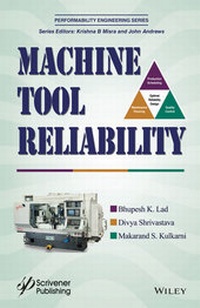
Machine Tool Reliability
Description

More details
Other editions
Additional editions
Persons
Content
Preface xi
1 Introduction 1
1.1 Basic Reliability Terms and Concepts 2
1.2 Machine Tool Failure 6
1.3 Machine Tool Reliability: Manufacturers' View Point 7
1.4 Machine Tool Reliability: Users' View Point 11
1.5 Organization of the Book 12
2 Basic Reliability Mathematics 17
2.1 Functions Describing Lifetime as a Random Variable 17
2.2 Probability Distributions Used in Reliability Engineering 21
2.2.1 Exponential Distribution 21
2.2.2 Weibull Distribution 22
2.2.3 Normal Distribution 23
2.2.4 The Lognormal Distribution 23
2.3 Life Data Analysis 24
2.3.1 Empirical Methods 27
2.3.2 Unbiased Estimation of Parameters 28
2.4 Stochastic Models for Repairable Systems 28
2.5 Simulation Approach for Reliability Engineering 31
2.6 Use of Bayesian Methods in Reliability Engineering 32
2.7 Closing Remarks 33
3 Machine Tool Performance Measures 35
3.1 Identifying Performance Measures 36
3.2 Mechanism to Link Users' Operational Measures with Machine Reliability and Maintenance Parameters 41
3.2.1 Availability Model 42
3.2.2 Performance Rate Model 45
3.2.3 Quality Rate Model 46
3.3 Closing Remarks 53
4 Expert Judgement Based Parameter Estimation Method for Machine Tool Reliability Analysis 55
4.1 Expert Judgement as an Alternative Source of Data in Reliability Studies 57
4.2 Expert Judgement Based Parameter Estimation Methods 58
4.2.1 Non-Repairable Component 59
4.2.2 Repairable Assembly 74
4.3 Some Desirable Properties of A "Good" Estimator 79
4.4 Closing Remarks 80
5 Machine Tool Maintenance Scenarios, Models and Optimization 81
5.1 Overview of Maintenance 82
5.1.1 Maintenance Models 84
5.1.2 Maintenance Optimization Techniques 86
5.2 Machine Tool Maintenance 87
5.3 Machine Tool Maintenance Scenarios 89
5.4 Preventive Maintenance Optimization Models for Different Maintenance Scenarios 91
5.4.1 Preventive Maintenance Optimization in Maintenance Scenario 1 (MSc 1) (Replacement model) 93
5.4.2 Preventive Maintenance Optimization in Maintenance Scenario 2 (MSc 2) (Repair-Replacement Model) 99
5.4.3 Preventive Maintenance Optimization in Maintenance Scenario 3 (MSc 3) (Overhauling Model) 104
5.5 Closing Remarks 110
6 Reliability and Maintenance Based Design of Machine Tools 113
6.1 Optimal Reliability Design 115
6.2 Optimal reliability design of machine tools 122
6.2.1 Machine Tool Functional Design 126
6.2.1.1 Special Purpose Machine Tool Design 126
6.2.1.2 General Purpose Machine Tool Design 126
6.2.1.3 Customized Machine Tool Design 126
6.2.2 Simultaneous Optimization of Reliability and Maintenance Under Three Functional Design Scenarios 127
6.2.2.1 Simultaneous Optimization for Special Purpose Machine Tool 127
6.2.2.2 Simultaneous Optimization for General Purpose Machine Tool Design Scenario 133
6.2.2.3 Simultaneous Optimization for Customized Machine Tool Design 137
6.3 Failure Mode and Effects Analysis 139
6.3.1 Cost Based FMEA Approach 145
6.4 Closing Remarks 155
7 Machine Tool Maintenance and Process Quality Control 157
7.1 Development of Statistical Process Control (SPC) 158
7.2 Economic Design of Control Chart 159
7.3 Process failure 165
7.4 Joint Optimization of Maintenance Planning and Quality Control Policy 166
7.4.1 Problem Description 169
7.4.2 Assumptions and Conditions 171
7.4.3 Integration Approaches 172
7.5 Joint Optimization of Maintenance Planning and Quality Control Policy Using X -Control Chart 172
7.5.1 Expected Cost Model for Corrective Maintenance due to FC1 174
7.5.2 Expected Cost Per Preventive Maintenance for a System 176
7.5.3 Determination of the Expected Cost Associated with the Process Quality Control 177
7.5.3.1 Expected Process Cycle Length 178
7.5.3.2 Expected Process Quality Control Cost (E[Cprocess-failure]) Model 182
7.5.4 Numerical Illustration 185
7.5.4.1 Sensitivity Analysis 186
7.5.5 Comparative Study of Integrated Model with Stand-alone Models 190
7.5.5.1 Maintenance Models 190
7.5.5.2 Statistical Process Control (SPC) Model 191
7.5.5.3 Comparison of Results 191
7.6 Joint Optimization of Preventive Maintenance and Quality Policy Incorporating Taguchi Quadratic Loss Function 192
7.6.1 Optimization Model 193
7.6.2 Numerical Example 196
7.6.2.1 Sensitivity Analysis 198
7.7 Joint Optimization of Preventive Maintenance and Quality Policy based on Taguchi Quadratic Loss Function Using CUSUM Control Chart 200
7.7.1 Optimization Model 201
7.7.2 Numerical Example 203
7.8 Extension of the Joint Optimization of Maintenance Planning and Quality Control Policy for Multi-component System 207
7.8.1 Problem Description 207
7.8.2 Joint Optimization of Maintenance Planning and Quality Control Policy Using Taguchi Loss Function Approach for a Multi-component System 208
7.8.3 Expected Cost Model for Corrective Maintenance due to FC1 for Multicomponent 209
7.8.4 Expected Cost per Preventive Maintenance for Multi-component System 209
7.8.5 Expected Cost Model for Quality Loss due to Process Failure (E[TCQ]process-failure)M-C 210
7.8.6 Numerical Example 214
7.9 Closing Remarks 216
8 Joint Optimization of Integrated Maintenance Scheduling and Quality Control Policy with Production Scheduling 219
8.1 Production Scheduling 220
8.2 Exploring the Link Between Production Scheduling and Maintenance 226
8.3 The Optimal Scheduling Problem 231
8.3.1 Expression for Expected Penalty Cost Incurred due to Batch Schedule Tardiness 232
8.3.2 Expression for Inventory Carrying Cost of Raw Material 233
8.3.3 Optimization Problem for Batch Scheduling 234
8.4 Joint Optimization of Preventive Maintenance and Quality Control Policy 235
8.5 Integration of Production Scheduling with Jointly Optimized Preventive Maintenance and Quality Control Policy
235
8.5.1 Expression for Expected Penalty Cost Incurred due to Batch and Maintenance Delay 236
8.5.2 Expression for Inventory Carrying Cost of Raw Material for an Integrated Model 240
8.5.3 Joint Optimization of Preventive Maintenance and Quality Control Policy with Production Scheduling 241
8.6 Numerical Illustration 242
8.6.1 Solution Procedure for the Integrated Problem 244
8.7 Solving Larger Problem 247
8.7.1 The Backward Forward Heuristic Algorithm 247
8.7.2 Genetic Algorithm 252
8.7.3 Numerical Illustration for Integrated Model for Large Number of Batches 252
8.8 Extension of the Integrated Approach Multiple Machine in Series 257
8.9 Closing Remarks 263
9 Machine Tool Reliability: Future Research Directions 267
9.1 Moving towards Servitization 268
9.2 Multi Agent-Based Systems 271
9.3 Closing Remarks 274
References 277
Appendices
Appendix A1: Java Code for Estimating Expected Number of Failures 297
Appendix A2: 'MATLAB' Genetic Algorithm Code for Joint Optimization of Production Scheduling and Maintenance Planning 303
Index 309
Chapter 1
Introduction
Reduced cost of production, timely delivery and high quality of products are the prime objectives for manufacturing industries. Breakdowns of production machinery or machine tools affect the manufacturer's ability to meet the goals of Cost, Time and Quality (CTQ). One of the studies suggests that the economic loss due to an unexpected stoppage in industry can be as high as US $70,000 to US $420,000 per day [1]. Application of reliability engineering tools and techniques to machine tools for improving the manufacturing system performance is therefore a vital area of study.
The machine tool industry is one of the supporting pillars for the competitiveness of the entire manufacturing sector since it produces capital goods which in turn may produce manufactured goods. Customers of machine tool manufacturers (termed as "users" in this book) are, in many cases, vendors to other customers and have commitments to meet. Breakdowns of machine tools may jeopardize their ability to meet these commitments and also cost a lot of money to the users in terms of poor quality, slower production, downtime, etc. Since poor reliability and improper maintenance of a machine tool greatly increase the life cycle cost to the users, many machine tool users have changed their purchase criteria for a machine tool from initial acquisition cost to Life Cycle Cost (LCC) or Total Cost of Ownership (TCO).
As reliability engineering plays an important role in reducing the LCC of machine tools, this book will be equally appealing to machine tool manufacturers and users.
The book covers both the manufacturer's and user's viewpoint of machine tool reliability. Decisions made during the design phase of a product have the largest impact on the life cycle cost of a system. The inherent failure and repair characteristics of components and assemblies are frozen with the selection of the machine tool configuration at the design stage. Therefore, the maintenance requirements of the machine tools are also fixed at the design stage itself. For example, a higher reliability component may require a lower replacement frequency for the same operating profile compared to a lower reliability component. Therefore, machine tool manufacturers need to consider the reliability and maintenance aspects at the design stage itself. On the other hand, the cost effectiveness of machine tools at the user's end also depends on the shop-floor level operations planning decisions, i.e., scheduling, inventory, quality control, etc. These shop-floor level operations planning decisions have interaction effect with machine tool reliability and maintenance. Therefore, machine tool users need to consider the reliability and maintenance aspects during operations planning. The goal of this book is to provide a consolidated volume on various dimensions of machine tool reliability and its implications from the manufacturer's and user's point of view.
The introductory chapter of the book describes basic reliability terms and defines machine tool failures. The importance of machine tool reliability from the manufacturers' and users' point of view is also discussed.
1.1 Basic Reliability Terms and Concepts
This section introduces important reliability terms and concepts which will help the reader in following the rest of the sections of the book.
Reliability: This is the probability that an item can perform its intended function for a specified interval under stated conditions [2].
In other words, it is the probability of survival over time. To determine the reliability of a particular component or system, an unambiguous and observable description of failure is essential. The machine tool failures are defined in the next section.
If T is a random variable, representing time to failure of the system or component, then reliability can be expressed as:
(1.1)
It is contextual here to clearly differentiate the term "quality" and "reliability." If quality is the conformance to the specifications at t = 0, then reliability can be considered as conformance to the specifications at t > 0. However, in this book, "reliability" is used in the context of the machine tools, while "quality" is used in the context of the products produced using machine tools.
Failure Rate (Hazard Rate): Failure rate or hazard rate is the instantaneous (at time t) rate of failure [3]. It is the instantaneous failure rate. This index is normally used for non-repairable components. A component of the system may have increasing, decreasing, or constant failure rate. It is further discussed in Chapter 2.
Rate of Occurrence of Failure (ROCOF): This index is often used in place of hazard rate for repairable system. Failures occur as a given system ages and the system is repaired to a state that may be the same as new, or better, or worse. Let N(t) be a counting function that keeps track of the cumulative number of failures a given system has had from time zero to time t. N(t) is a step function that jumps up one every time a failure occurs and stays at the new level until the next failure. The ROCOF is the total number of failures within an item population, divided by the total number of life units expended by that population during a particular measurement period under stated conditions [2].
Every system will have its own observed N(t) function over time. If we observed the N(t) curves for a large number of similar systems and "averaged" these curves, we would have an estimate of M(t) = the expected number (average number) of cumulative failures by time t for these systems.
Maintenance: All actions necessary for retaining an item in or restoring it to a specified condition [2].
Corrective Maintenance (CM): All actions performed as a result of failure, to restore an item to a specified condition [2]. Corrective maintenance can include any or all of the following steps: localization, isolation, disassembly, interchange, reassembly, alignment and checkout.
Preventive Maintenance (PM): All actions performed to retain an item in a specified condition by providing systematic inspection, detection, and prevention of incipient failures [2].
Predictive Maintenance: Predictive maintenance or Condition Based Maintenance (CBM) is carried out only after collecting and evaluating enough physical data on performance or condition of equipment, such as temperature, vibration, particulate matter in oil, etc., by performing periodic or continuous (online) equipment monitoring [4].
Maintainability: It is the relative ease and economy of time and resources with which maintenance can be performed. More precisely, it is the probability that an item can be retained in, or restored to, a specified condition within a specified time when maintenance is performed by personnel having specified skill levels, using prescribed procedures and resources, at each prescribed level of maintenance and repair [2].
Availability: Depending on the purpose of analysis, a number of different definitions are used in the literature, some of which are given below [3]:
Instantaneous or Point Availability, A(t): It is the probability that a system will be operational at any random time t. Unlike reliability, the instantaneous availability measure incorporates maintainability information.
Average Availability: It is the proportion of time a system is available for use during a mission. Mathematically, it is calculated as the mean value of the instantaneous availability function over the period (0, T).
(1.2)
Steady State Availability: The steady state availability of the system is the limit of the instantaneous availability function as the time approaches infinity.
(1.3)
Inherent Availability: It is the steady state availability when considering only the corrective maintenance downtime of the system. It does not include delays due to unavailability of maintenance personnel, unavailability of spare parts, administrative procedures, etc. The inherent availability of a system is a function of the reliability of its components and maintainability, which more or less get defined at the design stage of the equipment.
(1.4)
where MTBF is the mean time between failures and MTTR is the mean time to repair.
Operational Availability: It is a measure of the average availability over a period of time, including all the delays due to unavailability of maintenance personnel, spare parts, administrative procedures, etc. Operational availability is the availability that the customer actually experiences.
(1.5)
where MTBM is the mean time between maintenance, SDT and MDT are the supply and maintenance delays respectively.
Inherent availability and operational availability are used in this book and are discussed further in Chapter 3.
Life Cycle Cost (LCC): It is the sum of acquisition, logistics support, operating, and retirement and phase-out expenses [2].
1.2 Machine Tool Failure
The first step in applying any reliability engineering technique to any system is to clearly define the failures of that particular system. The Society of Automotive Engineering (SAE) defines the failure of production machinery/equipment as: "any event due to which the machinery/equipment is not available to produce parts at specified conditions when scheduled, or is not capable of producing parts or performing scheduled operations...
