

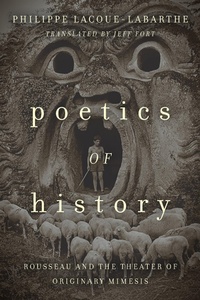
Poetics of History
Rousseau and the Theater of Originary Mimesis
Published on 5. February 2019
176 pages
978-0-8232-8236-4 (ISBN)
Description

Rousseau's opposition to the theater is well known: Far from purging the passions, it serves only to exacerbate them, and to render them hypocritical. But is it possible that Rousseau's texts reveal a different conception of theatrical imitation, a more originary form of mimesis? Over and against Heidegger's dismissal of Rousseau in the 1930s, and in the wake of classic readings by Jacques Derrida and Jean Starobinski, Lacoue-Labarthe asserts the deeply philosophical importance of Rousseau as a thinker who, without formalizing it as such, established a dialectical logic that would determine the future of philosophy: an originary theatricality arising from a dialectic between "nature" and its supplements.
Beginning with a reading of Rousseau's Discourse on Inequality, Lacoue-Labarthe brings out this dialectic in properly philosophical terms, revealing nothing less than a transcendental thinking of origins. For Rousseau, the origin has the form of a "scene"-that is, of theater. On this basis, Rousseau's texts on the theater, especially the Letter to d'Alembert, emerge as an incisive interrogation of Aristotle's Poetics. This can be read not in the false and conventional interpretation of this text that Rousseau had inherited, but rather in relation to its fundamental concepts, mimesis and katharsis, and in Rousseau's interpretation of Greek theater itself. If for Rousseau mimesis is originary, a transcendental structure, katharsis is in turn the basis of a dialectical movement, an Aufhebung that will translate the word itself (for, as Lacoue-Labarthe reminds us, Aufheben translates katharein). By reversing the facilities of the Platonic critique, Rousseau inaugurates what we could call the philosophical theater of the future.
Beginning with a reading of Rousseau's Discourse on Inequality, Lacoue-Labarthe brings out this dialectic in properly philosophical terms, revealing nothing less than a transcendental thinking of origins. For Rousseau, the origin has the form of a "scene"-that is, of theater. On this basis, Rousseau's texts on the theater, especially the Letter to d'Alembert, emerge as an incisive interrogation of Aristotle's Poetics. This can be read not in the false and conventional interpretation of this text that Rousseau had inherited, but rather in relation to its fundamental concepts, mimesis and katharsis, and in Rousseau's interpretation of Greek theater itself. If for Rousseau mimesis is originary, a transcendental structure, katharsis is in turn the basis of a dialectical movement, an Aufhebung that will translate the word itself (for, as Lacoue-Labarthe reminds us, Aufheben translates katharein). By reversing the facilities of the Platonic critique, Rousseau inaugurates what we could call the philosophical theater of the future.
More details
Edition
New edition
Language
English
Place of publication
NY
United States
Target group
Professional and scholarly
Edition type
New edition
File size
1,25 MB
ISBN-13
978-0-8232-8236-4 (9780823282364)
Copyright in bibliographic data and cover images is held by Nielsen Book Services Limited or by the publishers or by their respective licensors: all rights reserved.
Schweitzer Classification
Other editions
Additional editions
Book
02/2019
Fordham University Press
€34.50
Shipment within 10-20 days
Book
02/2019
Fordham University Press
€116.50
Shipment within 10-20 days
Persons
Philippe Lacoue-Labarthe (Author)
Philippe Lacoue-Labarthe was Professor of Philosophy at the Universite Marc Bloch, Strasbourg. His many books include Poetry as Experience; Typography: Mimesis, Philosophy, Politics; and, with Jean-Luc Nancy, The Literary Absolute: The Theory of Literature in German Romanticism.
Jeff Fort (Translator)
Jeff Fort is Associate Professor of French at the University of California, Davis, and the translator of more than a dozen books, by Jean Genet, Jacques Derrida, Maurice Blanchot, Jean-Luc Nancy, and others.
Philippe Lacoue-Labarthe was Professor of Philosophy at the Universite Marc Bloch, Strasbourg. His many books include Poetry as Experience; Typography: Mimesis, Philosophy, Politics; and, with Jean-Luc Nancy, The Literary Absolute: The Theory of Literature in German Romanticism.
Jeff Fort (Translator)
Jeff Fort is Associate Professor of French at the University of California, Davis, and the translator of more than a dozen books, by Jean Genet, Jacques Derrida, Maurice Blanchot, Jean-Luc Nancy, and others.
Content
Part I The Scene of Origin........................................... 1
Part II Anterior Theater............................................... 49
Notes....................................................................... 125
Part II Anterior Theater............................................... 49
Notes....................................................................... 125
