

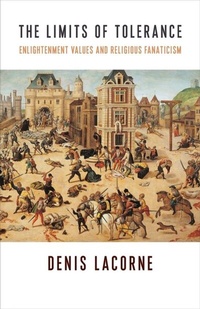
The Limits of Tolerance
Enlightenment Values and Religious Fanaticism
1st Edition
Published on 15. April 2019
100 pages
978-0-231-54704-8 (ISBN)
Description

The modern notion of tolerance-the welcoming of diversity as a force for the common good-emerged in the Enlightenment in the wake of centuries of religious wars. First elaborated by philosophers such as John Locke and Voltaire, religious tolerance gradually gained ground in Europe and North America. But with the resurgence of fanaticism and terrorism, religious tolerance is increasingly being challenged by frightened publics.
In this book, Denis Lacorne traces the emergence of the modern notion of religious tolerance in order to rethink how we should respond to its contemporary tensions. In a wide-ranging argument that spans the Ottoman Empire, the Venetian republic, and recent controversies such as France's burqa ban and the white-supremacist rally in Charlottesville, The Limits of Tolerance probes crucial questions: Should we impose limits on freedom of expression in the name of human dignity or decency? Should we accept religious symbols in the public square? Can we tolerate the intolerant? While acknowledging that tolerance can never be entirely without limits, Lacorne defends the Enlightenment concept against recent attempts to circumscribe it, arguing that without it a pluralistic society cannot survive. Awarded the Prix Montyon by the Académie Française, The Limits of Tolerance is a powerful reflection on twenty-first-century democracy's most fundamental challenges.
In this book, Denis Lacorne traces the emergence of the modern notion of religious tolerance in order to rethink how we should respond to its contemporary tensions. In a wide-ranging argument that spans the Ottoman Empire, the Venetian republic, and recent controversies such as France's burqa ban and the white-supremacist rally in Charlottesville, The Limits of Tolerance probes crucial questions: Should we impose limits on freedom of expression in the name of human dignity or decency? Should we accept religious symbols in the public square? Can we tolerate the intolerant? While acknowledging that tolerance can never be entirely without limits, Lacorne defends the Enlightenment concept against recent attempts to circumscribe it, arguing that without it a pluralistic society cannot survive. Awarded the Prix Montyon by the Académie Française, The Limits of Tolerance is a powerful reflection on twenty-first-century democracy's most fundamental challenges.
All prices
More details
Other editions
Additional editions
Book
07/2023
Columbia University Press
€31.50
Shipment within 10-20 days
Book
05/2019
Columbia University Press
€37.20
Shipment within 10-20 days
Persons
Lacorne Denis :
Denis Lacorne (PhD, Political Science, Yale) is University Professor of History at l'Institut d'Études Politiques de Paris and Director of Research at CERI-Sciences-Po. He is the author of (translated into English) Religion in America: A Political History (Columbia, 2011) and The Rise and Fall of Anti-Americanism: A Century of French Perception (Palgrave, 1990), the editor of The Measure and Mismeasure of Populations: The Statistical Use of Ethnic and Racial Categories in Multicultural Societies (Palgrave, 2011), and the co-editor (with Tony Judt) of With Us or Against Us: Studies in Global Anti-Americanism (Palgrave, 2005) and (with Tony Judt) The Politics of Language: Identity Politics in a Multilingual Age (NYU, 2004).Denis Lacorne is senior research fellow with the CERI (Centre d'Etudes et de Recherches Internationales) at Sciences Po, Paris. His books in English include Religion in America: A Political History (Columbia, 2011) as well as Language, Nation, and State: Identity Politics in a Multilingual Age (2004) and With Us or Against Us: Studies in Global Anti-Americanism (2005), both coedited with Tony Judt.
Denis Lacorne (PhD, Political Science, Yale) is University Professor of History at l'Institut d'Études Politiques de Paris and Director of Research at CERI-Sciences-Po. He is the author of (translated into English) Religion in America: A Political History (Columbia, 2011) and The Rise and Fall of Anti-Americanism: A Century of French Perception (Palgrave, 1990), the editor of The Measure and Mismeasure of Populations: The Statistical Use of Ethnic and Racial Categories in Multicultural Societies (Palgrave, 2011), and the co-editor (with Tony Judt) of With Us or Against Us: Studies in Global Anti-Americanism (Palgrave, 2005) and (with Tony Judt) The Politics of Language: Identity Politics in a Multilingual Age (NYU, 2004).Denis Lacorne is senior research fellow with the CERI (Centre d'Etudes et de Recherches Internationales) at Sciences Po, Paris. His books in English include Religion in America: A Political History (Columbia, 2011) as well as Language, Nation, and State: Identity Politics in a Multilingual Age (2004) and With Us or Against Us: Studies in Global Anti-Americanism (2005), both coedited with Tony Judt.
Content
Acknowledgments
New Introduction for the American Edition
1. Tolerance According to John Locke
2. Voltaire and Modern Tolerance
3. Tolerance in America
4. Tolerance in the Ottoman Empire
5. Tolerance in Venice
6. On Blasphemy
7. Multicultural Tolerance
8. Of Veils and Unveiling
9. New Restrictions, New Forms of Tolerance
10. Should We Tolerate the Enemies of Tolerance?
Epilogue for the American Edition: Tolerance in the Age of Terrorism
Notes
Index
New Introduction for the American Edition
1. Tolerance According to John Locke
2. Voltaire and Modern Tolerance
3. Tolerance in America
4. Tolerance in the Ottoman Empire
5. Tolerance in Venice
6. On Blasphemy
7. Multicultural Tolerance
8. Of Veils and Unveiling
9. New Restrictions, New Forms of Tolerance
10. Should We Tolerate the Enemies of Tolerance?
Epilogue for the American Edition: Tolerance in the Age of Terrorism
Notes
Index

