

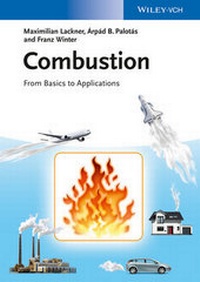
Combustion
From Basics to Applications
1st Edition
Published on 2. July 2013
288 pages
978-3-527-66721-5 (ISBN)
Description

Combustion, the process of burning, is defined as a chemical reaction between a combustible reactant (the fuel) and an oxidizing agent (such as air) in order to produce heat and in most cases light while new chemical species (e.g., flue gas components) are formed. This book covers a gap on the market by providing a concise introduction to combustion. Most of the other books currently available are targeted towards the experienced users and contain too many details and/or contain knowledge at a fairly high level. This book provides a brief and clear overview of the combustion basics, suitable for beginners and then focuses on practical aspects, rather than theory, illustrated by a number of industrial applications as examples. The content is aimed to provide a general understanding of the various concepts, techniques and equipment for students at all level as well as practitioners with little or no prior experience in the field.
The authors are all international experts in the field of combustion technology and adopt here a clear didactic style with many practical examples to cover the most common solid, liquid and gaseous fuels. The associated environmental impacts are also discussed so that readers can develop an understanding of the major issues and the options available for more sustainable combustion processes.
With a foreword by Katharina Kohse-Höinghaus
The authors are all international experts in the field of combustion technology and adopt here a clear didactic style with many practical examples to cover the most common solid, liquid and gaseous fuels. The associated environmental impacts are also discussed so that readers can develop an understanding of the major issues and the options available for more sustainable combustion processes.
With a foreword by Katharina Kohse-Höinghaus
More details
Other editions
Additional editions
Book
09/2013
1st Edition
Wiley-VCH
€88.90
Article exhausted; check different version
Book
09/2013
1st Edition
Wiley-VCH
€129.00
Article exhausted; check different version
Persons
Maximilian Lackner has been a lecturer on combustion at Vienna University of Technology since 2005. He studied Technical Chemistry at the same university, where he also earned his PhD degree and completed his habilitation. He obtained a Global Executive MBA from LIMAK
University in Linz, Austria. Between 2004 and 2011 he held several senior positions in the petrochemical industry in Europe and Asia. He has founded four companies and is a member of the advisory board of the VDI and an advisor to the US Department of Energy.
Prof. Árpád B. Palotás is the director of the Institute of Energy and Quality Affairs, as well as the head of the Department of Combustion Technology at the University of Miskolc, Hungary. He obtained his MSc degree in Metallurgical Engineering at the University of Miskolc and an MSc in Chemical Engineering at the Massachusetts Institute of Technology (MIT), Cambridge, MA, USA. Having completed his PhD studies at the University of Miskolc, he spent years as postdoctoral associate and visiting scientist at MIT and later at the University of Utah (Salt Lake City, UT, USA). At these institutions he continued his research on combustiongenerated aerosols, focusing on soot characterization as well
as on the development of fuel additives for the reduction of soot emission from aviation fuel sources.
Franz Winter is professor of Chemical Engineering at Vienna University of Technology, Austria. He is group leader and head of the Christian Doppler Laboratory for Chemical Engineering at High Temperatures at the Vienna University of Technology. He obtained his academic degrees from the Vienna University of Technology and has specialized in combustion and high temperature reaction kinetics. He has authored more than 300 scientific publications. He is chairman and reviewer on various scientific and technical advisory boards and an active member of the Combustion Institute.
University in Linz, Austria. Between 2004 and 2011 he held several senior positions in the petrochemical industry in Europe and Asia. He has founded four companies and is a member of the advisory board of the VDI and an advisor to the US Department of Energy.
Prof. Árpád B. Palotás is the director of the Institute of Energy and Quality Affairs, as well as the head of the Department of Combustion Technology at the University of Miskolc, Hungary. He obtained his MSc degree in Metallurgical Engineering at the University of Miskolc and an MSc in Chemical Engineering at the Massachusetts Institute of Technology (MIT), Cambridge, MA, USA. Having completed his PhD studies at the University of Miskolc, he spent years as postdoctoral associate and visiting scientist at MIT and later at the University of Utah (Salt Lake City, UT, USA). At these institutions he continued his research on combustiongenerated aerosols, focusing on soot characterization as well
as on the development of fuel additives for the reduction of soot emission from aviation fuel sources.
Franz Winter is professor of Chemical Engineering at Vienna University of Technology, Austria. He is group leader and head of the Christian Doppler Laboratory for Chemical Engineering at High Temperatures at the Vienna University of Technology. He obtained his academic degrees from the Vienna University of Technology and has specialized in combustion and high temperature reaction kinetics. He has authored more than 300 scientific publications. He is chairman and reviewer on various scientific and technical advisory boards and an active member of the Combustion Institute.
Content
PREFACE
HISTORY OF COMBUSTION
Introduction
Timetable
Outlook
Web Resources
FUELS
Introduction
Gaseous Fuels
Liquid Fuels
Solid Fuels
COMBUSTION PRINCIPLES
Basic Combustion Calculations
Heat-, Mass- and Momentum Transport and Balance
Elementary Reactions and Radicals
Ignition
ENVIRONMENTAL IMPACTS
Pollutants: Formation and Impact
Combustion and Climate Change
MEASUREMENT METHODS
Introduction
In Situ versus Ex Situ Measurements
Fuel Characterization
Investigation of Combustion Processes
APPLICATIONS
Burners
Industrial Boilers
Industrial Technologies
SAFETY ISSUES
Introduction
Fundamentals
Fire Classes
Working Mechanism of Fire Extinguishing Media
Fire Detectors
Deflagrations and Detonations
Dust Explosions
Legal Framework: Example of ATEX in Europe
Preventing and Mitigating the Effect of Explosions in Industry
Aspects of Preventive Fire Protection
Fire Suppression by Oxygen Reduction
Safety by Process Design
Other Important Terms Related to Fire Safety
INDEX
HISTORY OF COMBUSTION
Introduction
Timetable
Outlook
Web Resources
FUELS
Introduction
Gaseous Fuels
Liquid Fuels
Solid Fuels
COMBUSTION PRINCIPLES
Basic Combustion Calculations
Heat-, Mass- and Momentum Transport and Balance
Elementary Reactions and Radicals
Ignition
ENVIRONMENTAL IMPACTS
Pollutants: Formation and Impact
Combustion and Climate Change
MEASUREMENT METHODS
Introduction
In Situ versus Ex Situ Measurements
Fuel Characterization
Investigation of Combustion Processes
APPLICATIONS
Burners
Industrial Boilers
Industrial Technologies
SAFETY ISSUES
Introduction
Fundamentals
Fire Classes
Working Mechanism of Fire Extinguishing Media
Fire Detectors
Deflagrations and Detonations
Dust Explosions
Legal Framework: Example of ATEX in Europe
Preventing and Mitigating the Effect of Explosions in Industry
Aspects of Preventive Fire Protection
Fire Suppression by Oxygen Reduction
Safety by Process Design
Other Important Terms Related to Fire Safety
INDEX
