

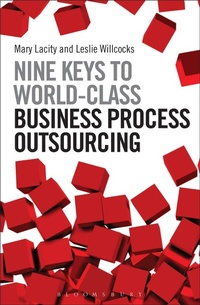
Nine Keys to World-Class Business Process Outsourcing
1st Edition
Published on 23. April 2015
256 pages
978-1-4729-1850-5 (ISBN)
Description

Business Process Outsourcing (BPO)-the sourcing of business services through external third parties-is a global phenomenon, which generated nearly $300 billion worldwide in 2012. BPO is highly IT-enabled, and on a growth trajectory that impacts across functions of major, medium and small enterprises, including procurement, human resources, accounting and finance, sales, marketing, legal, asset management and key administrative processes.
Despite this size and spread, BPO services and the ability of clients to manage their providers, are still evolving and have a mixed record. In the course of their research, the authors have found only 20% of outsourcing arrangements are world-class performers. A further 25% are 'good', 40% are 'OK' and 15% are 'poor'.
This book pinpoints and describes in detail the effective practices that characterize the top global BPO performers, including Microsoft, BP, EMC and TalkTalk. The authors provide case illustrations and examples throughout of how world-class practices were generated and evolved, and how they can be applied to real life settings and problem areas.
Despite this size and spread, BPO services and the ability of clients to manage their providers, are still evolving and have a mixed record. In the course of their research, the authors have found only 20% of outsourcing arrangements are world-class performers. A further 25% are 'good', 40% are 'OK' and 15% are 'poor'.
This book pinpoints and describes in detail the effective practices that characterize the top global BPO performers, including Microsoft, BP, EMC and TalkTalk. The authors provide case illustrations and examples throughout of how world-class practices were generated and evolved, and how they can be applied to real life settings and problem areas.
Reviews / Votes
In a time when organizations are seeking additional value from outsourcing, Nine Keys to World-Class BPO Performance provides a much-needed road map to making BPO relationships more successful. Both buyers of outsourcing services and their service providers need to take these lessons seriously - change is required. In Nine Keys, readers will find the practical advice to make the transformation a reality. * Managing Partner of Research, Everest Group * Lacity and Willcocks provide insights from the trenches about how to launch and sustain world-class outsourcing relationships to achieve world-class outsourcing performance. This book is a must read for both buyers and providers. * Founder and Chairman, Elevate Services * Mary Lacity and Leslie Willcocks represent the "dream team" of sourcing - and their book delivers grounded, insightful advice to those who strive to excel at business process outsourcing. This is a must read for any business manager who wants to understand the what, why and how of BPO best practice. * Principal Research Scientist, MIT Sloan Center for IS Research * It's been my pleasure and privilege to publish articles by the authors of this book in Professional Outsourcing Magazine for several years. They always offer fresh, engaging insights and this major practical volume looking at what makes world class performance does not disappoint. * Co-founder & Publisher of Professional Outsourcing Magazine *More details
Edition
1. Auflage
Language
English
Place of publication
London
United Kingdom
Target group
Professional and scholarly
ISBN-13
978-1-4729-1850-5 (9781472918505)
Copyright in bibliographic data and cover images is held by Nielsen Book Services Limited or by the publishers or by their respective licensors: all rights reserved.
Schweitzer Classification
Other editions
Additional editions
Mary Lacity | Leslie Willcocks
Nine Keys to World-Class Business Process Outsourcing
Book
04/2015
Bloomsbury Information
€39.50
Article exhausted; check different version
Persons
Dr. Mary Lacity is an Associate at The Outsourcing Unit, London School of Economics and Curator's Professor and International Business Fellow at University of Missouri-St. Louis, USA. She is a Certified Outsourcing Professional (R), Co-Chair of the IAOP Midwest Chapter, Industry Advisor for the Outsourcing Angels, Co-editor of the Palgrave Series: Work, Technology, and Globalization, and on the Editorial Boards for Journal of Information Technology, MIS Quarterly Executive, Journal of Strategic Information Systems, and Strategic Outsourcing: An International Journal. She was inducted into the IAOP's Hall of Fame in 2014. She is the recipient of the 2008 Gateway to Innovation Award and the 2000 World Outsourcing Achievement Award. She has published 16 books.
Dr. Leslie Willcocks is Director of The Outsourcing Unit, London School of Economics (LSE) and Professor of Technology, Work and Globalisation at LSE. He holds visiting chairs at Erasmus, Melbourne and Sydney universities and is an Associate Fellow at Green-Templeton, University of Oxford. He has been Editor-in-Chief of the Journal of Information Technology for the last 20 years, and is joint series editor, with Mary C. Lacity, of the Palgrave book series Technology Work and Globalization. He has co-authored 39 books. In February 2001 he won the PriceWaterhouseCoopers/Michael Corbett Associates World Outsourcing Achievement Award for his contribution to this field. In 2014 he was inducted into the Hall of Fame of the IAOP.
Dr. Leslie Willcocks is Director of The Outsourcing Unit, London School of Economics (LSE) and Professor of Technology, Work and Globalisation at LSE. He holds visiting chairs at Erasmus, Melbourne and Sydney universities and is an Associate Fellow at Green-Templeton, University of Oxford. He has been Editor-in-Chief of the Journal of Information Technology for the last 20 years, and is joint series editor, with Mary C. Lacity, of the Palgrave book series Technology Work and Globalization. He has co-authored 39 books. In February 2001 he won the PriceWaterhouseCoopers/Michael Corbett Associates World Outsourcing Achievement Award for his contribution to this field. In 2014 he was inducted into the Hall of Fame of the IAOP.
Content
- Cover
- HalfTitle
- Title
- Copyright
- Contents
- List of figures
- List of tables
- Professional credits
- Acknowledgements
- Foreword
- Introduction: Outsourcingas evolution
- Chapter 1 Introducing the nine keys to world-class BPO1
- 1.1. Introduction
- 1.2. The BPO report card
- 1.3. Sourcing practices that lead to good performance
- 1.4. The nine keys to world-class performance
- 1.5. Lessons learned
- Chapter 2 . Key 1: Assign a great leadership pair
- 2.1. Introduction
- 2.2. The ten attributes of effective leadership pairs
- 2.3. Rating the leadership pair attributes
- 2.4. Case studies: How leaders transform BPO performance
- 2.5. Leadership teams - the role of middle managers
- 2.6. Conclusion
- Chapter 3 . Key 2: Focus on business and strategic benefits beyond cost efficiencies
- 3.1. Introduction
- 3.2. Outsourcing aspirations
- 3.3. Business value
- 3.4. Cost plus innovation
- 3.5. Global sourcing evolution
- 3.6. Inviting providers into the strategic tent
- 3.7. Conclusion
- Chapter 4 . Key 3: Drive strong transition, transformation and change management capabilities
- 4.1. Introduction
- 4.2. Transformation management capability
- 4.3. Transition management capability
- 4.4. Ongoing change management
- 4.5. Conclusion
- Chapter 5 . Key 4: Adopt a partnering approach to governance
- 5.1. Introduction
- 5.2. The partnership view
- 5.3. Partnering behaviours
- 5.4. Conclusion
- Chapter 6 . Key 5: Align the retained organization, outsourced processes and provider staff
- 6.1. Introduction
- 6.2. Structures transformed from 'pyramids' to 'diamonds'
- 6.3. Employees transformed from 'back-office' doers to 'front-office' service coordinators
- 6.4. Internal clients transformed from 'users' to 'customers'
- 6.5. Provider relationships transformed from 'them' to 'us'
- 6.6. Conclusion
- Chapter 7 . Key 6: Resolve issues together and conflicts fairly
- 7.1. Introduction
- 7.2. Principles of collaborative problem-solving
- 7.3. Problems that arise in BPO relationships
- 7.4. Stories of service issues
- 7.5. Stories of relationship traumas
- 7.6. Stories of commercial conflicts
- 7.7. Conclusion
- Chapter 8 . Key 7: Use technology as enabler and accelerator of performance
- 8.1. Introduction
- 8.2. Self-service portals
- 8.3. Automation
- 8.4. Business analytics and forecasting tools
- 8.5. Workflow tools
- 8.6. Governance tools
- 8.7. Cloud delivery
- 8.8. Conclusion
- Chapter 9 . Key 8: Deploy domain expertise and business analytics
- 9.1. Introduction
- 9.2. The case of a grocery retailer
- 9.3. The case of an aircraft engine manufacturer
- 9.4. The case of reducing healthcare claim errors
- 9.5. Conclusion
- Chapter 10 . Key 9: Prioritize and incent innovation
- 10.1. Introduction
- 10.2. Definitions and examples on innovations
- 10.3. Incenting innovation
- 10.4. Delivering innovation
- 10.5. Conclusion
- Chapter 11 . Microsoft case study: Engaging a BPO provider to help create OneFinance
- 11.1. Introduction
- 11.2. Key 1: Assign a greatleadership pair
- 11.3. Key 2: Focus on business andstrategic benefits beyond cost efficiencies
- 11.4. Key 3: Drive strong transition,transformational and change managementcapabilities
- 11.5. Key 4: Adopt a partneringapproach to governance
- 11.6. Key 5: Align the retainedorganization, outsourced processesand provider staff
- 11.7. Key 6: Resolve issuestogether and conflicts fairly
- 11.8. Key 7: Use technology asenabler and accelerator of performance
- 11.9. Key 8: Deploy domain expertiseand business analytics
- 11.10. Key 9: Prioritize and incentinnovation
- 11.11. Conclusion
- Chapter 12 . BP case study: Reclaiming world-class performance
- 12.1. Introduction
- 12.2. BP's history of outsourcing
- 12.3. Key 1: Assign agreat leadership pair
- 12.4. Key 2: Focus on business andstrategic benefits beyond cost efficiencies
- 12.5. Key 3: Drive strong transition,transformational and change managementcapabilities
- 12.6. Key 4: Adopt a partneringapproach to governance
- 12.7. Key 5: Align the retainedorganization, outsourced processes andprovider staff
- 12.8. Key 6: Resolve issuestogether and conflicts fairly
- 12.9. Key 7: Prioritize and incentinnovation
- 12.10. Conclusion
- Chapter 13 . EMC case study: Journey to world-class performance
- 13.1. Introduction
- 13.2. Key 1: Assign a greatleadership pair
- 13.3. Key 2: Focus on business andstrategic benefits beyond cost efficiencies
- 13.4. Key 3: Drive strong transition,transformational and change managementcapabilities
- 13.5. Key 4: Adopt a partneringapproach to governance
- 13.6. Key 5: Align the retainedorganization, outsourced processes andprovider staff
- 13.7. Key 6: Resolve issues togetherand conflicts fairly
- 13.8. Key 7: Use technology asenabler and accelerator of performance
- 13.9. Key 8: Deploy domain expertiseand business analytics
- 13.10. Key 9: Prioritize and incentinnovation
- 13.11. Conclusion
- Chapter 14 . TalkTalk case study: Transforming a vendor into a partner
- 14.1. Introduction
- 14.2. TalkTalk's history
- 14.3. Key 1: Assign a greatleadership pair
- 14.4. Key 2: Focus on business andstrategic benefits beyond cost efficiencies
- 14.5. Key 3: Drive strong transition,transformational and change managementcapabilities
- 14.6. Key 4: Adopt a partneringapproach to governance
- 14.7. Key 5: Align the retainedorganization, outsourced processes andprovider staff
- 14.8. Key 6: Resolve issues togetherand conflicts fairly
- 14.9. Key 7: Deploy domain expertiseand business analytics
- 14.10. Key 8: Prioritize andincent innovation
- 14.11. Case discussion
- 14.12. Conclusion
- Appendix A Research base and method
- Appendix B Assessing leadership pair effectiveness
- Index
