

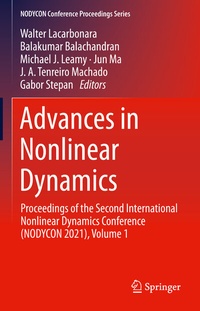
Advances in Nonlinear Dynamics
Description

This first of three volumes includes papers from the second series of NODYCON, which was held virtually in February of 2021. The conference papers reflect a broad coverage of topics in nonlinear dynamics, ranging from traditional topics from established streams of research to those from relatively unexplored and emerging venues of research. These include
- Fluid-structure interactions
- Mechanical systems and structures
- Computational nonlinear dynamics
- Analytical techniques
- Bifurcation and dynamic instability
- Rotating systems
- Modal interactions and energy transfer
- Nonsmooth systems
More details
Other editions
Additional editions
Persons
Walter Lacarbonara
Prof. Lacarbonara received his B.S. from Sapienza University of Rome, M.S. (Engineering Mechanics) from Virginia Tech (Blacksburg, VA, USA), and Ph.D. (Structural Engineering) from Sapienza University of Rome. He is currently a Professor at Sapienza University where he has been since 1998. His research interests cover nonlinear structural dynamics; asymptotic techniques; experimental nonlinear dynamics; nonlinear control of vibrations; multiscale modeling and dynamics of nanostructured and nonlinear materials.
Bala Balachandran
Prof. Balachandran received his B. Tech (Naval Architecture) from the Indian Institute of Technology, Madras, India, M.S. (Aerospace Engineering) from Virginia Tech, Blacksburg, VA and Ph.D. (Engineering Mechanics) from Virginia Tech. Currently, he is a Professor of Mechanical Engineering at the University of Maryland, where has been since 1993.
Michael Leamy
Prof. Leamy received his B.S. from Clarkson University, his M.S. and Ph.D. from the University of Michigan, respectively. He is currently a Full Professor at Georgia Tech where he moved in 2007 as an Assistant Professor. His research interests are in emerging and multidisciplinary areas of engineering science, with an emphasis on simulating nonlinear dynamical behaviors in structures and materials.
Jun Ma
Jun Ma received his Ph.D. from Huazhong Normal University for Theoretical Physics, China, in 2010. He is Professor of Physics at Lanzhou University of Technology, Department of Physics.
J. A Tenreiro Machado
J. A. Tenreiro Machado graduated with 'Licenciatura' (1980), PhD. (1989) and 'Habilitation' (1995), in Electrical and Computer Engineering at the University of Porto. Since 1998 he works at the Institute of Engineering, Polytechnic Institute of Porto, Dept. of Electrical Engineering where he is Principal Coordinator Professor.
Gabor Stepan
Gábor Stépán is a Professor of Applied Mechanics at Budapest University of Technology and Economics. He is member of the Hungarian Academy of Sciences and the Academy of Europe. He is the recipient of an ERC Advanced Grant. His research interests include delayed dynamical systems, stability theory, and nonlinear vibrations.
