

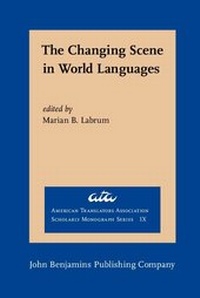
The Changing Scene in World Languages
Issues and challenges
1st Edition
Published on 27. November 1997
160 pages
978-90-272-8352-8 (ISBN)
Description

The 1997 ATA volume brings together articles on translation practice into the 21st century. Contributions deal with the Information Age, multilingualism in Europe, English as a Lingua Franca, Terminology standardization, translating for the media, and new directions in translator training. A comprehensive bibliography of dissertations makes this a useful reference tool.
More details
Other editions
Additional editions
Book
11/1997
John Benjamins Publishing Co
€111.30
Shipment within 10-15 days
Person
Content
- THE CHANGING SCENE IN WORLD LANGUAGES
- Title page
- Copyright page
- Table of contents
- Editor's Preface to The Changing Scene in World Languages
- Executive Summary
- NOTES
- Acknowledgments
- Valediction
- Section 1: Where We Have Been and Where We Are Going
- Translation in the Information Age
- Diversities in texts and related principles of translating
- Translating in Different Contexts
- The cultural context
- The verbal context
- The grammatical context
- Programs for the training of translators
- NOTES
- Implications of Multilingualism in the European Union for Translator Training in Spain
- Introduction
- The European Union1
- Consequences at the National Level in Spain
- Translation Services Available
- The Professional Market
- Freedom of movement
- Translation into the translator's non-primary language
- Translator Training in Spanish Universities
- The European Union's Academic Cooperation Programme
- Implicationsf or Training
- For Students
- For Methodology
- For Staff
- Some Possible Solutions
- Admission to classes
- Methodology
- Assessment
- Conclusion
- NOTES
- Spanish Film Translation: Ideology, Censorship and the Supremacy of the National Language
- Introduction
- Film Translation and the Spanish Audience
- Spanish Film Translation (1936-1975): Cultural Patronage
- Ministerial Guidelines on Spanish Film Censorship: A Brief Review
- Conclusion
- NOTES
- REFERENCES
- Section 2: Theoretical and Conceptual Perspectives
- Standardization and Interference in Terminology
- Introduction
- Terminology Participates in the Multidimensionality of Natural Language
- Representation and Sociocommunicative Basis of Terminology
- Terminology Participates in Variation
- Assumptions f or a Terminology of Social Basis
- Terminology Activity
- Standardization or Harmonization?
- Planning harmonization in terminology
- Harmonization in the creation of terminological resources
- Harmonization in the spreading and the interchange
- NOTES
- REFERENCES
- Translating Ausbausprachen
- Abstandsprachen and Ausbausprachen
- Preliminary remarks: Distance and development.
- Languages and dialects, once more
- The Case of Galician
- A Bit of History
- The development of the codification conflict
- Galician, a language by development?
- On Translators
- External Variables
- Internal Variables
- Concluding Remarks: Not so Harmless as It Appears to Be
- NOTES
- REFERENCES
- Issues Today, Challengesfor Tomorrow: Translation and English as the International Lingua Franca
- NOTES
- REFERENCES
- Section 3:Interaction and Development
- Strawberry Flowers in Realms of Chocolate: The Training of Literary Translators
- Disability Issues in Translation/Interpretation
- Introduction-Need for Translation Services
- The Importance of Accurate Rehabilitation Translation Services
- Language Translation is Also Necessary for Nonimmigrants
- Organization and Purpose of the Article
- The Definition of Disability
- Each Culture/Language Defines Disability Differently
- What the ADA Is
- The ADA can be Viewed as a Cultural Definition of Disability
- Translation/Interpretation Issues in Rehabilitation Services
- Issues in Translation/Interpretation that are Specific to Disability
- Conclusion
- REFERENCES
- Bibliography of Dissertations about Translation Topics (1973-1996)
- Bibliography
- Interpretation Pedagogy and Assessment
- Interpretation Theory
- Literary Translation and Theory
- Machine Translation
- Translation Pedagogy and Assessment
- Translation Theory (Translatology)
- Translation and Second Language Acquisition
- REFERENCES
- Contributors
- Corporate Members
- Institutional Members
- American Translators Association Officers and Board of Directors, 1997
- Recipients of the Alexander Gode Medal
- INDEX
