

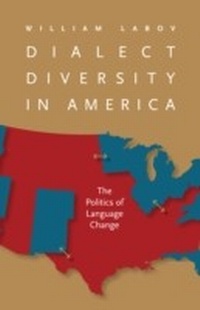
Dialect Diversity in America
Description

The sociolinguist William Labov has worked for decades on change in progress in American dialects and on African American Vernacular English (AAVE). In Dialect Diversity in America, Labov examines the diversity among American dialects and presents the counterintuitive finding that geographically localized dialects of North American English are increasingly diverging from one another over time.
Contrary to the general expectation that mass culture would diminish regional differences, the dialects of Los Angeles, Dallas, Chicago, Birmingham, Buffalo, Philadelphia, and New York are now more different from each other than they were a hundred years ago. Equally significant is Labov's finding that AAVE does not map with the geography and timing of changes in other dialects. The home dialect of most African American speakers has developed a grammar that is more and more different from that of the white mainstream dialects in the major cities studied and yet highly homogeneous throughout the United States.
Labov describes the political forces that drive these ongoing changes, as well as the political consequences in public debate. The author also considers the recent geographical reversal of political parties in the Blue States and the Red States and the parallels between dialect differences and the results of recent presidential elections. Finally, in attempting to account for the history and geography of linguistic change among whites, Labov highlights fascinating correlations between patterns of linguistic divergence and the politics of race and slavery, going back to the antebellum United States. Complemented by an online collection of audio files that illustrate key dialectical nuances, Dialect Diversity in America offers an unparalleled sociolinguistic study from a preeminent scholar in the field.
All prices
More details
Other editions
Additional editions

Person
William Labov, Fassit Professor of Linguistics at the University of Pennsylvania, is author or coauthor of numerous works on linguistics, including Principles of Linguistic Change, volumes 1-3, and The Atlas of North American English: Phonetics, Phonology, and Sound Change.
