

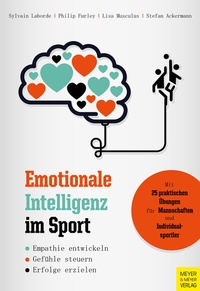
Emotionale Intelligenz im Sport
Empathie entwickeln - Gefühle steuern - Erfolgen erzielen
1st Edition
Published on 21. September 2017
160 pages
978-3-8403-1254-0 (ISBN)
Description

Was ist emotionale Intelligenz? Und welche Rolle spielt sie im Sport? In diesem Buch erklären die Autoren von der Deutschen Sporthochschule Köln detailliert das Konzept der emotionalen Intelligenz und beschreiben anschaulich deren Einfluss im Sport. Das Erkennen, Vermitteln und Regulieren der eigenen Emotionen, sowie der Emotionen anderer, im Wettkampf kann für den Spielausgang entscheidend sein! Als Startpunkt für eine gezielte Entwicklung der emotionalen Intelligenz enthält das Buch ein Diagnostikinstrument, um Stärken und Schwächen in verschiedenen Facetten der emotionalen Intelligenz zu ermitteln und anschließend gezielt zu fördern. Hierfür bietet das Buch zahlreiche praktische Übungen, die in verschiedenen Variationen sowohl mit Kindern und Jugendlichen als auch mit Erwachsenen eingesetzt werden können. Die Übungen und Tipps lassen sich nicht nur ins Individual- und Mannschaftstraining, sondern auch in den Schul- und Betriebssport einbauen.
More details
Other editions
Additional editions
Sylvain Laborde | Philip Furley | Lisa Musculus
Emotionale Intelligenz im Sport
Empathie entwickeln - Gefühle steuern - Erfolge erzielen
Book
09/2017
Meyer & Meyer
€19.95
Available immediately
Persons
Dr. Sylvain Laborde arbeitet als wissenschaftlicher Mitarbeiter im Psychologischen Institut (Abteilung Leistungspsychologie) der Deutschen Sporthochschule in Köln. Durch seine Forschung, seine Weiterbildungen, Sportlerbetreuung, und seine zahlreichen Studien und Konfenrenzbeiträge auf internationalen Kongressen über das Thema, ist er weltweit als einer der führenden Experten im Bereich emotionale Intelligenz im Sport tätig.
Dr. Philip Furley (M. A.) ist Dozent und Abteilungsleiter der Abteilung "Kognition & Motivation" am Institut für Kognitions- und Sportspielforschung (IKS) der Deutschen Sporthochschule Köln. Seine Forschungsschwerpunkte umfassen kognitionspsychologische Themen und sozialpsychologische Themen wie nonverbale Kommunikation und Emotionen. Er hat ebenfalls langjährige Erfahrung als aktiver Spieler im Handball (u.a. 3 A-Länderspiele), Tennis und Tischtennis und als Trainer im Handball.
Lisa Musculus (M. Sc. Psychologin) promoviert derzeit in einem längsschnittlichen Projekt zum Thema Entwicklung von kognitiven Entscheidungsprozessen im Fußball am Psychologischen Institut der Deutschen Sporthochschule Köln. Außerdem arbeitet sie in der praktischen Sportpsychologie, vor allem im Fußball und Tennis. In diesem Zusammenhang bietet sie individuelles Coaching, themenspezifische Gruppenworkshops oder Fortbildungen zu psychologisch relevanten Themen an.
Stefan Ackermann studiert aktuell an der Deutschen Sporthochschule Köln und arbeitet seit mehr als einem Jahr mit Dr. Laborde im Bereich emotionale Intelligenz im Sport zusammen. Er ist seit über einem halben Jahrzehnt als Fußballtrainer, zwischenzeitlich auch als Handballtrainer, sowie seit zwei Jahren als Übungsleiter für die Ballschule Köln tätig und bildet inzwischen selbst Trainer aus.
Content
- Cover
- Urheberrechtshinweis
- Inhalt
- 1 Einstieg
- 2 Was ist emotionale Intelligenz und wofu¨r brauche ich sie?
- 2.1 Die fu¨nf Kompetenzen der emotionalen Intelligenz
- 2.1.1 Identifikation - erkennen, wie man sich fu¨hlt und wie andere sich fu¨hlen
- 2.1.2 Ausdruck - Gefu¨hle vermitteln können und Empathie zeigen und empfinden
- 2.1.3 Verständnis - wieso ich mich fu¨hle, wie ich mich fu¨hle
- 2.1.4 Regulation - Gefu¨hle steuern und passend in der Situation reagieren
- 2.1.5 Nutzen - wie ich mit Emotionen meine und unsere Ziele besser erreiche
- 2.2 Wissen, Fähigkeit, Eigenschaft - die drei Stufen zur Ausbildung der emotionalen Intelligenz
- 2.2.1 Wissen
- 2.2.2 Fähigkeit
- 2.2.3 Eigenschaft
- 2.2.4 Die drei Level der EI-Meisterung eines Sportlers
- 3 Die Rolle der emotionalen Intelligenz im Sport und bei körperlicher Aktivität
- 3.1 Athleten - Leistung und emotionale Intelligenz
- 3.2 Trainer
- 3.3 Schiedsrichter und Kampfrichter
- 3.4 Körperliche Aktivität
- 4 Wie gut ist meine emotionale Intelligenz und wo liegen meine Schwächen? - Messung emotionaler Intelligenz mit dem Profil des Emotionalen-Kompetenzen-Fragebogens
- 4.1 Profil der emotionalen Kompetenzen im Vergleich zu anderen Fragebögen
- 4.2 Profil der emotionalen Kompetenzen
- 4.3 Auswertung Profil der emotionalen Kompetenzen
- 5 Erläuterung der emotionalen Kompetenzen
- 5.1 Identifikation der eigenen Emotionen
- 5.2 Identifikation der Emotionen anderer
- 5.3 Verständnis der eigenen Emotionen
- 5.4 Verständnis der Emotionen anderer
- 5.5 Ausdruck der eigenen Emotionen
- 5.6 Emotionsausdruck anderer - Empathieempfinden
- 5.7 Regulation der eigenen Emotionen
- 5.8 Regulation der Emotionen anderer
- 5.9 Nutzen der eigenen Emotionen
- 5.10 Nutzen der Emotionen anderer
- 6 Aktivitäten zum Training emotionaler Intelligenz
- 6.1 Aktivität "Emotionsbälle"
- 6.1.1 Variation: "Emotionsstaffel"
- 6.1.2 Variation: "Positive und negative Emotionsbälle"
- 6.2 Aktivität "Feuer, Wasser, Blitz"
- 6.2.1 Variation: "Verknu¨pfung mit Powerposen"
- 6.2.2 Variation: "Vormachen der Emotionen"
- 6.3 Aktivität "Emotionale Gesichter in Bewegung"
- 6.4 Aktivität "Emotionale Odyssee"
- 6.4.1 Variation: "Gesichtsausdruck und Körpersprache"
- 6.4.2 Variation: "Emotionales Interview"
- 6.5 Aktivität "Kommunikationsu¨bung"
- 6.5.1 Variation: "Klartext"
- 6.5.2 Variation: "Speedinterview"
- 6.6 Aktivität "Debriefingbogen"
- 6.7 Aktivität "Achtsamkeit"
- 6.7.1 Variation: "Körperscan"
- 6.8 Aktivität "Verkörperte Emotionen"
- 6.9 Aktivität "Emotionszeitreise"
- 6.9.1 Variation: "Emotionale Imagination"
- 6.10 Aktivität "Powerposen"
- 6.10.1 Variation: "Selbstvertrauen zeigen"
- 6.11 Aktivität "Vertrauen aufbauen"
- 6.11.1 Variation: "Sich fallen lassen"
- 6.12 Aktivität "Teambuilding"
- 6.12.1 Variation: "Zeige mir, dass ich auf dich zählen kann"
- 6.12.2 Variation: "Wir-Gefu¨hl fördern"
- 6.13 Aktivität "Seiltanz"
- 6.14 Aktivität "Die verstärkende Zitatestaffel"
- 6.14.1 Variation: "30-Tage-Zitate-Challenge"
- 6.15 Aktivität "Peptalk"
- 6.15.1 Variation: "Negativer Peptalk"
- 6.16 Aktivität "Emotionsvirus"
- 6.17 Aktivität "Emotions-Memory®"
- 6.17.1 Variation: "Emotions-Memory® mit Mimik"
- 6.17.2 Variation "Emotions-Memory® 1:1"
- 6.17.3 Variation: "Personalisiertes Emotions-Memory®"
- 6.17.4 Variation: "Komplexes Emotions-Memory®"
- 6.18 Aktivität "Emotionsquartett"
- 6.19 Aktivität "Profisportler-Raten"
- 6.20 Aktivität "Emotionsschauspiel"
- 6.21 Aktivität "Emotions-Halligalli"
- 6.22 Aktivität "Emotionale Pantomime"
- 6.23 Aktivität "Emotionsampel"
- 6.24 Aktivität "Emotionsregulation unter Druck"
- 6.24.1 Variation: "Umgang mit Konsequenzen"
- 6.25 Aktivität "Emotionen trainieren mit Musik"
- 6.25.1 Variation: "Musik auf und ab"
- 6.25.2 Variation: "Emotions-Playlist"
- 7 Nachwort
- 7.1 Danksagung
- Anhang
- 1 Tabellen
- 2 Literatur/Verweise
- 3 Bildnachweis
- 4 Autoren
