

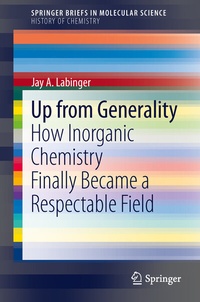
Up from Generality
Description

Reviews / Votes
From the reviews:
"The book contains many illustrations of inorganic chemists and is fully referenced . . Summing Up: Recommended. . upper-division undergraduates and above." (H. Goldwhite, Choice, Vol. 51 (8), April, 2014)
More details
Other editions
Additional editions
Person
Jay Labinger is a California native, born in Los Angeles in 1947. He was an undergraduate at Harvey Mudd College, and received his Ph.D. (in inorganic chemistry,of course) at Harvard University in 1974. After a postdoctoral stint at PrincetonUniversity, he held successive positions in academia (University of Notre Dame) and industry (Occidental Petroleum, ARCO) before coming to Caltech in 1986, where he is Administrator of the Beckman Institute and Faculty Associate in Chemistry. His chemistry research has been focused in the areas of organotransition metal chemistry and energy-related catalysis. Many of his contributions have taken the form of mechanistic explanation of transformations that are potentially valuable in the energy sphere; these include oxidative coupling of methane, selective oxidation of alkanes by soluble metal complexes, and conversion of methanol to a high-octane hydrocarbon. He was elected Fellow of the American Association for the Advancement of Science in 2009. For the last twenty years or so, he has also been active in scholarship on the borders between science and the humanities, writing on topics such as science and literature, controversial episodes in the history of chemistry, and the "Science Wars." He co-edited (with Harry Collins) the book The One Culture (2001), a conversation-in-print between scientists and scholars of science. He is a past president of the Society for Literature, Science and the Arts.
The One Culture (2001), a conversation-in-print between scientists and scholars of science. He is a past president of the Society for Literature, Science and the Arts.