

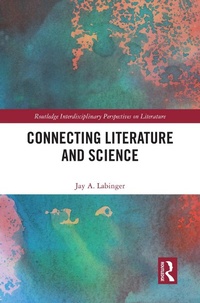
Connecting Literature and Science
1st Edition
Published on 18. November 2021
256 pages
978-1-000-47292-9 (ISBN)
Description

This book presents a case for engagement between the sciences and the humanities. The author, a professional chemist, seeks to demonstrate that the connections between those fields of intellectual activity are far more significant than anything that separates them. The book combines a historical survey of the relationships between science and literature with a number of case studies that examine specific scientific episodes-several drawn from the author's own research-juxtaposed with a variety of literary works spanning a wide range of period and genre-Dante to detective fiction, War and Peace to White Teeth-to elicit their common themes. The work argues for an empirical, non-theory-based approach, one that is closely analogous to connectionist models of brain development and function, and that can appeal to general readers, as well as to literary scholars and practicing scientists, who are open to the idea that literature and science should not be compartmentalized.
Reviews / Votes
"In Connecting Literature and Science, chemist Jay Labinger recounts his personal journey of beginning from a strong interest in both science and literature (which he calls his vocation and avocation respectively) to his growing belief that there are strong connections between the two through metaphor, analogy, and even a connectionist model of the brain. Throughout, his willingness to consider a range of ideas illuminates the text as he shows how generous interpretations can lead to breakthroughs not only in his experience but in the frontiers of both fields. Moving from a wide-ranging historical account to his own forays in interpreting dense literary and scientific texts, he models as well as demonstrates how these connections emerge. Strongly recommended for literary critics, scientists, and anyone interested in interdisciplinary connections." --N. Katherine Hayles, Distinguished Research Professor of English at UCLA andauthor of Postprint: Books and Becoming Computational
"This lucid study by a chemist who loves literature creates connections between literature and science as brains enable connections among neurons: not in a predetermined, top-down way but through use and experience. Connecting Literature and Science shows how code, translation, and irony matter as much to scientists as to artists as they try to make sense of life." --Laura Otis, Emory University
"Connecting Literature and Science reminds us that the debates over sciences vs. the humanities are far from over, and that there is still much to be gained for an analysis of how our fields are intimately connected - in often-surprising ways - through form and objective." --Andrew Mangham, University of Reading
"The author of this most readable book is the only person who can join an intimate, informed close reading of Richard Powers' "The Gold Bug Variations" and Stoppard's "Arcadia" with a discussion of the origins of left and right in molecules. Labinger also gives us a peace-making account of the science wars that will be a classic. Literature and science are indeed connected by the author, with authority and style." --Roald Hoffmann, chemist and writer
More details
Series
Edition
1. Auflage
Language
English
Place of publication
London
United Kingdom
Publishing group
Taylor & Francis Ltd
Target group
College/higher education
Illustrations
27 Halftones, black and white; 27 Illustrations, black and white
ISBN-13
978-1-000-47292-9 (9781000472929)
Copyright in bibliographic data and cover images is held by Nielsen Book Services Limited or by the publishers or by their respective licensors: all rights reserved.
Schweitzer Classification
Other editions
Additional editions
Jay A. Labinger
Connecting Literature and Science
Book
05/2023
1st Edition
Routledge
€63.40
Shipment within 10-20 days
Jay A. Labinger
Connecting Literature and Science
Book
11/2021
1st Edition
Routledge
€206.50
Shipment within 10-20 days
Person
Jay A. Labinger is the Administrator of the Beckman Institute at the California Institute of Technology. Trained as an organometallic chemist, he has published 200+ technical papers and patents, and 20+ non-technical essays, along with books on the history of chemistry and sociology of science. He is a Fellow of the American Association for the Advancement of Science.
Content
1. Introduction
2. A Brief History of Literature and Science
3. The Science Wars
4. Models of Engagement
5. Encoding an Infinite Message: Richard Powers's The Gold Bug Variations
6. Is That a Coded Message? It May Not Be So Simple!
7. Found in Translation
8. Entropy as Time's (Double-Headed) Arrow in Tom Stoppard's Arcadia
9. Chirality and Life
10. Making New Life
11. The End of Irony and/or the End of Science?
12. Conclusion
Appendix 1: Some Details of the Chemistry
Appendix 2: Suggestions for Further Reading
2. A Brief History of Literature and Science
3. The Science Wars
4. Models of Engagement
5. Encoding an Infinite Message: Richard Powers's The Gold Bug Variations
6. Is That a Coded Message? It May Not Be So Simple!
7. Found in Translation
8. Entropy as Time's (Double-Headed) Arrow in Tom Stoppard's Arcadia
9. Chirality and Life
10. Making New Life
11. The End of Irony and/or the End of Science?
12. Conclusion
Appendix 1: Some Details of the Chemistry
Appendix 2: Suggestions for Further Reading
