

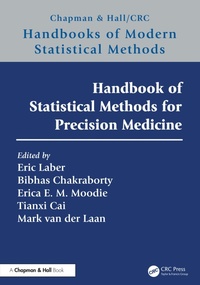
Handbook of Statistical Methods for Precision Medicine
1st Edition
Published on 23. October 2024
482 pages
978-1-040-12620-2 (ISBN)
Description

The statistical study and development of analytic methodology for individualization of treatments is no longer in its infancy. Many methods of study design, estimation, and inference exist, and the tools available to the analyst are ever growing. This handbook introduces the foundations of modern statistical approaches to precision medicine, bridging key ideas to active lines of current research in precision medicine.
The contributions in this handbook vary in their level of assumed statistical knowledge; all contributions are accessible to a wide readership of statisticians and computer scientists including graduate students and new researchers in the area. Many contributions, particularly those that are more comprehensive reviews, are suitable for epidemiologists and clinical researchers with some statistical training. The handbook is split into three sections: Study Design for Precision Medicine, Estimation of Optimal Treatment Strategies, and Precision Medicine in High Dimensions.
The first focuses on designed experiments, in many instances, building and extending on the notion of sequential multiple assignment randomized trials. Dose finding and simulation-based designs using agent-based modelling are also featured. The second section contains both introductory contributions and more advanced methods, suitable for estimating optimal adaptive treatment strategies from a variety of data sources including non-experimental (observational) studies. The final section turns to estimation in the many-covariate setting, providing approaches suitable to the challenges posed by electronic health records, wearable devices, or any other settings where the number of possible variables (whether confounders, tailoring variables, or other) is high. Together, these three sections bring together some of the foremost leaders in the field of precision medicine, offering new insights and ideas as this field moves towards its third decade.
The contributions in this handbook vary in their level of assumed statistical knowledge; all contributions are accessible to a wide readership of statisticians and computer scientists including graduate students and new researchers in the area. Many contributions, particularly those that are more comprehensive reviews, are suitable for epidemiologists and clinical researchers with some statistical training. The handbook is split into three sections: Study Design for Precision Medicine, Estimation of Optimal Treatment Strategies, and Precision Medicine in High Dimensions.
The first focuses on designed experiments, in many instances, building and extending on the notion of sequential multiple assignment randomized trials. Dose finding and simulation-based designs using agent-based modelling are also featured. The second section contains both introductory contributions and more advanced methods, suitable for estimating optimal adaptive treatment strategies from a variety of data sources including non-experimental (observational) studies. The final section turns to estimation in the many-covariate setting, providing approaches suitable to the challenges posed by electronic health records, wearable devices, or any other settings where the number of possible variables (whether confounders, tailoring variables, or other) is high. Together, these three sections bring together some of the foremost leaders in the field of precision medicine, offering new insights and ideas as this field moves towards its third decade.
More details
Series
Edition
1. Auflage
Language
English
Place of publication
London
United Kingdom
Publishing group
Taylor & Francis Ltd
Target group
College/higher education
Professional and scholarly
Illustrations
30 Tables, black and white; 49 Line drawings, black and white; 49 Illustrations, black and white
ISBN-13
978-1-040-12620-2 (9781040126202)
Copyright in bibliographic data and cover images is held by Nielsen Book Services Limited or by the publishers or by their respective licensors: all rights reserved.
Schweitzer Classification
Other editions
Additional editions
Eric Laber | Bibhas Chakraborty | Erica E. M. Moodie
Handbook of Statistical Methods for Precision Medicine
Book
10/2024
1st Edition
Chapman & Hall/CRC
€271.10
Shipment within 10-20 days

Eric Laber | Bibhas Chakraborty | Erica E. M. Moodie
Handbook of Statistical Methods for Precision Medicine
Book
10/2024
CRC Press
Unfortunately, price unknown
Available (delivery time upon request)
Persons
Eric B. Laber is the James B. Duke Distinguished Professor of Statistical Sciences and Biostatistics and Bioinformatics at Duke University. He is a fellow of the American Statistical Association and International Statistical Institute as well as the recipient of the Gottfried E. Noether Award, the Raymond J. Carroll Award, and the American Statistical Association Outstanding Application Award.
Bibhas Chakraborty is an Associate Professor jointly appointed by the Duke-National University of Singapore Medical School (Duke-NUS) and the Department of Statistics and Data Science at the National University of Singapore. He also holds an adjunct faculty position with the Department of Biostatistics and Bioinformatics at Duke University. He is a 2011 recipient of the Calderone Research Prize for Junior Faculty from Columbia University, a 2017 recipient of the Young Statistical Scientist Award from the International Indian Statistical Association and is an Elected Member of the International Statistical Institute (ISI). Along with Dr. Erica E.M. Moodie, he co-authored the first textbook on dynamic treatment regimes (Springer, New York, 2013). Currently he serves as an Associate Editor for Biometrics.
Erica E. M. Moodie is Professor of Biostatistics and Canada Research Chair in Statistical Methods for Precision Medicine at McGill University. She is the 2020 recipient of the CRM-SSC Prize in Statistics, is an Elected Member of the International Statistical Institute, and holds a chercheur de merite career award from the Fonds de recherche du Quebec-Sante. Dr Moodie is the Co-Editor of Biometrics and a Statistical Editor of Journal of Infectious Diseases.
Tianxi Cai is the John Rock Professor of Population and Translational Data Science at Harvard Chan School of Public Health (HSPH) and a Professor of Biomedical Informatics at Harvard Medical School (HMS). Dr. Cai's research includes statistical learning methods for efficient analysis of multi-institutional electronic health records data, real world evidence, and precision medicine using large scale genomic and phenomic data.
Mark van der Laan is the Jiann-Ping Hsu/Karl E. Peace Professor in Biostatistics and Statistics at the University of California, Berkeley. Mark research interests include censored data, causal inference, genomics and adaptive designs. Mark has led the development of Targeted Learning, including Super Learning and Targeted maximum likelihood estimation (TMLE). In 2005 Mark was awarded the Committee of Presidents of Statistical Societies (COPSS) Presidential Award. He also received the 2004 Spiegelman Award and 2005 van Dantzig Award. He is co-founder of the international Journal of Biostatistics and Journal of Causal Inference, and has authored various Springer books on Targeted Learning, Censored Data and Multiple Testing.
Bibhas Chakraborty is an Associate Professor jointly appointed by the Duke-National University of Singapore Medical School (Duke-NUS) and the Department of Statistics and Data Science at the National University of Singapore. He also holds an adjunct faculty position with the Department of Biostatistics and Bioinformatics at Duke University. He is a 2011 recipient of the Calderone Research Prize for Junior Faculty from Columbia University, a 2017 recipient of the Young Statistical Scientist Award from the International Indian Statistical Association and is an Elected Member of the International Statistical Institute (ISI). Along with Dr. Erica E.M. Moodie, he co-authored the first textbook on dynamic treatment regimes (Springer, New York, 2013). Currently he serves as an Associate Editor for Biometrics.
Erica E. M. Moodie is Professor of Biostatistics and Canada Research Chair in Statistical Methods for Precision Medicine at McGill University. She is the 2020 recipient of the CRM-SSC Prize in Statistics, is an Elected Member of the International Statistical Institute, and holds a chercheur de merite career award from the Fonds de recherche du Quebec-Sante. Dr Moodie is the Co-Editor of Biometrics and a Statistical Editor of Journal of Infectious Diseases.
Tianxi Cai is the John Rock Professor of Population and Translational Data Science at Harvard Chan School of Public Health (HSPH) and a Professor of Biomedical Informatics at Harvard Medical School (HMS). Dr. Cai's research includes statistical learning methods for efficient analysis of multi-institutional electronic health records data, real world evidence, and precision medicine using large scale genomic and phenomic data.
Mark van der Laan is the Jiann-Ping Hsu/Karl E. Peace Professor in Biostatistics and Statistics at the University of California, Berkeley. Mark research interests include censored data, causal inference, genomics and adaptive designs. Mark has led the development of Targeted Learning, including Super Learning and Targeted maximum likelihood estimation (TMLE). In 2005 Mark was awarded the Committee of Presidents of Statistical Societies (COPSS) Presidential Award. He also received the 2004 Spiegelman Award and 2005 van Dantzig Award. He is co-founder of the international Journal of Biostatistics and Journal of Causal Inference, and has authored various Springer books on Targeted Learning, Censored Data and Multiple Testing.
Content
Preface Part 1: Study Design For Precision Medicine 1. Adaptive Designs for Precision Medicine: Fundamental Statistical Considerations 2. Small Sample, Sequential, Multiple Assignment, Randomized Trial Design and Analysis 3. Sequential Multiple Assignment Randomized Trial with Adaptive Randomization (SMART-AR) for Mobile Health Devices 4. Bayesian Dose-Finding in Two Treatment Cycles based on Efficacy and Toxicity 5. Agent-Based Modeling in Medical Research - Example in Health Economics 6. Thompson Sampling for mHealth and Precision Health Applications Part 2: Estimation of Optimal Treatment Strategies 7. Constructing and Evaluating Optimal Treatment Sequences: An Introductory Guide for Bayesians 8. Measurement Error in Adaptive Treatment Strategies 9. Nonparametric Heterogeneous Treatment Effect Estimation in Repeated Cross Sectional Designs 10. Semiparametric Doubly Robust Targeted Double Machine Learning: A Review 11. Adversarial Monte Carlo Meta-Learning of Conditional Average Treatment Effects 12. Personalized Policy Learning 13. Bandit Algorithms for Precision Medicine Part 3: Precision Medicine in High Dimensions 14. Tailoring Variable Selection and Ranking for Optimal Treatment Decisions 15. Selecting Optimal Subgroups for Treatment Using Many Covariates 16. Statistical Learning Methods for Estimating Optimal Individualized Treatment Rules from Observational Data 17. Polygenic Risk Prediction for Precision Prevention 18. Post-Selection Inference for Individualized Treatment Rules with Nonparametric Confounding Control Bibliography
