

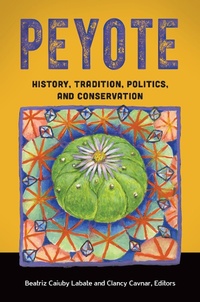
Peyote
History, Tradition, Politics, and Conservation
1st Edition
Published on 18. January 2016
312 pages
979-8-216-12805-2 (ISBN)
Description

This book explains the role that peyote-a hallucinogenic cactus-plays in the religious and spiritual fulfillment of certain peoples in the United States and Mexico, and examines pressing issues concerning the regulation and conservation of peyote as well as issues of indigenous and religious rights.
Why is mescaline-an internationally controlled substance derived from peyote-given exemptions for religious use by indigenous groups in Mexico, and by the pan-indigenous Native American Church in the United States and Canada? What are the intersections of peyote use, constitutional law, and religious freedom? And why are natural populations of peyote in decline-so much so that in Mexico, peyote is considered a species needing "special protection"? This fascinating book addresses these questions and many more. It also examines the delicate relationship between "the needs of the plant" as a species and "the needs of man" to consume the species for spiritual purposes.
The authors of this work integrate the history of peyote regulation in the United States and the special "trust responsibility" relationship between the American Indians and the government into their broad examination of peyote, a hallucinogenic cactus containing mescaline that grows naturally in Mexico and southern Texas. The book's chapters document how when it comes to peyote, multiple stakeholders' interests are in conflict-as is often the case with issues that involve ethnic identity, religion, constitutional interpretation, and conservation. The expansion of peyote traditions also serves as a foundation for examining issues of international human rights law and protections for religious freedom within the global milieu of cultural transnationalism.
Why is mescaline-an internationally controlled substance derived from peyote-given exemptions for religious use by indigenous groups in Mexico, and by the pan-indigenous Native American Church in the United States and Canada? What are the intersections of peyote use, constitutional law, and religious freedom? And why are natural populations of peyote in decline-so much so that in Mexico, peyote is considered a species needing "special protection"? This fascinating book addresses these questions and many more. It also examines the delicate relationship between "the needs of the plant" as a species and "the needs of man" to consume the species for spiritual purposes.
The authors of this work integrate the history of peyote regulation in the United States and the special "trust responsibility" relationship between the American Indians and the government into their broad examination of peyote, a hallucinogenic cactus containing mescaline that grows naturally in Mexico and southern Texas. The book's chapters document how when it comes to peyote, multiple stakeholders' interests are in conflict-as is often the case with issues that involve ethnic identity, religion, constitutional interpretation, and conservation. The expansion of peyote traditions also serves as a foundation for examining issues of international human rights law and protections for religious freedom within the global milieu of cultural transnationalism.
More details
Edition
1. Auflage
Language
English
Place of publication
New York
United States
Publishing group
Bloomsbury Publishing Plc
Target group
Interest Age: From 7 to 17 years
Illustrations
27 bw illus
ISBN-13
979-8-216-12805-2 (9798216128052)
Copyright in bibliographic data and cover images is held by Nielsen Book Services Limited or by the publishers or by their respective licensors: all rights reserved.
Schweitzer Classification
Other editions
Additional editions
Book
01/2016
Praeger Publishers Inc
€79.10
Shipment within 10-20 days
Persons
Beatriz Caiuby Labate, PhD, is professor at the Center for Research and Post Graduate Studies in Social Anthropology (CIESAS), in Guadalajara, Mexico, and visiting professor at the Drug Policy Program of the Center for Economic Research and Education (CIDE), in Aguascalientes, Mexico.
Clancy Cavnar, PsyD, is a research associate of the Nucleus for Interdisciplinary Studies of Psychoactives (NEIP) and a clinical psychologist who works at a dual diagnosis residential drug treatment center in San Francisco, CA.
Clancy Cavnar, PsyD, is a research associate of the Nucleus for Interdisciplinary Studies of Psychoactives (NEIP) and a clinical psychologist who works at a dual diagnosis residential drug treatment center in San Francisco, CA.
Content
- Cover
- Half Title
- Title
- Copyright
- Contents
- List of Illustrations
- Foreword
- Introduction
- 1. Decline of the Genus Lophophora in Texas
- 2. An Overview of Cacti and the Controversial Peyote
- 3. Peyote in the Colonial Imagination
- 4. Peyote, Christianity, and Constitutional Law: Toward an Antisubordination Jurisprudence
- 5. State and Federal Legal Protections for Peyote Use in the United States
- 6. Peyote, Conservation, and Indian Rights in the United States
- 7. Protecting the Peyote for Future Generations: Building on a Legacy of Perseverance
- 8. Peyote and Psychedelics on the Canadian Prairies
- 9. From Solid to Frothy: Use of Peyote in the Cora and Huichol Easter in Western Mexico
- 10. New Age Tourism in Wirikuta: Conflicts and Rituals
- 11. Paradoxes of Peyote Regulation in Mexico: Drug Conventions and Environmental Laws
- 12. Why Peyote Must Be Valued as Biocultural Patrimony of Mexico
- About the Editors and Contributors
- Index
