

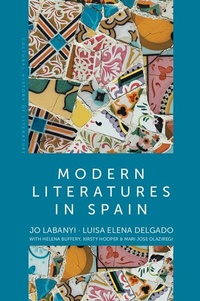
Modern Literatures in Spain
Description

Jo Labanyi and Luisa Elena Delgado provide the first cultural history of modern literatures in Spain. With contributors Helena Buffery, Kirsty Hooper, and Mari Jose Olaziregi, they showcase the country’s cultural richness and complexity by working across its four major literary cultures – Castilian, Catalan, Galician, and Basque – from the eighteenth century to the present.
Engaging critically with the concept of the “national”, Modern Literatures in Spain traces the uneven institutionalization of Spain’s diverse literatures in a context of Castilian literary hegemony, as well as examining diasporic and exile writing . The thematically organized chapters explore literary constructions of subjectivity, gender, and sexuality; urban and rural imaginaries; intersections between high and popular culture; and the formation of a public sphere. Throughout, readings are attentive to the multiple ways in which literature serves as a barometer of cultural responses to historical change.
An introduction to major cultural debates as well as an original analysis of key texts, this book is essential reading for students and scholars with an interest in the literatures and cultures of Spain.
Jo Labanyi is Professor Emerita of Spanish at New York University.
Luisa Elena Delgado is Professor of Spanish, Criticism and Interpretive Theory, and Gender and Women’s Studies at the University of Illinois at Urbana-Champaign.
Helena Buffery is Senior Lecturer in the Department of Spanish, Portuguese and Latin American Studies at University College Cork.
Kirsty Hooper is Professor of Hispanic Studies at the University of Warwick.
Mari Jose Olaziregi is Professor in the Department of Linguistics and Basque Studies at the Universidad del País Vasco / Euskal Herriko Unibertsitatea.
More details
Other editions
Additional editions
Persons
Luisa Elena Delgado is Professor of Spanish, Criticism and Interpretive Theory, and Gender and Women's Studies at the University of Illinois at Urbana-Champaign.
Helena Buffery is Senior Lecturer in the Department of Spanish, Portuguese and Latin American Studies at University College Cork.
Kirsty Hooper is Professor of Hispanic Studies at the University of Warwick.
Mari Jose Olaziregi is Professor in the Department of Linguistics and Basque Studies at the Universidad del País Vasco / Euskal Herriko Unibertsitatea.
Content
1 Modernity and the Singular Nation (1700-1840s)
2 From Sensibility to Desire: The Construction of the Modern Subject (1730s-1880s)
3 The Rise of the Public Sphere and the Professionalization of the Writer (1730s-1890s)
4 Countering Castilian: From Retrenchment to the Renaissance of Peripheral National Literatures (1710s-1890s)
5 The Uses of the Past: Writing the Nation (1760s-1890s)
6 Popular Culture: Exclusion and Appropriation (1760s-1930s)
7 Urban Modernity and the Provincial: Changing Concepts of Time and Space (1830s-1930s)
8 The Nation Called into Question (1890s-1920s)
9 Writers and Political Commitment (1930s-1960s)
10 Spain beyond Spain: Exile and Diaspora (1939-1980s)
11 Catalan, Galician, and Basque Literatures: Recovery and Institutionalization (1960s-1990s)
12 Rewriting Gender and Sexuality (1970s-2020)
13 Memory and Forgetting (1970s-2020)
14 Normalization, Crisis, and the Search for New Paradigms (1975-2021)
Works Cited
Index
Introduction
The title of our volume, Modern Literatures in Spain, recognizes Spain's particularity as a country that has developed literary markets in four languages: Castilian (whose rise to dominance as the language of state from the late fifteenth to early eighteenth centuries led to its becoming synonymous with Spanish), Catalan, Galician, and Basque (euskara in the Basque language). Our aim has been to offer a cultural history that is attentive to the way that "Spanish literature" has been constructed historically and came to refer solely to literature in Castilian. We have made a point of analyzing these four literatures relationally, avoiding the frequent tendency to treat them in separate chapters.
Throughout, we call into question geographic and linguistic definitions of the nation. Exile literature is explored in order to question the boundaries of the Spanish nation and its literary production; we consider exile writing in all four of Spain's literary languages. The discussion of literature in Basque covers the French as well as Spanish Basque country, since literary processes in the two territories have functioned as a continuum. The coverage of Catalan literature includes the Balearic Islands, Valencia, and the Catalan-speaking parts of Aragon. The sections on Galician literature in particular consider the fraught issue of authors from Spain's historic nationalities who write entirely or partly in Castilian. Foreign-born authors resident in Spain are mentioned at certain points, since the question of who counts as a Spanish (or Catalan or Galician or Basque) writer need not align with place of birth - or with mother tongue, for that matter.
The volume's timeline moves from the eighteenth century, in the course of which Castilian was imposed as the sole language of administration and education, to the present, with a solid publishing industry and literary output now established in Catalan, Galician, and Basque. While the minority languages still compete on an uneven playing field with Castilian, globalization has opened up opportunities for Spain's "minor" literatures. In the course of writing this book, we became increasingly aware that the timelines of the four literatures studied do not always coincide; for that reason, in certain chapters the temporal framing of the sections devoted to the various literatures differs. A major aim has been to rethink literary periodization: our chapters have a thematic focus, overlapping in their temporal coverage but gradually moving forward through time - in this way avoiding the impression that at a certain date one period ends and another starts. This has allowed us to take account of the multi-temporality of historical processes, with the coexistence at any one moment of what Raymond Williams identified as residual, dominant, and emergent tendencies (2009 [1977], 121-7). We have consequently been sensitive to the tensions and contradictions that give literary texts their dynamism and cultural relevance. The thematic focus of our chapters is organized in terms of forces of cultural change that leave their mark on, and are facilitated by, changes in literary form: we take seriously Williams's claim (2009 [1977], 128-35) that literary form does not simply mirror cultural processes but is a motor of change through its imaginative capacity to give expression to still inchoate social concerns.
There are several ways in which this cultural history of modern literatures in Spain differs from existing Spanish literary histories, in addition to its relational treatment of the country's four literatures. First, its discussion of literary movements emerges out of the exploration of literature's ability to act as a barometer of cultural change, rather than being a primary organizing principle; this avoids a view of literary history as a closed system of intertextual literary influences. Second, we have questioned the principles that underlie histories of national literature by working against the notion of a literary canon comprised by texts that are deemed worthy to represent the national - a notion that has excluded authors from certain social categories, as well as privileging certain kinds of subject matter and style. The forging of Catalan, Galician, and Basque literary canons that has been necessary to give status to minority literatures has not been exempt from such exclusions. The conception of the canon as a corpus of works deemed worthy to represent the national has meant that literary histories have often included texts that were little read or performed. We have tried in our cultural history to give a sense of what the Spanish public actually read or viewed on stage; consequently, our volume approximates to a history of literary tastes. We thus pay considerable attention to popular literary forms, many of which - especially those associated with urban culture - have been dismissed as vulgar. We have also worked against a tendency to construct "Spanish literature" (seen in the singular) in a uniformly serious register, on the supposition that the serious is better suited to represent the national. This tendency has led to the exclusion from the canon of a great deal of literary works that are huge fun - and were enjoyed by a broad public for that reason.
In this respect, we have been mindful of Pierre Bourdieu's theorization of taste as a means of constructing class distinctions, and of the process whereby, in the course of the nineteenth century, literature established itself as a (supposedly) autonomous field by defining literary merit as the inverse of commercial gain (1996a [1979], 1996b [1992]). In tracing the emergence in modern Spain of a public sphere, we have stressed the importance of journalism, not only for creating several modern literary genres but also for enabling the professionalization of the writer. We have sought to show how the literary field evolved in the course of the twentieth century with the requirement from the 1930s to the 1950s - on both sides of the Spanish Civil War - that writers commit to specific political options, and the impact since the return to democracy in 1975 of the consensus politics favored by the Spanish state and the increasing pressures of the neoliberal market, both challenged in recent years.
As should be clear from the above, we hope to have shown that, while the social and political attitudes taken by writers are hugely varied, literature is never truly autonomous; declarations of literary autonomy are themselves ideological statements. This is, therefore, a political as well as cultural history of literature, inasmuch as it situates literature in relation to political responses to, and proposals for, historical change, as well as in relation to changing social formations and experiences. In those social experiences we include the creation of new forms of subjectivity, where literature has played a vital role. A major factor here, considered throughout the volume, is the role played by literature in the construction - and critique - of gender roles. That involves much more than broadening the canon beyond the usual (heterosexual/homosocial) male suspects - though that is something we have also tried to do.
The book has been written by the two co-authors Jo Labanyi and Luisa Elena Delgado working together as a team with the three contributors: Helena Buffery for literature in Catalan, Kirsty Hooper for literature in Galician, and Mari Jose Olaziregi for literature in Basque. In some chapters, one of us has served as lead author, with one or more co-writers contributing particular sections; in others, the division of labor has been more even. Most chapters cover more than one of Spain's four literatures, in various combinations as appropriate to the topic. Chapters 1, 2, and 3 discuss literature in Castilian only. Chapters 4 and 11 deal solely with literatures in Catalan, Galician, and Basque. Buffery was responsible for all the sections on literature in Catalan, as well as for writing the frame narrative for chapter 11; she additionally wrote the sections on Spanish-language literature in chapter 10, for which she was lead author, and played a major role through her attention to the relational dimension of issues discussed in different sections of the text. Hooper wrote all the sections on literature in Galician, as well as the frame narrative for chapter 4. Olaziregi wrote all the sections on literature in Basque. The sections on literature in Castilian were shared by Delgado and Labanyi, co-writing chapters 7 and 12, and with Delgado being lead author for chapters 1 and 14, and Labanyi being lead author for chapters 2, 3, 5, 6, 8, 9, and 13. Although we have each taken responsibility for writing specific sections, the planning and rewriting of the book as a whole has been done by all of us working together, in order to produce what we hope is a coherent narrative.
We have provided English translations of quotations from Spanish, Catalan, Galician, and Basque, and of titles and organizations (where not self-evident) on first mention in each chapter. Dates of works are given on first mention in each chapter. The book's thematic organization means that many authors are discussed in more than one chapter; readers are encouraged to use the index to locate multiple mentions of particular authors. We have assumed that not all of our readers will have prior knowledge of the literatures of Spain or of Spanish history. Each chapter has a...
