

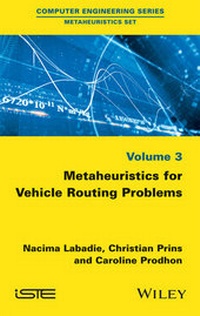
Metaheuristics for Vehicle Routing Problems
Published on 10. February 2016
194 pages
978-1-119-13677-4 (ISBN)
Description

This book is dedicated to metaheuristics as applied to vehicle routing problems. Several implementations are given as illustrative examples, along with applications to several typical vehicle routing problems.
As a first step, a general presentation intends to make the reader more familiar with the related field of logistics and combinatorial optimization. This preamble is completed with a description of significant heuristic methods classically used to provide feasible solutions quickly, and local improvement moves widely used to search for enhanced solutions. The overview of these fundamentals allows appreciating the core of the work devoted to an analysis of metaheuristic methods for vehicle routing problems. Those methods are exposed according to their feature of working either on a sequence of single solutions, or on a set of solutions, or even by hybridizing metaheuristic approaches with others kind of methods.
More details
Other editions
Additional editions
Nacima Labadie | Christian Prins | Caroline Prodhon
Metaheuristics for Vehicle Routing Problems
Book
02/2016
1st Edition
Wiley-ISTE
€164.50
Shipment within 15-20 days
N. Labadie
Metaheuristics for Vehicle Routing Problems
Software
02/2016
Wiley
€173.48
No shipping information available
Content
- Cover
- Title Page
- Copyright
- Contents
- Notations and Abbreviations
- Notations
- Abbreviations related to problems
- Abbreviations related to methods
- Introduction
- Chapter 1. General Presentation of Vehicle Routing Problems
- 1.1. Logistics management and combinatorial optimization
- 1.1.1. History of logistics
- 1.1.2. Logistics as a science
- 1.1.3. Combinatorial optimization
- 1.2. Vehicle routing problems
- 1.2.1. Problems in transportation optimization
- 1.2.2. Vehicle routing problems in other contexts
- 1.2.3. Characteristics of vehicle routing problems
- 1.2.3.1. Components
- 1.2.3.2. Constraints
- 1.2.3.3. Objectives
- 1.2.4. The capacitated vehicle routing problem
- 1.2.4.1. Mathematical model
- 1.2.4.2. Solution methods
- 1.3. Conclusion
- Chapter 2. Simple Heuristics and Local Search Procedures
- 2.1. Simple heuristics
- 2.1.1. Constructive heuristics
- 2.1.2. Two-phase methods
- 2.1.3. Best-of approach and randomization
- 2.2. Local search
- 2.2.1. Principle
- 2.2.2. Classical moves
- 2.2.3. Feasibility tests
- 2.2.4. General approach from Vidal et al.
- 2.2.5. Multiple neighborhoods
- 2.2.6. Very constrained problems
- 2.2.7. Acceleration techniques
- 2.2.8. Complex moves
- 2.3. Conclusion
- Chapter 3. Metaheuristics Generating a Sequence of Solutions
- 3.1. Simulated annealing (SA)
- 3.1.1. Principle
- 3.1.2. Simulated annealing in vehicle routing problems
- 3.2. Greedy randomized adaptive search procedure: GRASP
- 3.2.1. Principle
- 3.2.2. GRASP in vehicle routing problems
- 3.3. Tabu search
- 3.3.1. Principle
- 3.3.2. Tabu search in vehicle routing problems
- 3.4. Variable neighborhood search
- 3.4.1. Principle
- 3.4.2. Variable neighborhood search in vehicle routing problems
- 3.5. Iterated local search
- 3.5.1. Principle
- 3.5.2. Iterated local search in vehicle routing problems
- 3.6. Guided local search
- 3.6.1. Principle
- 3.6.2. Guided local search in vehicle routing problems
- 3.7. Large neighborhood search
- 3.7.1. Principle
- 3.7.2. Large neighborhood search in vehicle routing problems
- 3.8. Transitional forms
- 3.8.1. Evolutionary local search principle
- 3.8.2. Application to vehicle routing problems
- 3.9. Selected examples
- 3.9.1. GRASP for the location-routing problem
- 3.9.2. Granular tabu search for the CVRP
- 3.9.3. Adaptive large neighborhood search for the pickup and delivery problem with time windows
- 3.10. Conclusion
- Chapter 4. Metaheuristics Based on a Set of Solutions
- 4.1. Genetic algorithm and its variants
- 4.1.1. Genetic algorithm
- 4.1.2. Memetic algorithm
- 4.1.3. Memetic algorithm with population management
- 4.1.4. Genetic algorithm and its variants in vehicle routing problems
- 4.2. Scatter search
- 4.2.1. Scatter search principle
- 4.2.2. Scatter search in vehicle routing problems
- 4.3. Path relinking
- 4.3.1. Principle
- 4.3.2. Path relinking in vehicle routing problems
- 4.4. Ant colony optimization
- 4.4.1. Principle
- 4.4.2. ACO in vehicle routing problems
- 4.5. Particle swarm optimization
- 4.5.1. Principle
- 4.5.2. PSO in vehicle routing problems
- 4.6. Other approaches and their use in vehicle routing problems
- 4.7. Selected examples
- 4.7.1. Scatter search for the periodic capacitated arc routing problem
- 4.7.2. PR for the muti-depot periodic VRP
- 4.7.3. Unified genetic algorithm for a wide class of vehicle routing problems
- 4.8. Conclusion
- Chapter 5. Metaheuristics Hybridizing Various Components
- 5.1. Hybridizing metaheuristics
- 5.1.1. Principle
- 5.1.2. Application to vehicle routing problems
- 5.1.3. Selected examples
- 5.1.3.1. Hybrid tabu search-guided local search for the VRP with simultaneous pickups and deliveries
- 5.1.3.2. Hybrid GRASP-ELS for the VRP with two-dimensional loading constraints
- 5.1.3.3. Hybrid reactive tabu search enhanced by an evolutionary strategy for the open VRP
- 5.2. Matheuristics
- 5.2.1. Principle
- 5.2.2. Application to vehicle routing problems
- 5.2.2.1. Structural decomposition
- 5.2.2.2. Set covering and partitioning approaches
- 5.2.2.3. LP-based neighborhood reduction techniques
- 5.2.3. Selected examples
- 5.2.3.1. A hierarchical decomposition-based matheuristic for the LRP
- 5.2.3.2. Set partitioning-based matheuristic for the heterogeneous fleet vehicle routing problem (HFVRP)
- 5.2.3.3. Granular variable neighborhood search for the team orienteering problem
- 5.3. Conclusion
- Conclusion
- Bibliography
- Index
