

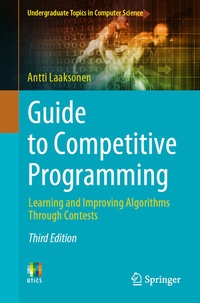
Guide to Competitive Programming
Description

This textbook features new material on advanced topics, such as calculating Fourier transforms, finding minimum cost flows in graphs, and using automata in string problems. Critically, the text accessibly describes and shows how competitive programming is a proven method of implementing and testing algorithms, as well as developing computational thinking and improving both programming and debugging skills.
Topics and features:
- Introduces dynamic programming and other fundamental algorithm design techniques, and investigates a wide selection of graph algorithms
- Compatible with the IOI Syllabus, yet also covering more advanced topics, such as maximum flows, Nim theory, and suffix structures
- Provides advice for students aiming for the IOI contest
- Surveys specialized algorithms for trees, and discusses the mathematical topics that are relevant in competitive programming
- Examines the use of the Python language in competitive programming
- Discusses sorting algorithms and binary search, and examines a selection of data structures of the C++ standard library
- Explores how GenAI will impact on the future of the field
- Covers such advanced algorithm design topics as bit-parallelism and amortized analysis, and presents a focus on efficiently processing array range queries
- Describes a selection of more advanced topics, including square-root algorithms and dynamic programming optimization
Fully updated, expanded and easy to follow, this core textbook/guide is an ideal reference for all students needing to learn algorithms and to practice for programming contests. Knowledge of programming basics is assumed, but previous background in algorithm design or programming contests is not necessary. With its breadth of topics, examples and references, the book is eminently suitable for both beginners and more experienced readers alike.
More details
Other editions
Additional editions
Previous edition
Person
Dr. Antti Laaksonen
has worked as a teacher and researcher at the University of Helsinki and Aalto University, Finland. He has served as one of the organizers of the Finnish Olympiad in Informatics since 2008, and as the Scientific Chair of the Baltic Olympiad in Informatics in 2016. He has also coached and led the Finnish team at several international programming contests, including the International Olympiad in Informatics 2009-2016, and has established experience in teaching programming and algorithms.
Content
1. Introduction.- 2. Programming Techniques.- 3. Efficiency.- 4. Sorting and Searching.- 5. Data Structures.- 6. Dynamic Programming.- 7. Graph Algorithms.- 8. Algorithm Design Topics.- 9. Range Queries.- 10. Tree Algorithms.- 11. Mathematics.- 12. Advanced Graph Algorithms.- 13. Geometry.- 14. String Algorithms.- 15. Additional Topics.
