

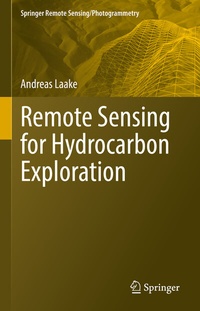
Remote Sensing for Hydrocarbon Exploration
Description

This book provides insights into the benefits of using remote sensing data from a geoscientist's perspective, by integrating the data with the understanding of Earth's surface and subsurface. In 3 sections, the book takes a detailed look at what data explorationists use when they explore for hydrocarbon resources, assess different terrain types for planning and hazards and extract present-day geologic analogs for subsurface geologic settings. The book presents the usage of remote sensing data in exploration in a structured way by detecting individual geologic features as building blocks for complex geologic systems. This concept enables readers to build their own workflows for the assessment of complex geologic systems using various combinations of remote sensing data.
Section 1 introduces readers to the foundations of remote sensing for exploration, covers various methods of image processing and studies different digital elevation and bathymetry models. Section 2 presents the concept of geomorphology as a means to integrate surface and subsurface data. Different aspects of rendering in 2D and 3D are explained and used for the interpretation and extraction of geologic features that are used in exploration.
Section 3 addresses remote sensing for hydrocarbon exploration in detail, from geophysical data acquisition to development and infrastructure planning. The organization of this chapter follows an exploration workflow from regional to local modeling studying basin and petroleum system modeling as well as logistics planning of seismic surveys and near-surface modeling. Aspects of field development and infrastructure planning comprise multi-temporal and dynamic modeling. The section closes with a structured approach to extracting geologic analogs from interpreted remote sensing data.
The book will be of interest to professionals and students working in exploration for hydrocarbons and water resources, as well as geoscientists and engineers using remote sensing for infrastructure planning, hazard assessment and dynamic environmental studies.
More details
Other editions
Additional editions
Person
Dr. Andreas Laake is a physicist and geoscientist with over 30 years of industry experience in processing, interpretation and integration of geological, geophysical, and remote sensing data from acquisition planning and data acquisition, to geological modeling from prospect to global scale. He is a Geophysical Advisor for Schlumberger Digital and Integration in Aachen, Germany, where he develops and executes digital exploration projects using analysis and interpretation of seismic data for geological modeling and reservoir characterization, integration of seismic, non-seismic, satellite and well data, and geological model building from basin to global scale.
The author envisages processing, interpretation and integration of geoscience data as an art to unlock the information that is hidden in the raw data. The author's approach to the visualization of the results aims at the co-rendering of multiple data types in a form that inspires the intuitive interpretation of the viewer to draw comprehensive conclusions that are supported by the context of multiple data types, each of which provide a different facet of the studied features.
