

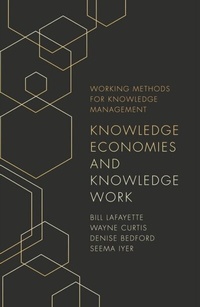
Knowledge Economies and Knowledge Work
1st Edition
Published on 24. October 2019
304 pages
978-1-78973-775-2 (ISBN)
Description

Our global economy is going through a major transformation, from an industrial economy, to a knowledge economy, rendering knowledge a primary factor in production. In this practical, real-world focused book, expert authors Bill LaFayette, Wayne Curtis, Denise Bedford and Seema Iyer come together to define and discuss knowledge work.
A common misconception claims that knowledge work is limited to high-skill and technology occupations. The truth is that this growing field applies across all aspects of the economy, which has critical implications on not only macro-, but also micro-levels. As the nature of work is changing, the functions of managing work must also change, as well as our approaches to education and educational organizations. Through a thorough exploration of the functions and structures required to adapt to this change, as well as a close examination of the geography of knowledge, this first book in the Working Methods for Knowledge Management series helps leaders leverage knowledge to better serve their communities, workplaces, and organizations.
This practical book serves as a guide for corporate leaders and managers, knowledge managers, workforce professionals, policy makers, labor economists, human capital researchers, and educators. It helps diverse audiences understand the implications of this transformation and helps them navigate this new economy.
A common misconception claims that knowledge work is limited to high-skill and technology occupations. The truth is that this growing field applies across all aspects of the economy, which has critical implications on not only macro-, but also micro-levels. As the nature of work is changing, the functions of managing work must also change, as well as our approaches to education and educational organizations. Through a thorough exploration of the functions and structures required to adapt to this change, as well as a close examination of the geography of knowledge, this first book in the Working Methods for Knowledge Management series helps leaders leverage knowledge to better serve their communities, workplaces, and organizations.
This practical book serves as a guide for corporate leaders and managers, knowledge managers, workforce professionals, policy makers, labor economists, human capital researchers, and educators. It helps diverse audiences understand the implications of this transformation and helps them navigate this new economy.
Reviews / Votes
Lafayette and colleagues take a project-focused approach to building an understanding of knowledge management in today's business world. They cover knowledge economy, building the new knowledge capital, how the knowledge economy affects organizations and individuals, and stories of place in a knowledge economy. Their topics include how the knowledge economy works, human capital: definitions and growth, how work changes in the knowledge economy, learning and the knowledge capacity of organizations, and the role of place in growing and leveraging knowledge capital. Distributed in North America by Turpin Distribution. -- Annotation (c)2019 * (protoview.com) *More details
Series
Language
English
Place of publication
Bingley
United Kingdom
Target group
Professional and scholarly
File size
2,89 MB
ISBN-13
978-1-78973-775-2 (9781789737752)
Copyright in bibliographic data and cover images is held by Nielsen Book Services Limited or by the publishers or by their respective licensors: all rights reserved.
Schweitzer Classification
Other editions
Additional editions
Bill LaFayette | Wayne Curtis | Denise Bedford
Knowledge Economies and Knowledge Work
Book
10/2019
Emerald Publishing Limited
€69.50
Shipment within 10-20 days
Persons
Bill LaFayette, PhD, is owner of Columbus, Ohio-based Regionomics, an economic and workforce strategy firm specializing in the economics of communities and regions.
Wayne Curtis, PhD, researches social entrepreneurship and wealth building strategies for working class Americans, seeking alternative was to build and accumulate wealth.
Denise Bedford, PhD, is faculty at Georgetown University, a Visiting Scholar at University of Coventry, and Distinguished Practitioner, U.S. Department of State.
Seema Iyer, PhD, is Director of the Baltimore Neighborhood Indicators Alliance at the University of Baltimore and oversees the undergraduate program in Real Estate and Economic Development.
Wayne Curtis, PhD, researches social entrepreneurship and wealth building strategies for working class Americans, seeking alternative was to build and accumulate wealth.
Denise Bedford, PhD, is faculty at Georgetown University, a Visiting Scholar at University of Coventry, and Distinguished Practitioner, U.S. Department of State.
Seema Iyer, PhD, is Director of the Baltimore Neighborhood Indicators Alliance at the University of Baltimore and oversees the undergraduate program in Real Estate and Economic Development.
Content
Part I: Knowledge Economy 1. How the Economic Landscape is Changing
2. How the Knowledge Economy Works
3. The Knowledge Economy: Its Implications for Organizations, Work and Workers
4. How Your World is Changing
Part II: Building the New Knowledge Capital
5. Knowledge Capital: The Big Picture
6. Human Capital: Definitions and Growth
7. Structural Capital: Definitions and Growth
8. Relational and Network Capital: Definitions and Growth
Part III: How the Knowledge Economy Affects Organizations and Individuals
9. How Work Changes
10. How Management Changes
11. How Human Resource Management Changes
12. How Learning and Training Changes
Part IV: Stories of Place in a Knowledge Economy
13. Role of Place in Growing and Leveraging Knowledge Capital
14. Business Stories of Knowledge Capital
2. How the Knowledge Economy Works
3. The Knowledge Economy: Its Implications for Organizations, Work and Workers
4. How Your World is Changing
Part II: Building the New Knowledge Capital
5. Knowledge Capital: The Big Picture
6. Human Capital: Definitions and Growth
7. Structural Capital: Definitions and Growth
8. Relational and Network Capital: Definitions and Growth
Part III: How the Knowledge Economy Affects Organizations and Individuals
9. How Work Changes
10. How Management Changes
11. How Human Resource Management Changes
12. How Learning and Training Changes
Part IV: Stories of Place in a Knowledge Economy
13. Role of Place in Growing and Leveraging Knowledge Capital
14. Business Stories of Knowledge Capital
