

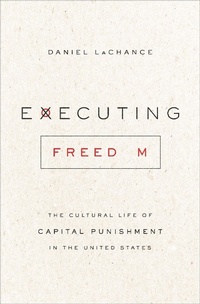
Executing Freedom
The Cultural Life of Capital Punishment in the United States
1st Edition
Published on 4. March 2020
272 pages
978-0-226-06672-1 (ISBN)
Description

"Breaks new ground . . . shows compellingly and convincingly that punishment provides a major gateway to exploring a society and culture."-
Journal of American History
In the mid-1990s, as public trust in big government was near an all-time low, 80% of Americans told Gallup that they supported the death penalty. Why did people who didn't trust government to regulate the economy or provide daily services nonetheless believe that it should have the power to put its citizens to death?
That question is at the heart of Executing Freedom, a powerful, wide-ranging examination of the place of the death penalty in American culture and how it has changed over the years. Drawing on an array of sources, including congressional hearings and campaign speeches, true crime classics like In Cold Blood, and films like Dead Man Walking, Daniel LaChance shows how attitudes toward the death penalty have reflected broader shifts in Americans' thinking about the relationship between the individual and the state. Emerging from the height of 1970s disillusion, the simplicity and moral power of the death penalty became a potent symbol for many Americans of what government coulddo-and LaChance argues, fascinatingly, that it's the very failure of capital punishment to live up to that mythology that could prove its eventual undoing in the United States.
"Fiercely provocative . . . A must-read for socio-legal studies and punishment scholars who want to know more about how the phenomenon of capital punishment took on a life of its own in the modern US cultural imagination."- Theoretical Criminology
In the mid-1990s, as public trust in big government was near an all-time low, 80% of Americans told Gallup that they supported the death penalty. Why did people who didn't trust government to regulate the economy or provide daily services nonetheless believe that it should have the power to put its citizens to death?
That question is at the heart of Executing Freedom, a powerful, wide-ranging examination of the place of the death penalty in American culture and how it has changed over the years. Drawing on an array of sources, including congressional hearings and campaign speeches, true crime classics like In Cold Blood, and films like Dead Man Walking, Daniel LaChance shows how attitudes toward the death penalty have reflected broader shifts in Americans' thinking about the relationship between the individual and the state. Emerging from the height of 1970s disillusion, the simplicity and moral power of the death penalty became a potent symbol for many Americans of what government coulddo-and LaChance argues, fascinatingly, that it's the very failure of capital punishment to live up to that mythology that could prove its eventual undoing in the United States.
"Fiercely provocative . . . A must-read for socio-legal studies and punishment scholars who want to know more about how the phenomenon of capital punishment took on a life of its own in the modern US cultural imagination."- Theoretical Criminology
More details
Other editions
Additional editions
Book
02/2018
University of Chicago Press
€30.50
Shipment within 10-20 days
Book
11/2016
University of Chicago Press
€34.66
Article exhausted; check different version
Person
Daniel LaChance is assistant professor of history at Emory University.
Content
- Intro
- Contents
- Acknowledgments
- Introduction. When Bundy Buckles Up
- Part I. From Rehabilitation to Retribution
- Chapter 1. "Inside Your Daddy's House": Capital Punishment and Creeping Nihilism in the Atomic Age
- Chapter 2. "The Respect Which Is Due Them as Men": The Rise of Retribution in a Polarizing Nation
- Part II. Executable Subjects
- Chapter 3. Fixed Risks and Free Souls: Judging and Executing Capital Defendants after Gregg v. Georgia
- Chapter 4. Shock Therapy: The Rehabilitation of Capital Punishment
- Part III. The Killing State
- Chapter 5. "A Country Worthy of Heroes": The Old West and the New American Death Penalty
- Chapter 6. Father Knows Best: Capital Punishment as a Family Value
- Epilogue. Disabling Freedom
- Notes
- Index
